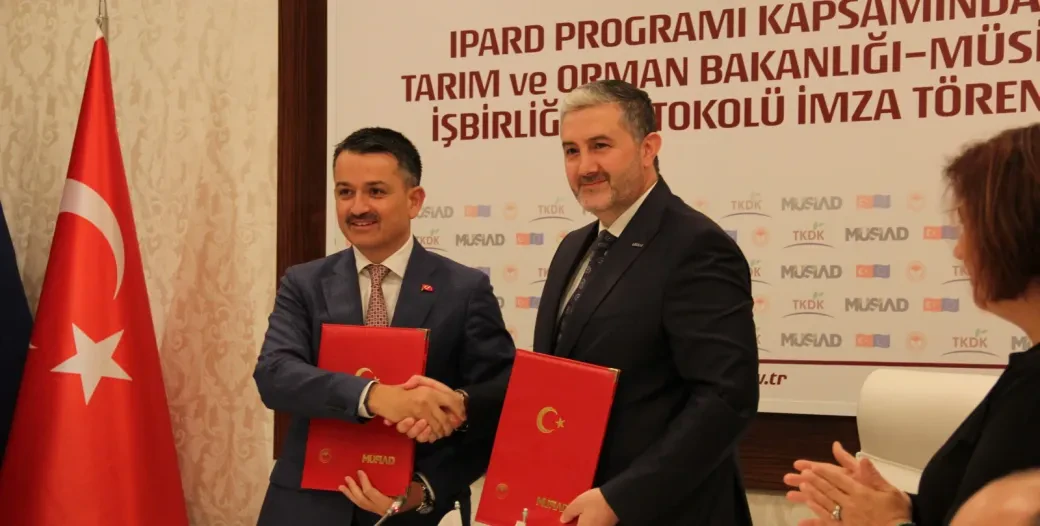
A cooperation protocol was signed between the Ministry and the Independent Industrialists and Businessmen Association (MÜSİAD) at the Meeting Hall of the Agriculture and Rural Development Support Institution (TKDK)
Minister of Agriculture and Forestry Bekir Pakdemirli stated that, thanks to the cooperation protocol signed between the ministry and MÜSİAD, they would help association members move into investment in rural areas, saying, "MÜSİAD will provide training to its members within the scope of IPARD. When calls for applications are announced, MÜSİAD members will be informed swiftly."
A cooperation protocol was signed between the Ministry and the Independent Industrialists and Businessmen Association (MÜSİAD) at the Meeting Hall of the Agriculture and Rural Development Support Institution (TKDK).
Pakdemirli said that they had cooperated with MÜSİAD in order to further increase the effectiveness of the European Union Rural Development Programme (IPARD) grant programme, and noted that the work to be carried out with MÜSİAD would touch every individual in the country.
Underlining that, thanks to the protocol, they would reach investors who are MÜSİAD members and contribute to their moving into investment in rural areas, Pakdemirli said, "MÜSİAD will provide training to its members within the scope of IPARD. When calls for applications are announced, MÜSİAD members will be informed swiftly."
Recalling that the 3rd Agriculture and Forestry Council to be held in October is an important organization in which the sector's next 25 years will be shaped, Pakdemirli said, "We particularly want MÜSİAD to take part in this council and to convey its ideas and views."
Underlining that they aim to make more investment in rural areas, Pakdemirli explained that investments such as pine nut processing plants, dairy farms and solar energy plants are supported through the rural development grants provided under IPARD.
TRY 4 Billion in Grants Provided Through IPARD
Referring to "LEADER (Links between Actions for the Development of the Rural Economy) - Implementation of Local Development Strategies in Rural Areas", an approach launched three weeks ago within the scope of IPARD, Pakdemirli said:
"Today we are issuing a call for applications worth a total of EUR 13 million, that is TRY 83 million, within the scope of LEADER. Within this framework, we will provide support in rural areas to local action groups that are established in line with IPARD criteria and that prepare development strategies suited to their locality. In its first stage, LEADER will be implemented in 12 provinces: Ankara, Amasya, Çanakkale, Çorum, Denizli, Diyarbakır, Erzurum, Kastamonu, Manisa, Ordu, Samsun and Şanlıurfa. LEADER is being launched for the first time among European Union candidate countries in Türkiye"
Pakdemirli said, "Over the past 8 years, with the TRY 4 billion in grants we provided under IPARD, we supported more than 14,000 facilities, 7,000 of which belong to women and young people. We created TRY 10 billion in investment and 60,000 new jobs in rural areas," and reported that this year a call totalling EUR 310 million, that is approximately TRY 2 billion, was issued under IPARD-2.
"The Perception of Rural Development Must Be Revived"
MÜSİAD President Abdurrahman Kaan, for his part, said that as MÜSİAD they carry out work aimed at enabling members to succeed in their current businesses and thereby contribute more to the Turkish economy.
Explaining that achieving rural development is directly proportional to the determination of the political will, above all of policymakers, Kaan stated that they see progress in food, agriculture, livestock and forest products, which they regard as one of the strategic sectors, as the starting point for rural development.
Emphasizing that the gradually fading perception of rural development needs to be revived, Kaan stated that for this purpose they had established the MÜSİAD Rural Transformation, Agricultural and Livestock Development Committee.
Referring to the importance of agricultural production in terms of countries' external dependency and self-sufficiency, Kaan commented, "While there are an average of 3,000-4,000 varieties of seed across the entire European continent, today there are around 7,000 varieties of seed in our lands alone. Close to 4,000 of these are endemic seeds. While we hold such wealth in our hands, it is of vital importance that we protect it and pass it on to future generations."
Drawing attention to the significant progress the country has made in the production and foreign trade of agricultural products, Kaan said that domestic demand is being met in the production of cereals, vegetables, fruit and other plant products.
Referring to the importance of planning in food, agriculture and livestock, Kaan said:
"Türkiye's targets are big, and if we move forward in a planned manner, we have the strength to achieve these targets. As we have stated on every platform, as MÜSİAD we are always ready to put our shoulder to the wheel on this matter. In this context, I hope that the protocol we will sign today will bring blessings first and foremost to our country, our nation and our business world."