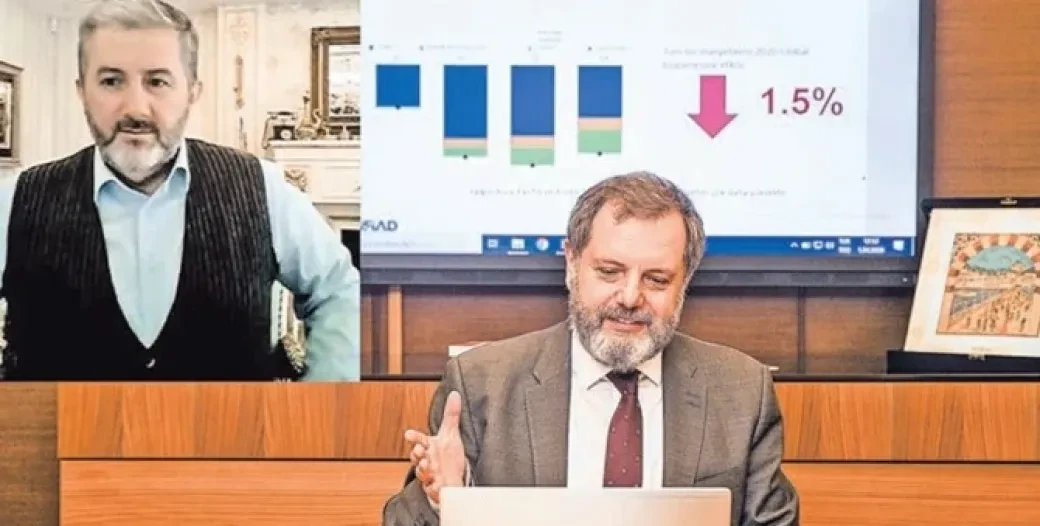
MÜSİAD President Abdurrahman Kaan answered the questions of Dünya Newspaper via video conference. Kaan said that the expansion step expected against the virus outbreak should be directed at banks rather than at large companies, and that the companies that really need support are SMEs, which shoulder 75 percent of employment.
Independent Industrialists and Businessmen Association (MÜSİAD) President Abdurrahman Kaan said that small and medium-sized enterprises (SMEs), which provide 75 percent of employment, must be supported in order to preserve social peace in Türkiye. Noting that there is talk of the state supporting large companies in order to protect the supply chain during the difficult process caused by the pandemic, President Kaan pointed out that this does not guarantee a flow of money to smaller businesses, and stated that in order to give large companies breathing space, support could be provided not to companies but to clearing transactions through banks.
MÜSİAD President Abdurrahman Kaan answered the questions of DÜNYA Chairman of the Board Hakan Güldağ by video conference during the pandemic days and assessed the report “The World Economy at Risk in the Face of Corona / Towards a New World Order” that they submitted to the Presidency.
Close Monitoring of the Outbreak with 11 Thousand Members in 95 Countries
MÜSİAD closely follows developments regarding the coronavirus, defined as a ‘pandemic’ because it is an outbreak experienced by the whole world, with a total of 11 thousand members in 95 countries. President Kaan says, “We are the largest business organization with the chance to obtain data across the world,” and adds: “Through our members we have the chance to see ‘from the inside’ which measures are taken in which countries and how they are implemented. By compiling both these experiences and our earlier studies, we submitted a 70-page report to our Presidency.”
When reminded that a number of supports, chiefly the printing of money, are being demanded in order to protect businesses in Türkiye, President Kaan said, “If central banks and the banking system are to be questioned in the new world order, how right is it to transfer money to the market through the existing system…
We do not merely think of the first idea that comes to mind. We also take into account its possible subsequent effects. In our report we said, ‘interventions to be carried out by the state are necessary in order to remove uncertainty in the short term.’ What matters here is to cover economic activity in a state of uncertainty and to keep the welfare level of households stable. As we say, ‘May God not bring us from abundance to want.’ If you are living in a certain comfort, the moment you disturb that comfort neither politics nor trade remains; everything moves towards ruin. We must maintain this level,” he assesses.
Expansion Is Appropriate on a Bank Basis, Not on a Company Basis
Kaan notes the following regarding support for large companies: “SMEs account for 75 percent of employment in Türkiye, 64 percent of turnover, 56 percent of exports and 36 percent of imports. SMEs are definitely the segment that must be protected. We work mainly on assembly with imports of intermediate goods. When logistics contracted because of corona, a shortage of intermediate goods arose. It must also be said that we have taken the easy way out. We are hunting someone else’s bird with someone else’s stone. Let the company have no equity capital of its own, let it borrow from the bank, and failing that from eximbanks abroad. Reserve funds never crossed our minds. On financing large companies, the Central Bank might perhaps do this: it could provide a counterpart to banks for matured clearing transactions, and the banks would later repay this to the CB. We do not approve of going beyond that. Relief for large companies in the market can only come about this way. We consider expansion by the CB appropriate on a bank basis, but not on a company basis. In August 2018 these companies put the country in very great difficulty. They took their money away. You were going to invest in your business in trade. Large companies in particular took the credit they had obtained for stock from the banks and put it into investment. But when you come to SMEs, we suffer a credit shortage.”
Kaan also conveys that they do not consider it right for the large companies established under the ministries to go beyond their regulatory role, saying, “If these companies take up a position competing with the market, the course moves towards the structure of a socialist order, and subsequently we suffer the losses of these companies. The order of the market must not be disrupted either,” he says.
Large Companies Transferred Money to Other Markets Rather Than to Production
Stating that Turkish capital is fragile, President Kaan makes the following determination: “Capital stock is important; when you do not have it, it means you have no infrastructure to build your strength on. You must transfer money to production, not abroad. Large companies say, ‘the crisis has come, alas what shall we do, let the state help us.’ Just as the whole world abandoned the perception of production, so did our large-capital institutions in Türkiye. They transferred their money towards other markets rather than production. While the large enterprises that should have shouldered the burden were putting their money to work in financial markets, they left the entire burden to SMEs, which make up 75 percent of employment in Türkiye. When SMEs became unable to carry this burden, we came face to face with this crisis.”
SMEs Are Predominantly Being Protected All Over the World
President Kaan explains that they continuously consult on the corona outbreak through MÜSİAD’s extensive international structure and notes the following: “In recent days I held a world presidents meeting. I spoke with 33 countries. We looked at many countries from Australia to the Netherlands and Sudan: which country gives what kind of support… We will announce those as well. We see that SMEs are predominantly protected in the world too. The parameter taken into account in the index for improving the investment climate is the SME. As you know, this is a list we want to enter the top 10 of.”
%78 of Medicines from the USA, %85 of Raw Materials from Asia
Abdurrahman Kaan underlines that after 11 September, the 2008 financial crisis and the Covid-19 pandemic, the world has passed into a new world order. Noting that, given the epidemics humanity has previously experienced, the pandemic is no surprise, Kaan expresses the following view: “This is not the first epidemic, nor will it be the last. In April 2019 Elif Kırbaş from the TSE System Certification Group Directorate brought the subject into their publications. We also conveyed it in our reports at that time. The process we are living through is in fact a continuation of 2011. The squeezed global economy in fact brought the footsteps of the crisis. In the period after 2011 capitalism began to redefine itself, and the definition of money is changing too. Even without Covid-19 we were heading towards a different process. We had drawn attention to these at the Visionary meetings held by MÜSİAD. There is a change. For instance, 78 percent of pharmaceutical companies in the world are of US origin. But 85 percent of medicinal and aromatic plants come from Asia. That is, it presents us with important data in terms of raw materials and place of production. Global warming points to agricultural production gradually shifting to Russia. The world is preparing for this change.”
The Squeezed Global Economy Exploded with Covid-19
Recalling the 2019 growth figures and 2020 forecasts of the world, the G20, the USA, the EU, Japan and China, President Kaan said: “Before the Covid-19 outbreak, the OECD and World Bank forecasts pointed to a contraction in production in the world. Indeed, in our reports at that time we stated that 2020 would be a test year.” Kaan continued: “The projections revised in November had been calculated by simulating the effects of the trade wars. OPEC oil policy, the impact on markets of the risks that political uncertainty in Syria and the Middle East would create, and the decline in global investment appetite were already steering countries towards expansionary monetary policy. The process that began with corona created an effect much like the killing of Archduke Franz Ferdinand, heir to the Austro-Hungarian Empire, by the young Serbian nationalist, which caused the outbreak of World War I. It became a point of explosion for an already squeezed system.”
Politicians and CEOs Used Corona as an Excuse
Kaan also notes that corona has brought the question “epidemic or opportunity?” onto the agenda for the G20, saying: “Politics was in difficulty because of the slowdown of the economy. This became an excuse for politicians. Trump, China and the European economies will all say that the situation stems from corona. The CEOs of the world left their posts. Even before the virus, companies’ balance sheets were not very good. The financial virus frightened, corona became the excuse. Russia, China and Türkiye stand out as the countries growing stronger politically.”
President Kaan states that in the previous year the USA and China introduced the concept of ‘trade wars’ to the world, and explains what Türkiye’s export target should be in a system that rebuilds walls. Kaan says, “The economy is now shifting to the East in the world. Asian countries such as Japan, South Korea, India, Indonesia and Malaysia have a 28 percent share in the world economy. China alone accounts for 52 percent of intermediate goods production. That is why we must increase our exports to the East.”
The Next Step Is the Collapse of the Banking System; God Willing We Will Not Experience It
Abdurrahman Kaan recalled that they had voiced the forecast that the world would enter a stagflation cycle around 2020 following a commodity crisis in the report they prepared in 2018 for the New Economy Program (NEP). Kaan notes that those who said ‘you are exaggerating’ about these statements at the time now agree with him. Commenting on the diagram in the report, Kaan says: “Looking at it from above right now, we are at the end of the third cycle. The next step is ‘the collapse of the banking system’; God willing we will not experience it. In our statements we constantly speak of ‘the synchronization of production, investment and trade.’ Rather than being a bloc, our country’s capital segment has an unplanned, many-headed, scattered form that is not resilient to shocks. We prepared a 200-page report on the need for this to change and sent it to our Presidency.” Kaan added: “I once made a statement that the business world must renew itself. Today in Türkiye, chambers and exchanges in particular have an aspect that largely handles the registration side of trade but has little share in production and investment. It has been like this for years. While the world was changing, we could not attract foreign capital either. In the period after 2001, following USD 16-17 billion, we were experiencing an investment process of USD 5-6 billion. We said, ‘We must move to a new model.’ We submitted the report on that too.”
Banks Will Have to Come and Become Partners with Us
“We think a recovery process will begin in 2021,” Kaan says, and notes the following: “There is also the issue of interest rates falling in Türkiye. Inflation is currently at the level of 11.86 percent, interest rates are around 9.5. This shows a course towards -2 in interest. In the coming period, imagine inflation rising a little; when you think of it going up to 16-17, you will see this. What will the owners of this money in the banks do, what will companies do? Perhaps even the banks will have to come and become partners with us. There is no commodity left in the world in which they can place their money. From now on they will either move to production or invest in good investment areas so as not to head towards bankruptcy. There is no such expectation in perception. But I have been saying this for 2.5 years. We are more occupied with participation banks, we keep saying it. By pressing them, we had them made partners in a few projects. When we first came, we had organized the Humane Finance Summit and voiced it there. Afterwards we began to implement it ourselves. At the moment the only remedy is to act through the Venture Capital Fund. I have been an industrialist for 35 years and work with 27 thousand producers. I can analyze production and retail markets well.”
A 30-Day Proposal for Short-Time Working
We want those who started work one month earlier to benefit from the short-time working allowance as well, that is, 30 days. Currently the premium payment is 450 days… We request that this be lowered to 150 days too. In this way no one is left outside.
The MÜSİAD Corona Crisis Centre Was Established
Noting that they established the MÜSİAD Corona Crisis Centre on 16 March after the first case was seen in Türkiye on 11 March, Kaan continues as follows: “We have a very broad member profile, from large companies to the smallest. Therefore we can obtain very important data. We carried out this work so that it would be conveyed to the relevant ministries and from there to the Presidency. We also aim to continuously follow the field implementation of the packages. You may take a decision, but three or four days later, depending on its effects, another decision may be needed. We thought we must establish a structure in which the business world comes together. Because there may be things that could create a domino effect.”
China Has Reached a Position Where It Can Play with the Parameters on Its Own
When we look at the computer, electronics and other equipment sectors, 27 percent of world production is in China. That is, if 7 products are produced, 2 are produced in China. Look at the EU here: it has a 15 percent share, but the 28 countries of the EU obtain 14 percent from China and provide 15 percent. And from that resource it obtains, it puts forth only 4 percent added value. Everything is tied to China. A similar picture faces us in transport and related sectors as well. Together with the effect of China’s ‘One Belt One Road’ project, we see that it has also tied transport and logistics to itself. A single country has reached a position where it can play very seriously with the parameters.
It Will Take 9 Months for the World to Return to Normal
On the pandemic, the scenarios in fact converge on the probability of a peak from country to country. In this case, the normalization of one country does not mean that the course will return to normal all over the world. Based on the examples of China and South Korea, assuming that the average contagion incubation is 75 to 90 days, and together with the data that 114 countries have been moderately and severely affected, even the return of the wave-by-wave isolation periods to normal will take approximately 9 months. The effect of all these costs on 2020 global growth will be a decline of 1.5 percent. The areas where business is good are food, health, health equipment, and cleaning and hygiene equipment. We had said that these sectors are indispensable.
Time to Determine New Logistics Routes and to Look at France
The low and declining index for Germany, the main driving force of growth in Europe, points to an economy nearing recession, since it experienced almost zero growth in the last quarter. We too can take France alongside us as a new partner. Moreover, it is now time to determine new logistics systems and routes. Our exports to the EU are at the level of 48 percent, but the twin shock to be experienced here with the contraction of supply and demand will be compensated in other areas. If China recovers rapidly and goes for a price-cutting policy, this time we must move to a new production policy via the place on which we are dependent in imports. This corona was an excuse, but through this excuse it is in fact a return to what we as MÜSİAD have always said: ‘the power of money passes through production.’
Uncertainty in Agriculture Brings Grave Consequences
Right now it is especially the seedling planting period. Many of our farmers are calling and asking us what to do. Our farmer cannot find anywhere to consult. If there is uncertainty in agriculture, it will have very grave consequences. If the uncertainty continues, we may face a very great food crisis after June. We do not feel a difficulty right now. Both demand has fallen and many products have returned to the domestic market. We have products on hand. While the world is experiencing a commodity crisis, insisting on standing in the retail and manufacturing sectors means we will not be able to stop the upward increase in demand-driven CPI. In a commodity crisis, backing up food and livestock now for a manufacturing industry whose capacity will fall anyway creates balance in GNP. Therefore we must also think carefully about the post-outbreak period. Particularly in the increase in demand that will be experienced in the food sector after the Covid-19 pandemic, Türkiye’s positive image in world consumption perception compared with China must be well evaluated at this point. Although stocks in the sense of food and agriculture in our country are sufficient for the domestic market, in order to predict the spread process of the virus well and to rise to the position of an exporter not only for the domestic market but for the world market, there is no solution other than increasing our production volume in traditional sectors, chiefly food.
Food Has Also taken Action Like the 'Science Board' in Health, Next Should Be an Economic Strategic Board'
We have USD 17 billion of exports in food. We have USD 12 billion of imports. Agriculture gives a surplus of USD 5 billion. Our population is growing. Because of corona you may not be able to buy that USD 12 billion worth of products either. After the virus everyone wants to keep the goods they produce in their own country. We buy rice from abroad; China and Taiwan have closed and are not selling. Wheat… We are the world’s largest flour exporting country; at the moment Russia has closed in wheat and prices have risen. The flour exporter was buying this from abroad, producing and selling. Now there is a situation that will reduce Türkiye’s exports. If we want to continue exporting, we must increase wheat production areas and productivity, we must develop Türkiye’s organic soil areas. We must make national production compulsory. Such crises repeat. Covid-20 will come, and 21 will come too. We think that the strategic sector must be redefined here. Meat and milk production is alive, you cannot stop it, this sector must work. Because we do not have grazing land, we need feed. Feed is imported too. Carcass meat prices have risen. Now the livestock farmer is waiting, wondering whether to slaughter. This livestock farmer of ours needs to be guided. Just as there is a science board in health, the Ministry of Agriculture has now carried out a study on this. However, there needs to be a strategic board regarding what will be done in the economy in Türkiye together with the effects of Covid-19.
Can It Be Lentil Soup Summer and Winter...
At one point I declared war on lentil soup, asking ‘can lentil soup be eaten summer and winter.’ There are 400 thousand tons of imports in lentils. Where in Türkiye must we produce in order to meet this need of ours? Now Canada is not selling lentils either. Our people in agriculture are very hardworking, they have a great deal of work. If you take away their appetite, they move away from this business, and it becomes very bad. At the moment the average age of farmers is 55. In our Rural Towns project there is the establishment of enterprises in which the villager is also a partner. Let us do land consolidation for work done with 200 tractors and solve it with 15 tractors. Let everyone receive their rent and become a partner there. In this way let us produce more hygienically. We saw that the world is not ready for a biological war. We too must think about this in our own production bases. It has emerged that production has a need for greater sterility and greater isolation.
WE MUST BE READY FOR THE PARADIGM SHIFT
Money Does Not Actually Exist; It Is Now a Promissory Note!
Last year we prepared a report foreseeing that the world would enter a new system. We set out the new trends in the paradigm shift. What were they: inflation management indexed to risk through the circulation and transaction volume of money… A new world in which money is taken as a commodity and every institution and organization will have the authority to create its own money… Money has now become an option commodity for consumption, not for investment. Money no longer exists. It is not cash. It is not book money. It is not bank money. Money is a promissory note that in fact does not exist and is calculated as if it existed at a future date… We also drew attention to what Türkiye must do in this paradigm shift. Indeed, as MÜSİAD we renewed our own structuring in line with the new world order. As you will recall, within our organization we designated our management units with thematic names in order to be more solution-oriented
In This Process We Can Plan the Renovation of Tourism Facilities
The service sector has stopped. We must look at this urgently. Tourism has stopped. But we can use this process as an opportunity for the renovation of facilities. We must plan this. People in the world who have stayed shut in at home for 2-3 months will want to go on holiday once things improve. Which country will they go to… That is where we must respond to the need by making up for our shortcomings. The Ministry of Tourism must also promote this.
Solution Proposals for Türkiye on New Threats
- Investment must be made in real sector infrastructure, not in the financial sector.
- Investment must be made in capital goods sectors.
- A transition must be made towards an Asian-type economic model.
- Debates on CB independence must end and the CB’s weight in the real sector must be reduced.
- The way must be opened for company mergers, since transaction costs and the bureaucratic burden have been removed.
- Sub-economic models must be adopted.
- The divergence in capital must be eliminated.
- Emphasis must be given to micro rather than macro policies.
- Money must cease to be a commodity.
According to the report, what should Türkiye’s new strategic sectors be?
1-FOOD AND LIVESTOCK
2-AVIATION AND SURFACE TRANSPORT
3-BIOTECHNOLOGY AND GENETICS
4-DEFENCE, INTELLIGENCE AND QUALIFIED HUMAN RESOURCES
5-CULTURAL INDUSTRIES
6-METROPOLITAN TOURISM
For the news:https://www.dunya.com/ekonomi/istihdami-kobiler-sagliyor-destegi-de-once-onlar-alsin-haberi-467041
Independent Industrialists and Businessmen Association (MÜSİAD) President Abdurrahman Kaan said that small and medium-sized enterprises (SMEs), which provide 75 percent of employment, must be supported in order to preserve social peace in Türkiye. Noting that there is talk of the state supporting large companies in order to protect the supply chain during the difficult process caused by the pandemic, President Kaan pointed out that this does not guarantee a flow of money to smaller businesses, and stated that in order to give large companies breathing space, support could be provided not to companies but to clearing transactions through banks.
MÜSİAD President Abdurrahman Kaan answered the questions of DÜNYA Chairman of the Board Hakan Güldağ by video conference during the pandemic days and assessed the report “The World Economy at Risk in the Face of Corona / Towards a New World Order” that they submitted to the Presidency.
Close Monitoring of the Outbreak with 11 Thousand Members in 95 Countries
MÜSİAD closely follows developments regarding the coronavirus, defined as a ‘pandemic’ because it is an outbreak experienced by the whole world, with a total of 11 thousand members in 95 countries. President Kaan says, “We are the largest business organization with the chance to obtain data across the world,” and adds: “Through our members we have the chance to see ‘from the inside’ which measures are taken in which countries and how they are implemented. By compiling both these experiences and our earlier studies, we submitted a 70-page report to our Presidency.”
When reminded that a number of supports, chiefly the printing of money, are being demanded in order to protect businesses in Türkiye, President Kaan said, “If central banks and the banking system are to be questioned in the new world order, how right is it to transfer money to the market through the existing system…
We do not merely think of the first idea that comes to mind. We also take into account its possible subsequent effects. In our report we said, ‘interventions to be carried out by the state are necessary in order to remove uncertainty in the short term.’ What matters here is to cover economic activity in a state of uncertainty and to keep the welfare level of households stable. As we say, ‘May God not bring us from abundance to want.’ If you are living in a certain comfort, the moment you disturb that comfort neither politics nor trade remains; everything moves towards ruin. We must maintain this level,” he assesses.
Expansion Is Appropriate on a Bank Basis, Not on a Company Basis
Kaan notes the following regarding support for large companies: “SMEs account for 75 percent of employment in Türkiye, 64 percent of turnover, 56 percent of exports and 36 percent of imports. SMEs are definitely the segment that must be protected. We work mainly on assembly with imports of intermediate goods. When logistics contracted because of corona, a shortage of intermediate goods arose. It must also be said that we have taken the easy way out. We are hunting someone else’s bird with someone else’s stone. Let the company have no equity capital of its own, let it borrow from the bank, and failing that from eximbanks abroad. Reserve funds never crossed our minds. On financing large companies, the Central Bank might perhaps do this: it could provide a counterpart to banks for matured clearing transactions, and the banks would later repay this to the CB. We do not approve of going beyond that. Relief for large companies in the market can only come about this way. We consider expansion by the CB appropriate on a bank basis, but not on a company basis. In August 2018 these companies put the country in very great difficulty. They took their money away. You were going to invest in your business in trade. Large companies in particular took the credit they had obtained for stock from the banks and put it into investment. But when you come to SMEs, we suffer a credit shortage.”
Kaan also conveys that they do not consider it right for the large companies established under the ministries to go beyond their regulatory role, saying, “If these companies take up a position competing with the market, the course moves towards the structure of a socialist order, and subsequently we suffer the losses of these companies. The order of the market must not be disrupted either,” he says.
Large Companies Transferred Money to Other Markets Rather Than to Production
Stating that Turkish capital is fragile, President Kaan makes the following determination: “Capital stock is important; when you do not have it, it means you have no infrastructure to build your strength on. You must transfer money to production, not abroad. Large companies say, ‘the crisis has come, alas what shall we do, let the state help us.’ Just as the whole world abandoned the perception of production, so did our large-capital institutions in Türkiye. They transferred their money towards other markets rather than production. While the large enterprises that should have shouldered the burden were putting their money to work in financial markets, they left the entire burden to SMEs, which make up 75 percent of employment in Türkiye. When SMEs became unable to carry this burden, we came face to face with this crisis.”
SMEs Are Predominantly Being Protected All Over the World
President Kaan explains that they continuously consult on the corona outbreak through MÜSİAD’s extensive international structure and notes the following: “In recent days I held a world presidents meeting. I spoke with 33 countries. We looked at many countries from Australia to the Netherlands and Sudan: which country gives what kind of support… We will announce those as well. We see that SMEs are predominantly protected in the world too. The parameter taken into account in the index for improving the investment climate is the SME. As you know, this is a list we want to enter the top 10 of.”
%78 of Medicines from the USA, %85 of Raw Materials from Asia
Abdurrahman Kaan underlines that after 11 September, the 2008 financial crisis and the Covid-19 pandemic, the world has passed into a new world order. Noting that, given the epidemics humanity has previously experienced, the pandemic is no surprise, Kaan expresses the following view: “This is not the first epidemic, nor will it be the last. In April 2019 Elif Kırbaş from the TSE System Certification Group Directorate brought the subject into their publications. We also conveyed it in our reports at that time. The process we are living through is in fact a continuation of 2011. The squeezed global economy in fact brought the footsteps of the crisis. In the period after 2011 capitalism began to redefine itself, and the definition of money is changing too. Even without Covid-19 we were heading towards a different process. We had drawn attention to these at the Visionary meetings held by MÜSİAD. There is a change. For instance, 78 percent of pharmaceutical companies in the world are of US origin. But 85 percent of medicinal and aromatic plants come from Asia. That is, it presents us with important data in terms of raw materials and place of production. Global warming points to agricultural production gradually shifting to Russia. The world is preparing for this change.”
The Squeezed Global Economy Exploded with Covid-19
Recalling the 2019 growth figures and 2020 forecasts of the world, the G20, the USA, the EU, Japan and China, President Kaan said: “Before the Covid-19 outbreak, the OECD and World Bank forecasts pointed to a contraction in production in the world. Indeed, in our reports at that time we stated that 2020 would be a test year.” Kaan continued: “The projections revised in November had been calculated by simulating the effects of the trade wars. OPEC oil policy, the impact on markets of the risks that political uncertainty in Syria and the Middle East would create, and the decline in global investment appetite were already steering countries towards expansionary monetary policy. The process that began with corona created an effect much like the killing of Archduke Franz Ferdinand, heir to the Austro-Hungarian Empire, by the young Serbian nationalist, which caused the outbreak of World War I. It became a point of explosion for an already squeezed system.”
Politicians and CEOs Used Corona as an Excuse
Kaan also notes that corona has brought the question “epidemic or opportunity?” onto the agenda for the G20, saying: “Politics was in difficulty because of the slowdown of the economy. This became an excuse for politicians. Trump, China and the European economies will all say that the situation stems from corona. The CEOs of the world left their posts. Even before the virus, companies’ balance sheets were not very good. The financial virus frightened, corona became the excuse. Russia, China and Türkiye stand out as the countries growing stronger politically.”
President Kaan states that in the previous year the USA and China introduced the concept of ‘trade wars’ to the world, and explains what Türkiye’s export target should be in a system that rebuilds walls. Kaan says, “The economy is now shifting to the East in the world. Asian countries such as Japan, South Korea, India, Indonesia and Malaysia have a 28 percent share in the world economy. China alone accounts for 52 percent of intermediate goods production. That is why we must increase our exports to the East.”
The Next Step Is the Collapse of the Banking System; God Willing We Will Not Experience It
Abdurrahman Kaan recalled that they had voiced the forecast that the world would enter a stagflation cycle around 2020 following a commodity crisis in the report they prepared in 2018 for the New Economy Program (NEP). Kaan notes that those who said ‘you are exaggerating’ about these statements at the time now agree with him. Commenting on the diagram in the report, Kaan says: “Looking at it from above right now, we are at the end of the third cycle. The next step is ‘the collapse of the banking system’; God willing we will not experience it. In our statements we constantly speak of ‘the synchronization of production, investment and trade.’ Rather than being a bloc, our country’s capital segment has an unplanned, many-headed, scattered form that is not resilient to shocks. We prepared a 200-page report on the need for this to change and sent it to our Presidency.” Kaan added: “I once made a statement that the business world must renew itself. Today in Türkiye, chambers and exchanges in particular have an aspect that largely handles the registration side of trade but has little share in production and investment. It has been like this for years. While the world was changing, we could not attract foreign capital either. In the period after 2001, following USD 16-17 billion, we were experiencing an investment process of USD 5-6 billion. We said, ‘We must move to a new model.’ We submitted the report on that too.”
Banks Will Have to Come and Become Partners with Us
“We think a recovery process will begin in 2021,” Kaan says, and notes the following: “There is also the issue of interest rates falling in Türkiye. Inflation is currently at the level of 11.86 percent, interest rates are around 9.5. This shows a course towards -2 in interest. In the coming period, imagine inflation rising a little; when you think of it going up to 16-17, you will see this. What will the owners of this money in the banks do, what will companies do? Perhaps even the banks will have to come and become partners with us. There is no commodity left in the world in which they can place their money. From now on they will either move to production or invest in good investment areas so as not to head towards bankruptcy. There is no such expectation in perception. But I have been saying this for 2.5 years. We are more occupied with participation banks, we keep saying it. By pressing them, we had them made partners in a few projects. When we first came, we had organized the Humane Finance Summit and voiced it there. Afterwards we began to implement it ourselves. At the moment the only remedy is to act through the Venture Capital Fund. I have been an industrialist for 35 years and work with 27 thousand producers. I can analyze production and retail markets well.”
A 30-Day Proposal for Short-Time Working
We want those who started work one month earlier to benefit from the short-time working allowance as well, that is, 30 days. Currently the premium payment is 450 days… We request that this be lowered to 150 days too. In this way no one is left outside.
The MÜSİAD Corona Crisis Centre Was Established
Noting that they established the MÜSİAD Corona Crisis Centre on 16 March after the first case was seen in Türkiye on 11 March, Kaan continues as follows: “We have a very broad member profile, from large companies to the smallest. Therefore we can obtain very important data. We carried out this work so that it would be conveyed to the relevant ministries and from there to the Presidency. We also aim to continuously follow the field implementation of the packages. You may take a decision, but three or four days later, depending on its effects, another decision may be needed. We thought we must establish a structure in which the business world comes together. Because there may be things that could create a domino effect.”
China Has Reached a Position Where It Can Play with the Parameters on Its Own
When we look at the computer, electronics and other equipment sectors, 27 percent of world production is in China. That is, if 7 products are produced, 2 are produced in China. Look at the EU here: it has a 15 percent share, but the 28 countries of the EU obtain 14 percent from China and provide 15 percent. And from that resource it obtains, it puts forth only 4 percent added value. Everything is tied to China. A similar picture faces us in transport and related sectors as well. Together with the effect of China’s ‘One Belt One Road’ project, we see that it has also tied transport and logistics to itself. A single country has reached a position where it can play very seriously with the parameters.
It Will Take 9 Months for the World to Return to Normal
On the pandemic, the scenarios in fact converge on the probability of a peak from country to country. In this case, the normalization of one country does not mean that the course will return to normal all over the world. Based on the examples of China and South Korea, assuming that the average contagion incubation is 75 to 90 days, and together with the data that 114 countries have been moderately and severely affected, even the return of the wave-by-wave isolation periods to normal will take approximately 9 months. The effect of all these costs on 2020 global growth will be a decline of 1.5 percent. The areas where business is good are food, health, health equipment, and cleaning and hygiene equipment. We had said that these sectors are indispensable.
Time to Determine New Logistics Routes and to Look at France
The low and declining index for Germany, the main driving force of growth in Europe, points to an economy nearing recession, since it experienced almost zero growth in the last quarter. We too can take France alongside us as a new partner. Moreover, it is now time to determine new logistics systems and routes. Our exports to the EU are at the level of 48 percent, but the twin shock to be experienced here with the contraction of supply and demand will be compensated in other areas. If China recovers rapidly and goes for a price-cutting policy, this time we must move to a new production policy via the place on which we are dependent in imports. This corona was an excuse, but through this excuse it is in fact a return to what we as MÜSİAD have always said: ‘the power of money passes through production.’
Uncertainty in Agriculture Brings Grave Consequences
Right now it is especially the seedling planting period. Many of our farmers are calling and asking us what to do. Our farmer cannot find anywhere to consult. If there is uncertainty in agriculture, it will have very grave consequences. If the uncertainty continues, we may face a very great food crisis after June. We do not feel a difficulty right now. Both demand has fallen and many products have returned to the domestic market. We have products on hand. While the world is experiencing a commodity crisis, insisting on standing in the retail and manufacturing sectors means we will not be able to stop the upward increase in demand-driven CPI. In a commodity crisis, backing up food and livestock now for a manufacturing industry whose capacity will fall anyway creates balance in GNP. Therefore we must also think carefully about the post-outbreak period. Particularly in the increase in demand that will be experienced in the food sector after the Covid-19 pandemic, Türkiye’s positive image in world consumption perception compared with China must be well evaluated at this point. Although stocks in the sense of food and agriculture in our country are sufficient for the domestic market, in order to predict the spread process of the virus well and to rise to the position of an exporter not only for the domestic market but for the world market, there is no solution other than increasing our production volume in traditional sectors, chiefly food.
Food Has Also taken Action Like the 'Science Board' in Health, Next Should Be an Economic Strategic Board'
We have USD 17 billion of exports in food. We have USD 12 billion of imports. Agriculture gives a surplus of USD 5 billion. Our population is growing. Because of corona you may not be able to buy that USD 12 billion worth of products either. After the virus everyone wants to keep the goods they produce in their own country. We buy rice from abroad; China and Taiwan have closed and are not selling. Wheat… We are the world’s largest flour exporting country; at the moment Russia has closed in wheat and prices have risen. The flour exporter was buying this from abroad, producing and selling. Now there is a situation that will reduce Türkiye’s exports. If we want to continue exporting, we must increase wheat production areas and productivity, we must develop Türkiye’s organic soil areas. We must make national production compulsory. Such crises repeat. Covid-20 will come, and 21 will come too. We think that the strategic sector must be redefined here. Meat and milk production is alive, you cannot stop it, this sector must work. Because we do not have grazing land, we need feed. Feed is imported too. Carcass meat prices have risen. Now the livestock farmer is waiting, wondering whether to slaughter. This livestock farmer of ours needs to be guided. Just as there is a science board in health, the Ministry of Agriculture has now carried out a study on this. However, there needs to be a strategic board regarding what will be done in the economy in Türkiye together with the effects of Covid-19.
Can It Be Lentil Soup Summer and Winter...
At one point I declared war on lentil soup, asking ‘can lentil soup be eaten summer and winter.’ There are 400 thousand tons of imports in lentils. Where in Türkiye must we produce in order to meet this need of ours? Now Canada is not selling lentils either. Our people in agriculture are very hardworking, they have a great deal of work. If you take away their appetite, they move away from this business, and it becomes very bad. At the moment the average age of farmers is 55. In our Rural Towns project there is the establishment of enterprises in which the villager is also a partner. Let us do land consolidation for work done with 200 tractors and solve it with 15 tractors. Let everyone receive their rent and become a partner there. In this way let us produce more hygienically. We saw that the world is not ready for a biological war. We too must think about this in our own production bases. It has emerged that production has a need for greater sterility and greater isolation.
WE MUST BE READY FOR THE PARADIGM SHIFT
Money Does Not Actually Exist; It Is Now a Promissory Note!
Last year we prepared a report foreseeing that the world would enter a new system. We set out the new trends in the paradigm shift. What were they: inflation management indexed to risk through the circulation and transaction volume of money… A new world in which money is taken as a commodity and every institution and organization will have the authority to create its own money… Money has now become an option commodity for consumption, not for investment. Money no longer exists. It is not cash. It is not book money. It is not bank money. Money is a promissory note that in fact does not exist and is calculated as if it existed at a future date… We also drew attention to what Türkiye must do in this paradigm shift. Indeed, as MÜSİAD we renewed our own structuring in line with the new world order. As you will recall, within our organization we designated our management units with thematic names in order to be more solution-oriented
In This Process We Can Plan the Renovation of Tourism Facilities
The service sector has stopped. We must look at this urgently. Tourism has stopped. But we can use this process as an opportunity for the renovation of facilities. We must plan this. People in the world who have stayed shut in at home for 2-3 months will want to go on holiday once things improve. Which country will they go to… That is where we must respond to the need by making up for our shortcomings. The Ministry of Tourism must also promote this.
Solution Proposals for Türkiye on New Threats
- Investment must be made in real sector infrastructure, not in the financial sector.
- Investment must be made in capital goods sectors.
- A transition must be made towards an Asian-type economic model.
- Debates on CB independence must end and the CB’s weight in the real sector must be reduced.
- The way must be opened for company mergers, since transaction costs and the bureaucratic burden have been removed.
- Sub-economic models must be adopted.
- The divergence in capital must be eliminated.
- Emphasis must be given to micro rather than macro policies.
- Money must cease to be a commodity.
According to the report, what should Türkiye’s new strategic sectors be?
1-FOOD AND LIVESTOCK
2-AVIATION AND SURFACE TRANSPORT
3-BIOTECHNOLOGY AND GENETICS
4-DEFENCE, INTELLIGENCE AND QUALIFIED HUMAN RESOURCES
5-CULTURAL INDUSTRIES
6-METROPOLITAN TOURISM
For the news:https://www.dunya.com/ekonomi/istihdami-kobiler-sagliyor-destegi-de-once-onlar-alsin-haberi-467041