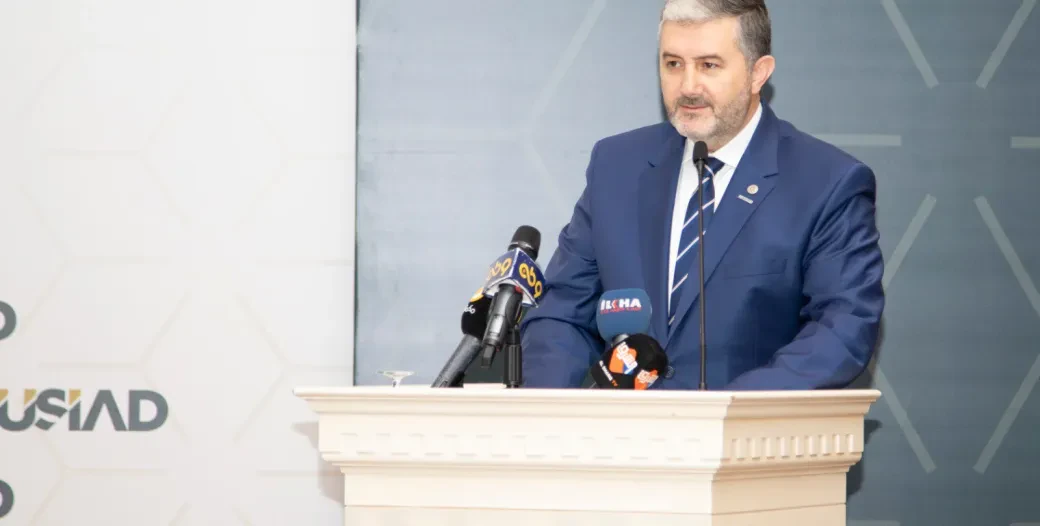
The conference titled “Islamic Financial Markets in the Light of Realities and Obligations”, organized in partnership by the Independent Industrialists and Businessmen Association (MÜSİAD), the International Business Forum (IBF) and the European Academy of Islamic Finance and Economics (EAIFE), was held at the MÜSİAD Head Office.
Within the scope of the program held with the participation of MÜSİAD President Abdurrahman Kaan, MÜSİAD Founding President and IBF Chairman Erol Yarar, President of the European Academy of Islamic Finance and Economics Eşref Dowaba and Secretary General of the International Union of Muslim Scholars Ali Karadaği, a conference was organized on the topics of Islamic Economics, the Islamic Finance Sector and the Global Economy.
“Islamic Finance Is an Important Alternative for Societies Outside the Islamic World as Well”
Speaking at the opening session of the conference, Abdurrahman Kaan stated that Islamic finance, whose applications in the modern sense date back to the 1960s, has reached significant dimensions within the global economy.
Noting that the Islamic finance sector today has a size of approximately USD 3 trillion, Kaan said:
“With Islamic banks and their instruments and with applications such as sukuk and takaful, Islamic finance constitutes a very important position for Muslim societies. While sukuk, takaful and other interest-free financial institutions and funds make up approximately 30 percent of the sector's assets, the remaining 70 percent is covered by Islamic banks. Participation banks, which are increasing their share in the sector in Türkiye day by day, raised their share of the banking sector to 5.3 percent in 2018. In this period, the net profit for the period of participation banks rose by 34.1 percent to TRY 2 billion 123 million, while their total equity increased by 23 percent to TRY 17 billion. The Islamic finance sector, whose global size is expected to reach 4 trillion by the end of 2020, is expected to rise rapidly to much higher levels in the years ahead.”
Conveying that the existing infrastructure must be developed in order to increase the potential of Islamic finance, Kaan said, “The existence of regulatory and supervisory institutions for the sector will play an important role in the growth of Islamic financial institutions. Increasing the recognition of the sector and developing the existing market depend on diversifying products and offering new instruments with high added value.”
Pointing out that setting standards is also very important in terms of the compliance of interest-free financial system instruments with Islamic finance principles, Kaan emphasized that the development of the system is also linked to increasing education, knowledge and awareness in the field of interest-free finance.
Explaining that the number of institutions providing education on interest-free finance in the world today has reached approximately 700, which is an important development, Kaan said that it is also striking that the United Kingdom ranks first on this list with 80 institutions.
“Islamic Finance Is an Important Alternative for Societies Outside the Islamic World as Well”
Stating that the Islamic finance sector is an important alternative not only for Muslim societies but also for societies outside the Islamic world, Kaan continued his remarks as follows:
“Because the tremors and crises experienced by the global financial system are accelerating global capital's efforts to seek alternatives. In times of crisis, conventional banks holding risky assets may face liquidity difficulties. Islamic banks do not experience liquidity problems because they stay away from such risky assets. Thus, after the crisis, Islamic finance has turned into an alternative not only for investors in the Islamic world but also for other investors. Today companies have moved beyond targeting profit alone and have come to concern themselves with many social, cultural and political problems of society. When we look at Islamic history, we see that economic formations such as 'the Akhi tradition and futuwwa' operated with a similar sensitivity. Since the day we took office, we have been saying that building an interest-free financial system is essential. Because we see the current system as the greatest obstacle to making sustainable the commercial relations we have built with a thousand and one difficulties.”
“Economic Power Is Being Concentrated in the Hands of Those Who Possess Knowledge”
Emphasizing that as MÜSİAD they have put forward projects that are unique to these lands and can convey values not only in terms of financing but also in terms of operation, Kaan expressed that they see the spread of the partnership culture as one of the most important of these projects.
Drawing attention to the fact that partnership constitutes an alternative to a business person taking on the burden of interest in order to shoulder an investment alone, Kaan said, “This is a matter that eases the entrepreneur's hand in terms of the steps to be taken in trade in the period ahead and enables them to move in a freer space.”
“Economic Power Is Being Concentrated in the Hands of Those Who Possess Knowledge”
Stating that processes such as obtaining, processing and transforming knowledge are accepted as the essential element of the economic system, Kaan made the assessment, “This situation has become a very important strategy for countries at the macro level and for companies at the micro level. Today, only countries or companies that succeed in making use of the knowledge they acquire can increase their gains. Thus they rise to a position where they will lead the others. In other words, economic power is being concentrated in the hands of those who possess knowledge.”
Emphasizing the need to focus seriously on obtaining knowledge in commercial, technological or financial terms and on gaining an advantage in matters such as investment, R&D, production and competition, Kaan said, “Today, when we feel the impact of trade wars more with each passing day, the flow of information in economic and commercial terms is more important than ever. While trade and technology wars continue among the world's major centres of power, we too must analyse well what we need to do and take action as soon as possible. As MÜSİAD, we serve today with 225 contact points abroad and 312 in total.”
Kaan said that it offers the opportunity to establish relations with financial markets, banks, financial institutions, companies, universities and experts from different regions of the world.
“The Companies of People with Faith, Morality, Knowledge and Enterprise Must Be Grown”
Speaking in the opening part of the conference, IBF Chairman Erol Yarar stated that a Muslim who has money should look for a moral entrepreneur, and that the companies of people with faith, morality, knowledge and enterprise must be grown.
Conveying that believing entrepreneurs should be brought together with those who have capital, Yarar said:
"We are all in a prison, and as individuals in the prison we are given water to drink and food to eat by the prison owners. They throw alcohol into this water and they put pork fat into our food. Is it permissible for us to drink this water? Is it permissible for us to eat this food? Is there anyone who will issue a fatwa on this? this is what we are discussing. We need to get out of this prison. Unless we escape from this prison, unless we dig a tunnel and escape, there will inevitably be something forbidden in every meal we eat. Because we are all in captivity. No one will be able to say there is none; we are all in captivity, we are inside this system. We need to get out of this prison. Otherwise, every time we eat and drink, we will not be able to say with a peaceful heart that it is lawful. If we cannot regain the spirit of the Medina Market, there is no salvation for us from the prison. Let us do in the Islamic countries, let us do in Türkiye, what America has done in Silicon Valley."
Expressing that they founded MÜSİAD 30 years ago in order to change the system and that there is no sainthood for them as long as they remain inside this system, Yarar made the assessment, “If we try to do business and grow inside this system, there is no sainthood for us. We need to create a different market. The topics we are discussing are wrong. The starting point of money is the market; an understanding of money that does not start from the market is like separating the alcohol out of the water. The place where we will take the first step is the market. The believer is a business person. There are interest-free financial institutions in which we want to invest Muslims' money; by whose rules are they forced to play? They play by the rules of that prison.”
Pointing out that when one goes to the bank and asks for money to make an investment, collateral is demanded, Yarar used the following expressions:
"Banks and financial institutions in France, Germany and America ask this question too, and our own financial institution asks this question as well. So they give money to those who have money and property, and they do not give money to those who have morality, faith and knowledge. Because this has no value in the capitalist world, but it has great value in Islam. In the Medina Market this was important. But in our market this has no importance either. We do not ask whether this man who comes is competent, whether he is a believer. We ask whether he has property. The rich get richer. The poor are left with no chance at all. The one with faith, morality, knowledge and enterprise is left with no value.
"We Proposed That İstanbul Become the Capital of the Islamic Economy"
EAIFE President Eşref Dowaba, for his part, stated that whoever has money has a say, and that military power is needed to protect borders while money is needed to protect internal fronts.
Conveying that successful business people are needed in order to manage money and that development can be achieved in this way, Dowaba expressed that the rules of the Islamic economy must be implemented for genuine development.
Expressing that it is not possible to have a say in the world economy without entering the money markets, Dowaba said:
“Without entering the money markets, without entering the stock markets, without managing securities, it is not possible for economic development to take place. We witnessed the weakening of the Turkish lira. Despite the absence of any economic justification, the value of the Turkish lira was brought down. This shows that we need to be stronger in the money markets. The time has come to give concrete form to the Islamic economy. We proposed that İstanbul become the capital of the Islamic economy. This may be possible because İstanbul is located at a special geographical point. In this framework, we will voice this proposal, our invitation and our cause once again at this conference, which will last two days."
“We Want an Islamic International Monetary Fund to Be Established”
Secretary General of the International Union of Muslim Scholars Ali Karadaği, for his part, stated that they want an Islamic International Monetary Fund (IMF) to be established, that work should be carried out on this and that it can be realized.
Conveying that fatwas concerning stock exchanges are requested from them and that they are even asked to make concessions, Karadaği said, “We want a clean stock exchange. In this way we can lay the foundation of the Islamic economy.”
The conference, which continued with the participation of various guests, will continue tomorrow from where it left off.