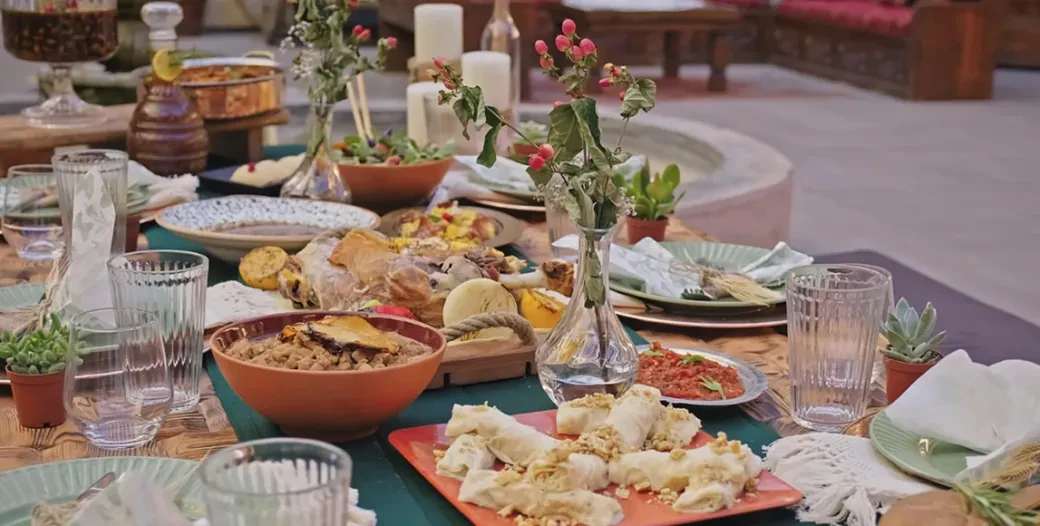
Independent Industrialists and Businessmen Association (MÜSİAD) President Abdurrahman Kaan released a written statement on culinary exports as a product of the cultural economy and on the commercialization of Turkish Culinary Arts. Stating that work should begin now, as preparation for the period at the end of the process, so that our country can take a larger share of culinary exports while the effects of the pandemic are still being felt, Abdurrahman Kaan touched on the following in his statement;
The world today is going through a period in which knowledge and the culture attached to it are in constant change. What moves between societies and people is not only information but also cultural components. Today, the sectors in which cultural economies show the greatest permeability are known to be cinema and music. The American dominance in this field has recently been challenged by the effects of Far Eastern Asian countries, particularly on the young generation. What is carried from one country to another through a cultural product is not merely a film, a piece of music or a book; it is that country's way of life, its traditions, its history — in short, its cultural codes. However, while we take the main items of this export in the cultural industry to be “audovisual arts”, we are in fact overlooking a very important item: culinary arts and products.
Of course, the share of the cinema sector in carrying eating and drinking habits from one country to another cannot be denied. Because a culinary industry displayed visually arouses curiosity in another country, or at least creates a rapprochement. The same cuisine, when carried to your country, reduces the sense of foreignness. We frequently see this in the American and European film and series sector. Our using this method as well, particularly through the series we export, will serve as a preliminary preparation for our culinary exports in the future.
Under the heading of culinary exports, it is necessary not to scatter too much and to move along a specific line. It will be beneficial to begin work now, particularly while the effects of the pandemic are being felt, as preparation for the period at the end of the process. The export items;
1. Recipe exports 2. Presentation exports 3. Origin product exports — classifying them under these headings will guide us in the commercialization of our culinary arts.
The amount you pay for the meal you eat in a French restaurant is recorded as a recipe import for Türkiye and as a recipe export for France. Likewise, the amount you pay for a Turkish dish in France is recorded as a recipe export for us and as a recipe import for them. For this reason, while our cuisine is being promoted, we must protect our recipes at every stage — from the menus of restaurants in foreign countries to independent Turkish Cuisine restaurants — and register them in accordance with a certain standard.
First of all, we must classify the cuisines in our country and categorize the recipes of these cuisines in accordance with a certain standard. In this way, at the very beginning of the road, it can be clearly explained which local cuisine the recipe to be exported belongs to and what its recipe is, and its standards can be determined.
The principal cuisines our country possesses and which will be exported can be listed as follows:
İstanbul Palace Cuisine, Eastern Black Sea Cuisine, Eastern Anatolian Cuisine, Aegean Cuisine, Mediterranean Cuisine, Gaziantep Cuisine, Şanlıurfa Cuisine, Erzurum Cuisine, Afyon Cuisine, Kayseri Cuisine, Konya Cuisine, Kastamonu Cuisine, Samsun Cuisine, Tekirdağ Cuisine, Bursa Cuisine, Sivas Cuisine, Tokat Cuisine, Maraş Cuisine.
This practice is a serious investment in Turkish Culinary Culture. As MÜSİAD, in 2007 we published a book titled “A Journey to Local Flavours”, in which we compiled the original dishes of all the cities in Türkiye. At that time I was the Chairman of the Food and Agriculture Sector Board, and I voiced the importance of this matter at every opportunity. For years I strove for Turkish Culinary Culture to reach standards and to be commercialized. Today, as the President of MÜSİAD, particularly during our Renewal process, we established one of our committees solely to work in this field: the “Gastro-Economy and Turkish Culinary Arts Committee”. This committee is chaired by Ramazan Bingöl. Our 1st International Symposium on Turkish Culinary Culture, designed by our committee and which we planned to hold under the auspices of the Presidency, was unfortunately postponed because of the Pandemic. Yet within the scope of this symposium not only would our culinary culture have been promoted, but culinary arts would also have been addressed as a cultural component with international participation and applied workshops would have been set up. However, we plan to carry out this work after the Pandemic.
We must attach importance to recipe exports and particularly to the representation of Turkish cuisine abroad with different dishes and flavours. Because the few dishes that come to mind when Turkish cuisine is mentioned are in fact an indication that such a broad food culture has not found the value it deserves in the world.
As the second export item, we see presentation exports. Cuisine does not consist of recipes alone. At the same time, every dish has a cooking and presentation style of its own and of its region. For example, if the recipe for “testi kebabı” is being exported, its earthenware jug must also become a subject of presentation and trade at the same time. Likewise copper bowls, special vessels for drinking sherbet and ayran, special cooking utensils; in short, what is at issue here is the export of the products of Turkish culinary art. In addition, kitchen consumables can also be exported in forms that reflect Turkish culture.
The third export item is origin or provenance product exports. Marketing well the fact that products belonging to a particular region must be used in the recipes of certain dishes will increase the demand for those products and will support their cultivation and planting in those regions. As the same product is planted in our provinces that have almost the same climatic conditions, the income our farmers will obtain from high value-added products will also rise. Marketing well the fact that dishes must be cooked with, say, hazelnut oil or İspir beans will also increase the demand for those products.
All of these are activities that support production and investment; and this will ensure the commercialization of cuisine through three export items. Indeed, institutionalization can be achieved by establishing micro SMEs for the production of certain products. Encouraging the female workforce in particular to work on products such as noodles, tarhana and sweet snack treats that can easily be produced and marketed would be a good start in terms of investment. I believe that once a certain standard is set for the products and they are promoted with emphasis on their being produced by natural means, Turkish Food Production, together with its positive perception in the world, will expand its own market.
What will the investment we make in Turkish Culinary Art bring us?
First of all, it develops human development and employment opportunities. It supports the export of kitchen consumables. It opens a new door for the furniture sector that makes up the kitchen and diversifies their export areas.
The venue itself emerges as the most important investment item. However, at this point, once all the conditions have been determined, there is a stage that is essential for us: Certification. The process following the compilation, registration and classification of recipes and cuisines must be completed with the certification stage. At this point, as MÜSİAD, together with all our branches in 81 provinces and our branches and representative offices abroad, we are launching a movement to promote and commercialize our cuisine through a very comprehensive project and initiative. Because we see the export of our Turkish Culinary Arts as a movement in which only such a widespread organization can be present at every stage and provide support.
At this stage, with a serious marketing effort, we can plan events that will ensure the promotion of Turkish Cuisine in every country, particularly abroad. Indeed, only in this way can this commercialization and export movement we have launched in our country find a ground for itself abroad and arouse the expected interest and curiosity. I am of the opinion that MÜSİAD will be active in the field as a strong partner in this project. With the collaborations to be made with our relevant ministries, TSE, TPE and TÜRKAK, I consider it appropriate that such a long-term and planned movement be regarded as a preliminary preparation for the rise of the services sector, which will become active again particularly with the end of the pandemic.
Simit and börek have been added to kebab, döner and baklava
Türkiye's export item worth USD 18,676,000 probably consists of kebab, döner, baklava and, in recent times, the rising items of simit and börek. In fact, these are direct product exports rather than recipe exports. This situation shows that, as a result of the branding of our cuisine, thousands of high value-added products of Turkish origin have the potential to open up to world markets.
Efforts Must Be Accelerated for Culinary Exports as a Product of the Cultural Economy and for the Commercialization of Turkish Culinary Arts
News from MÜSİAD