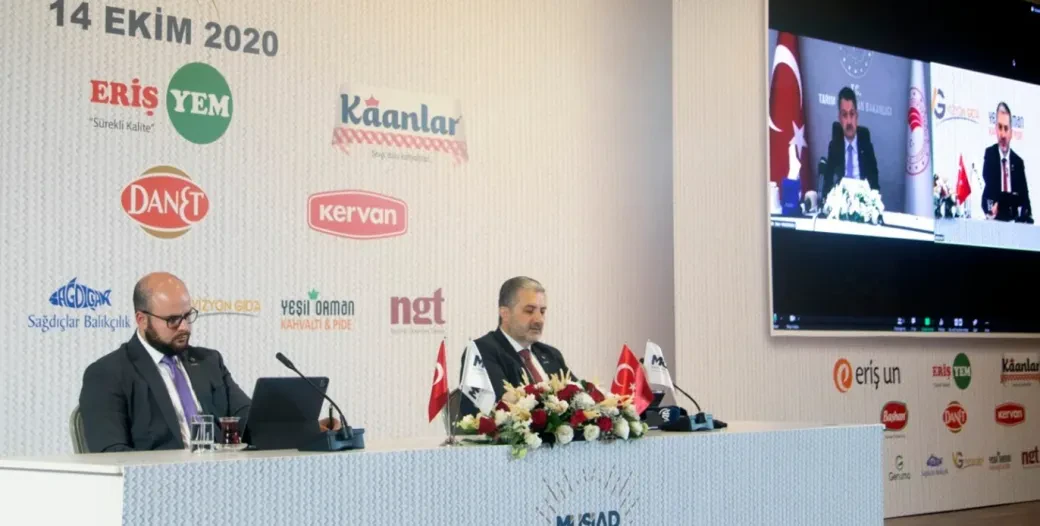
MÜSİAD, which stands out with the projects it develops for the development of the Turkish economy, is bringing to life the Smart Agricultural Town Project, another rural development project. Aiming to restructure rural life to urban standards, this project targets a broad-based transformation in order to encourage rural living.
Türkiye has nearly 3 million agricultural holdings, agricultural employment varying between 5 and 5.5 million people, and more than 36 thousand village settlements including small towns.
In our country, where one out of every four people lives in rural areas, agricultural and rural development policies retain their importance in every period. Because a country's agricultural strength is determined by its production power.
In Türkiye, where migration from villages to metropolitan cities continues, rural life needs to be made comfortable in order to halt this migration.
MÜSİAD, one of the largest non-governmental organizations in Türkiye with 11 thousand members, is bringing to life the Smart Agricultural Town Project with the aim of creating a sustainable ecosystem with a high quality of life in rural areas. A press conference was held today to announce this project, with the participation of Minister of Agriculture and Forestry Dr. Bekir Pakdemirli.
RURAL CITY LIFE WILL BE OFFERED TO 3 THOUSAND PEOPLE
Saying that he closely follows the projects carried out in the field of agriculture and rural development, Dr. Bekir Pakdemirli said: “I thank everyone who contributed to MÜSİAD's Smart Agricultural Town Project, which shows that the future of our country is agriculture.”
Saying that they see the pandemic period as an opportunity for rural development, Pakdemirli also underlined the importance of the word “smart” in MÜSİAD's project. Stating that the use of technology in agriculture must be increased, Pakdemir said: “We are a country with production power in agriculture. After the pandemic, while shelves stood empty in many countries, we experienced no problems whatsoever in the agriculture and food sector in Türkiye. During the pandemic we saw food nationalism come to the fore even more. This will remain on the agenda in the coming years as well. Therefore, in order to increase our strength in agriculture even further, we must hold firmly to projects in the agricultural sector.”
Speaking at the meeting, MÜSİAD President Abdurrahman Kaan gave the following information about the aim of the project:
“30 percent of Türkiye's exports are carried out by agriculture-based industrialists. In fact, the sectors that bring net foreign currency to Türkiye, that is, that do not produce a trade deficit, are found only in the category of agriculture and agriculture-based industry. According to the new report published by the Food and Agriculture Organization of the United Nations, global agri-food trade more than doubled since 1995 to reach USD 1.5 trillion in 2018. The rising exports of developing countries, which account for more than one third of the world total, have been effective in this increase. In other words, while the course is advantageous for Türkiye, we aim to further accelerate and strengthen Türkiye's upward movement in agriculture with new projects and initiatives. The MÜSİAD Smart Agricultural Cities project that we will bring to life in line with this goal involves a broad-based transformation in order to encourage work in keeping with the rural development goal, above all in the fields of agriculture, livestock breeding and industrial agriculture, and to encourage rural living.”
Stating that with the agricultural towns to be created in each of our cities a trade volume of 400 million lira per town will be reached, Kaan also underlined that rural city life will be offered to 3 thousand people, comprising 500 families and one thousand employees.
THE PROJECT HAS 5 MAIN HEADINGS
Speaking about the details of the project, MÜSİAD Rural Development Committee Chairman Abdullah Eriş explained that the Smart Agricultural Cities Project, which aims to create a natural and smart living culture that is self-sufficient, productive and developing while not compromising on social life, covers five main headings.
The first of these is the Digital Smart Agriculture Production System. It is planned that environmental, technological and innovative principles will be applied in the Smart Agricultural Cities through agricultural modernization applications such as innovative developments in agriculture, agricultural meteorology, early warning systems, irrigation and fertilization automation, smart fertilizer management, precision spraying and traceability software. It is targeted to establish 250 enterprises at SME scale in the ecosystem to be created.
The second heading is the Collective Wisdom Production Ecosystem. The greatest problem in rural areas is the absence of a culture of joint production. In the Smart Agricultural Cities, the foremost criteria are being able to work together jointly and producing together while sharing the earnings fairly. Enterprises such as a machinery park, a heifer centre, a slaughterhouse, feed and product silos and an animal care centre will be established under the collective wisdom production ecosystem.
Under the heading of the High Welfare and Living Ecosystem, an ecosystem that brings together the opportunities found in the city and the natural life found in the countryside is targeted. In order to offer together the high welfare sought in cities alongside a quality and natural life, it is aimed to establish detached houses with gardens, educational institutions, cafés and restaurants, a shopping mall, a sports hall, a cinema and theatres in rural areas as well.
Another of the project's important main headings is the Producing and Transforming Social Ecosystem. Those living in rural areas have limited opportunities to develop themselves and to socialize. With the Agricultural Town, people will both socialize by pursuing their hobbies and contribute to production. Within this scope, a handicrafts centre, painting and music workshops and lifelong learning centres will be established.
The last heading is the Collective Wisdom Management Ecosystem. Because it is planned that this ecosystem will be managed by collective wisdom and by professionals.
CLICK TO ACCESS THE WEBSITE AND THE AGRICULTURE REPORT