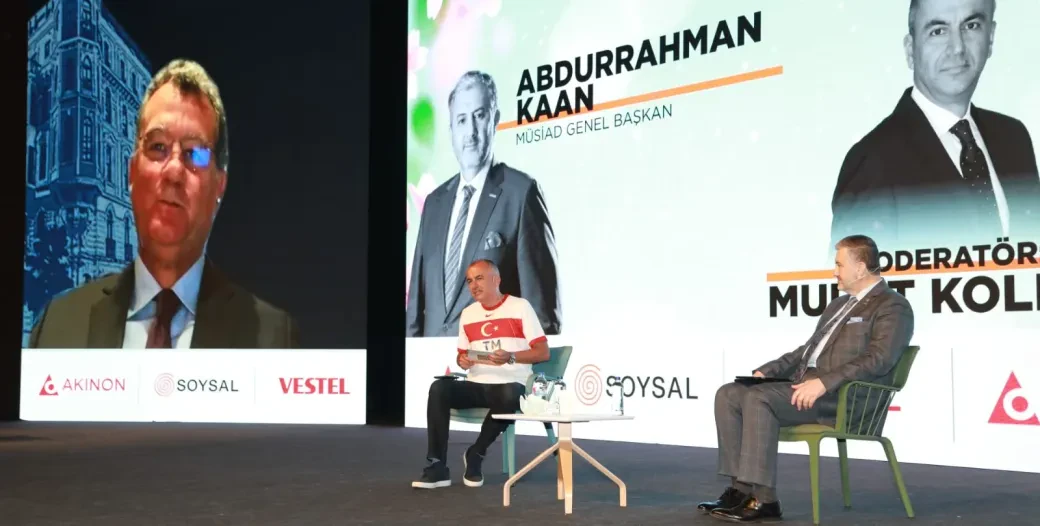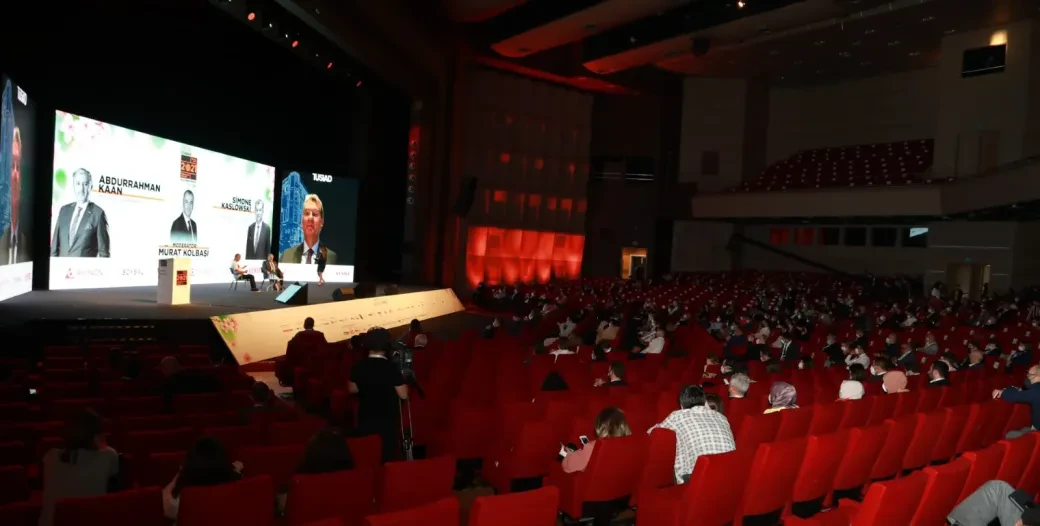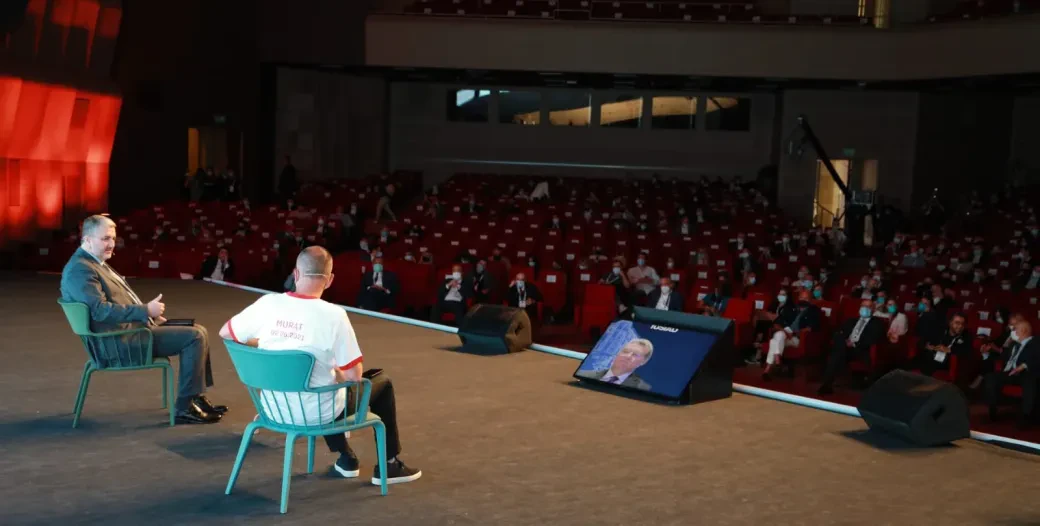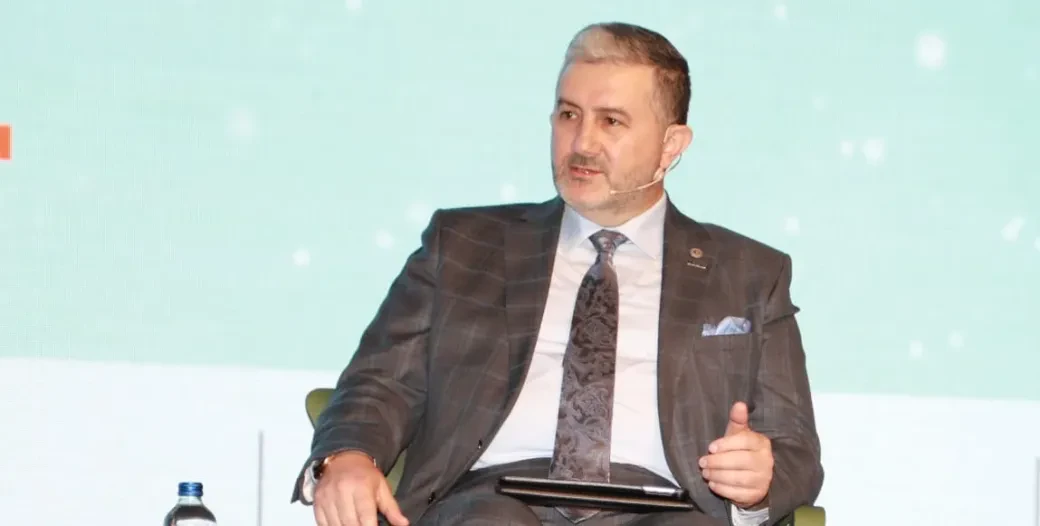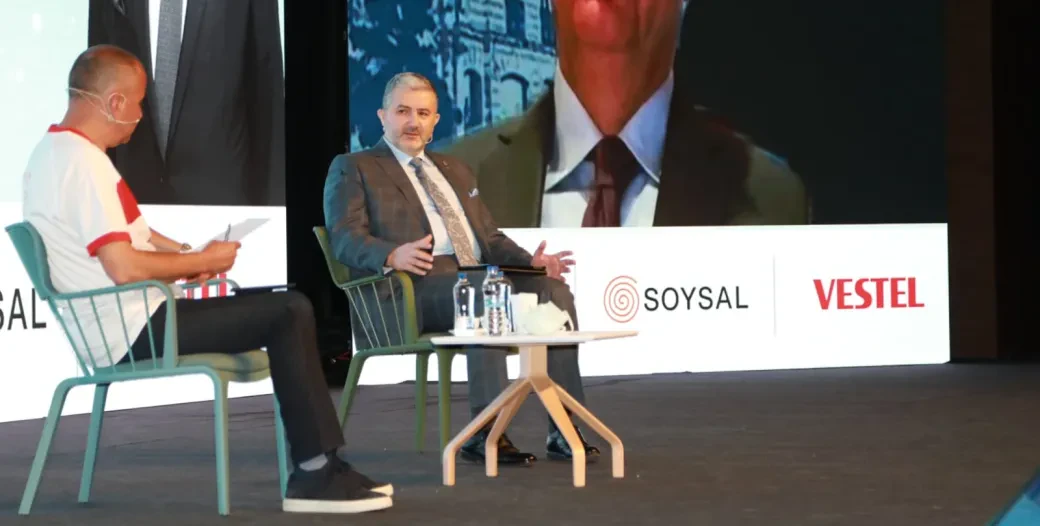
Abdurahman Kaan, President of the Independent Industrialists and Businessmen Association (MÜSİAD), attended the session titled "A Türkiye with High Competitiveness" together with TÜSİAD Chairman Simone Kaslowski at Retail Days, held at the İstanbul Haliç Congress Center. Answering the questions of moderator Murat Kolbaşı, President Kaan shared important assessments on current economic developments.
Mr. President, MÜSİAD has completed a full 30 years; it is a valuable and effective NGO of ours founded by 12 people. Could you please tell us about MÜSİAD’s organization and its contribution to our competitiveness; may we hear 30 years from you in 3 minutes?
MÜSİAD was founded in 1990, in a small office in İstanbul, by 12 idealist business people who love their country. Today it is a strong capital platform that has risen on the foundation of brotherhood, that has become influential in our country and in the world, that carries out its activities at a total of 225 locations in our country and around the world, and that, with more than 11 thousand members, represents more than 60 thousand enterprises.
In order to keep pace with, and go beyond, the change and transformation taking place in the world, we first carried out within our own structure the transformation needed for our country to take its place among the countries that have a say. We implemented this process of change, which we named “Renewal”, through the brands and projects we created within MÜSİAD, each of them containing steps more important than the other, in order to carry our country into the future more strongly.
As MÜSİAD, in the new era we set out with the understanding of being “the unifying force in the economy”.
In line with Türkiye's "2023 Vision", we redesigned our management model with a modern approach in order to adapt to the political, economic and technological developments occurring on a global scale. Within the scope of “Renewal”, MÜSİAD acts on the principle of making capital more active, more participatory and stronger by spreading it to the grassroots.
Therefore, we consider this step extremely important in terms of further increasing our country's competitiveness.
Many changes took place in the World during the pandemic period; if we take into account the changes in supply and value chains, which fields and sectors should we focus on in order to increase Türkiye’s global competitiveness, what should we do abroad, may we hear MÜSİAD’s domestic and international projects from you?
After the negative effects of the crisis experienced in 2019, 2020 had begun full of hope for the retail sector. Having started 2020 rapidly, the sector was anticipating a year beyond its targets and expectations. With the Covid-19 pandemic, which broke all the rules, the expected momentum could not be captured in the remainder of the year. For the retail sector, the Covid-19 pandemic first began as a global supply chain crisis. Far Eastern suppliers are the primary manufacturers or raw material suppliers for many players in the retail sector. With the factories that closed under the effect of the epidemic that started in China and spread to the entire Far East in a short time, the disruptions in production, the closing of borders and imports coming almost to a standstill, the fluctuations experienced in the supply chain became inevitable.
The most important feature distinguishing the pandemic from other global supply chain risks is the speed of its global spread. This situation leads to disruptions in demand and in logistics infrastructure being added to the supply-side shock that emerged after the pandemic.
As a result of the pandemic spreading rapidly to different geographies, the halt of production activities in these geographies affected global demand in two respects. First, in the classical sense, demand for finished goods fluctuated for reasons such as the protective measures of economic units or the increase in unemployment. While demand for some products increased, demand for some products decreased. Second and more importantly, the production interruptions that emerged in developed countries also caused fluctuations in orders at each stage of the global supply chain.
Due to the rapid spread of the Covid-19 virus, the closure of shopping malls and stores has significantly affected the retail sector. The current situation creates great difficulties especially for the non-food retail sector, which derives a significant part of its turnover from customer traffic. In order to solve the problems arising in the supply chain, human resources and store operations and to make a healthy transition to the post-epidemic period, it may be necessary to take measures both inside and outside the store.
Because of the closure of stores in the non-food retail sector and social distancing practices in the food retail sector, consumers have largely directed their shopping to e-commerce channels. Although companies' e-commerce turnovers have reached record levels, it does not seem very possible for this channel to reach the turnover obtained from physical channels in a normal period. The reason for this is that consumers who prioritize their personal safety during the Covid-19 process shop less frequently; the need for personal safety comes to the fore as one of the driving forces of the declining spending trend. For this reason they prefer to save rather than to spend. Consequently, preparing the store format, which has an important place in total trade, for the new period with the necessary measures is of critical importance in terms of overcoming the crisis.
As MÜSİAD, we had already long since moved to a project-based Committee system in the new era. Because the new world order makes it obligatory to use incentive mechanisms efficiently together with fast and proactive projects and thereby to attain an effective capital stock. Unfortunately our country is not a strong country in terms of capital stock. In this situation, the failure to achieve capital efficiency, the failure to establish appropriate project-support or incentive systems, and the failure to develop projects compatible with the regional advantages of cities all play a major role. However, I do not want to pass on without touching upon one more point here: the fragmentation and separation in the capital structure in Türkiye is one of the obstacles before a sound and sustainable capital stock.
Let us recall what happened in the early periods of the pandemic. The mobility of capital, goods and people came almost to a standstill and countries turned inward along the axis of the rule of “self-sufficiency”. This once again revealed the need to revise the hard rules of globalization, and the concept called the great reset, that is, the great zeroing, began to be discussed. What was the great reset?
1. Each country prioritizing its own resources in the production-trade-investment synchronization
2. Export items and quantities being determined only after domestic demand has been calculated on a definite and long-term basis
3. Minimizing import dependency
4. Countries revising their long-term policies on their natural resources, primarily water, as well as minerals and derivative energy resources
5. Making plans capable of coping with the inflationary effect that will be created by the drought that will confront us as a natural consequence of climate change and by the increase in food prices we will experience as a result of it
6. Establishing robust production bases so that production does not stop, or so that disruption remains temporary, in the face of possible epidemics and disasters
7. Diversifying the China-centred supply and logistics system and reducing this high dependency on China
8. Re-discussing the duties and powers of the triple structure consisting of the World Bank, the International Monetary Fund and the World Trade Organization, which we call the Breton Woods system, and preventing practices carried out to the detriment of developing countries
9. They began to revise their economic planning within the framework of new and dynamic countries coming to the fore in the face of the ageing world population and becoming production bases.
10. Countries giving more weight to their national economy systems with the shock inflicted by the pandemic.
With these 10 items I listed above, our domestic and national capital and industrialization policies are now the sole axis that will carry us to the 2023 and post-2023 targets. In this context we have of course made the advantage provided by a broad organizational network productive through project generation and have signed off on many innovations.
In 2020, which passed with economic difficulties, we held one of Türkiye’s most important fairs.
We held MÜSİAD EXPO 2020, the largest fair held after the pandemic and one that attracted intense interest from both exhibitors and visitors, with broad participation and completed it successfully.
Nearly 15 thousand visitors from 102 countries, primarily from Europe, Asia-Pacific, Eurasia, Africa and the MENA countries, attended the 4-day fair. We held our fair with the slogan “Global Trade Is Here”.
Our 23 committees in total under the roof of MÜSİAD Assembly began to gather potential investors and industrialists in Anatolia around certain projects, with projects compatible with their own thematic or sectoral fields.
These projects began to encourage the capital power in Anatolia to invest in projects or to become partners in them.
For example, with our Investment and Production Bases Project, we created a model that will turn our small-scale companies, which have difficulty producing in narrow areas and therefore cannot reach scale, into institutionalized companies ready to move to organized industrial zones over time, by building living and production zones where all their needs are met in the same environment.
In order to enter among the top ten economies in the world, and for the epidemics and disasters that are likely to recur under any circumstances, we have to establish production bases. By establishing production bases, it becomes possible to protect companies, employees and production in cases of epidemic or severe disaster and to keep them going without a full shutdown.
We briefly named this model SME INCUBATION CENTRES. This model, in which all the needs of SMEs from education to accommodation, from social activities to art environments, are met in the same living space, aims to create a safe production and living space both for our workers and for our producers and their families.
This project of ours was also one of our works planned from the centre and transferred towards Anatolia. At the same time, this project of ours was registered as a project under state auspices by the SBB within the scope of YOİKK.
Likewise, with our Smart Agricultural Cities Project, we launched an initiative to encourage rural development and in this way to support reverse migration and attain a homogeneous population structure.
We presented this as a model to the Ministry of Agriculture and Forestry.
With the Smart Agricultural Cities Model, we developed an initiative to encourage rural life and support rural development, with opportunities targeting the population crowded into big cities and especially women's and young people's enterprises.
Today many of our members in Anatolia are carrying out preparatory work to implement this initiative in their own regions.
Many more projects like these have been produced by our committees and spread to the grassroots.
Branding cities in the field of gastro-tourism through gastro-economy and Turkish Culinary Arts; establishing structures such as Caravan Tourism and Field Hospitals through multiple partnerships; creating a secure purchasing platform in the second-hand vehicle market; creating a secure real estate buying and selling platform; and, in line with the 2023 targets, growing selected SMEs in 20 places and 23 locations to turn them into Türkiye and World Brands.
This and many projects like it have been the fruits of MÜSİAD’s renewal adventure.
We created the MÜSİAD Brand in 6 basic fields in line with Türkiye’s 6 basic strategies:
1. MÜSİAD INNOVA ( MÜSİAD YENİLİK), for adaptation to the conditions of innovation management and digital transformation.
2. MÜSİAD FUTURE (MÜSİAD GELECEK), to develop the strategic sectors and business models of the future,
3. MÜSİAD ACADEMY, to turn education into a MÜSİAD school and give it a corporate identity.
4. 2023 YER-EL (20 YER 23 EL), covering the work directed at our Anatolian companies in order to bring out World Brands from Türkiye by increasing branding and the brand values of companies and to turn our SMEs into large-scale corporate brands,
5. MÜSİAD INVEST (MÜSİAD YATIRIM), to turn the credibility advantage and the field of the MÜSİAD Brand and the savings kept under the mattress into mass investments and partnerships in Türkiye’s investment strategies and to establish the systematics of investment funds,
As many of you have witnessed, we continue and will continue our work without interruption. We will carry on developing projects and serving our country, our nation and the lands where we were born.
As MÜSİAD, while upholding the ideals of our founders and these targets of ours, we also maintain the MÜSİAD tradition.
Our Qard al-Hasan Fund, one of the finest applications of this tradition, becomes a balm for wounds through the goodwill of our members and enables us to strengthen the culture of brotherhood and pass it on to new generations.
Organizations with a broad reach in the domestic and foreign arena such as MÜSİAD are in fact the main element of this diplomacy. Two years ago, when we spoke of trade diplomacy, we even published a book defining it and setting out its conditions. Later it became both the slogan of an institution and one of the policies of our state. Of course we take pride in this. Because we are all in the same boat. Now we speak of investment diplomacy. Because investment is not like trade. Trade is a transaction with defined rules. Investment, on the other hand, is in fact a decision-making process. Investment is not an action that takes place under limited conditions and in a controlled manner within regulations, like production and trade; it is a decision-making process. For this reason, just as investment cannot be kept separate from production and trade, it is a process management that can change direction with multiple variables.
Tangible values such as brand and production knowledge should be reconsidered within the concept of “localization of investment”, national capital should not be limited only to residents within the country, every kind of foreign investment transaction should be accepted if it provides input to the country within the scope of transaction interest, that is, transaction benefit, and these activities should also be evaluated within the scope of investment.
Apart from this, again in connection with this concept comes the creation of an investment diaspora.
Our Turkish investors resident abroad and residents there need to direct their savings and investments to our country and at the same time, by acting together with foreign partners there, to direct the production field to Türkiye and turn Türkiye into an investment market. At its 225 active points abroad, MÜSİAD works under the MÜSİAD GLOBAL brand with the MÜSİAD trade and Investment network system, which we briefly call M-TIA, both to access investment and investor information and to direct this diaspora towards the country.
We can actually also call this hunting for foreign investors. Because a brand-new investment system is now in question. Both investment trade and investor trader. Establishing an agency system that runs these two different applications together is now inevitable.
Our retail sector is a very strong sector, it continues to open stores abroad rapidly, Turkish brands now have more than 5000 stores abroad; within this framework what should be done so that this strong growth continues and, most importantly, so that the perception of Turkish brands abroad rises...
Currently, China and the other Far Eastern countries form the basis of the global supply chain. However, the situation that emerged with the epidemic we have experienced shows that almost the whole of one link of the supply chain remaining dependent on one country or region can lead to the complete breakdown of the supply chain in a possible emergency (for example, as we experienced in this epidemic).
For example, almost half of global chemical raw material production is supplied from China. If the epidemic in China had not been brought under control in March and China had not started production again in April, production would have had to stop on a global scale in many vital sectors such as pharmaceutical production, which needs chemical raw materials.
For this reason it will be inevitable for countries and multinational companies to consider substitute and additional new investments to China and the Far East in order to diversify the links in their supply chains. At this point, countries that traditionally have production infrastructure and capability, are in a good geopolitical position and have a well-trained workforce will be at an advantage.
The 2021 budget includes expenditures for opening new stores and improving existing stores. Another issue on the 2021 agenda of retail sector players in order to protect revenues is the increase in exports. The lifting of weekend restrictions is very important for the retail sector in terms of balancing weekend sales, which are important for it. In 2021, companies focusing on cost optimization, efficiency and digitalization also continue to open stores. Despite the decline in store sales, the number of stores in the retail sector is increasing because of the rising demand for high-street stores and the opportunities in rents. Another important issue for protecting revenues is increasing exports. Companies trying to turn exchange rate increases into an opportunity have focused on overseas sales. Exports will create a competitive advantage especially for retailers that are strong in domestic production.
It has emerged that the ability to substitute the entire supply chain rapidly with domestic production is an important capability for countries. After the epidemic it will be inevitable for states to increase investments through the public sector or through incentives in order to increase and complete production capabilities in such sectors. Public and private sector investors acting together in these fields will be beneficial in the coming period.
Esteemed President, you are at the head of a very important NGO; besides your own business I also see you in many other NGOs, you launched the renewal process at MÜSİAD; what messages would you like to give as Abdurrahman Kaan to us and to those listening today? Why do you think NGOs are important, why should our business people take on duties in these organizations?
As you know, the realization of economic and social development at the national level depends first of all on eliminating or minimizing interregional imbalances. And this can only be achieved through local and regional development.
Today civil society organizations play an important role in achieving local and regional development. Because NGOs, by using the advantages they possess for the development of the field in which they operate at the local and regional level, have functions capable of ensuring national and social development. As the world's most widespread and effective NGO and a strong capital platform, MÜSİAD too has a great duty at this point.
Aware of our responsibility, on the one hand we are expanding our fields of activity all over the world, and on the other hand we are reaching every one of our cities by weaving a strong network in our country. In addition to general issues, we also identify local problems and develop solution proposals. Thanks to its broad organizational network, MÜSİAD reaches micro data directly. In regional and holistic development, being able to obtain micro and macro data together is a great advantage. We are the only NGO that can process micro information by taking it directly from the grassroots; that is where our difference lies.
Therefore, while NGOs have such an important function, I consider it important for every business person who cares about the future of their country and believes they should have a share in that future to take on duties within NGOs.
When the mobility of capital, goods and people came almost to a standstill with the pandemic, countries began to revise their economic planning within the framework of “self-sufficiency”. From this point on, the aggressive global economic system clustered in certain countries gradually gave way to unitary structures and new production bases. However, this time the existence of national economies, in which the effect of the state will be felt much more strongly, will be essential. At this point our domestic and national capital and industrialization policies are now the sole axis that will carry us to the 2023 and post-2023 targets. The pandemic has in fact greatly increased Türkiye’s importance on the World economic atlas. This opportunity must be evaluated immediately and in the most effective way.
We are not an island country. We are a country surrounded by many neighbouring countries in the border or axis area. Especially when territorial waters such as the Aegean, the Black Sea and the Mediterranean, which are highly strategic and essential to protect for the sake of the blue homeland, are added to this situation, we see and experience that both political and military diplomacy passes along a very fine line.
Yes, a country surrounded by so many neighbours; while it must be on alert at all times politically in the face of diplomatic and military conditions, it is also fortunate in economic and commercial terms. Because every neighbour is a new bond, a new relationship, a new commercial alliance. This is where important duties fall to capital organizations like ours. Because states establish relations with one another not personally but within the circle of interests. The same applies in commercial life. Civil Society Organizations spread over a wide area like ours are like a velvet glove put on the iron hand of the state. They can rebuild and even repair strained relations in the background by establishing trade and investment networks through the channel of economic diplomacy. With both our commercial diplomacy network and our reporting system that prioritizes economic intelligence, we too are carrying commercial neighbourliness beyond borders.
In your opinion, where should Türkiye’s most important investment be made in the coming period in order to increase its competitiveness?
As a country we have sufficient accumulation, infrastructure and also a well-trained young workforce in terms of production capabilities. In logistics terms too we are a candidate to be a regional centre. However, in the last decade Türkiye’s share of global direct investment flows has halved. Similarly, there is a significant slowdown in merger and acquisition activity; the value of total merger and acquisition activity is less than %1 of GDP, whereas this ratio is at the level of %4 in world averages.
Our observation during the epidemic period is that the interest of foreign investors has turned towards our country again, especially for certain strategic sectors. In order for Türkiye to be a centre of attraction in terms of international investments in the coming period, it is important that the public and private sectors work together to implement the necessary reforms rapidly and that Türkiye’s brand value is brought to the fore again in the eyes of investors.
In September 2018 I made a statement to Anadolu Agency: “In our country consumption has exceeded production for a long time. The solution to the problems is closely related to being able to reverse this phenomenon. That is, by moving to the understanding of “consuming by producing”, it is possible to overcome all problems, primarily economic ones. Only to the extent that we succeed in producing can we become the rising country of this century. Otherwise, we may find ourselves facing the loss of our present gains." I said. At the point we have reached today, the fact that the plans to combat inflation will be made along this axis is also promising.
Türkiye has still not been able to use effectively its position of being on supply and logistics lines. Türkiye is still not a country that has been able to bring out brands or market high value-added products in the sectors in which it is expert and in which it has been a producer in the world for many years. I give this example everywhere. It is a simple but effective example: there are differences between selling flour and selling simit in terms of brand, price-return and commercial return. Yet making simit from flour is not such a difficult process. On the contrary, it adds value to the basic raw material. The producer in Türkiye is still far from this mentality. However, the emphasis our esteemed President placed particularly on value-added production and branding in the newly announced Economic Reform Package is proof that we have entered the right axis.
The retail sector, which was a very important sector in the Turkish market before the epidemic as well, has greatly increased its importance after the epidemic too. It is observed that the needs in the retail sector will increase not only because of the effect of the epidemic but especially together with the number of households increasing rapidly day by day in Türkiye. It is considered that, as in other fields, technological infrastructure has a very important role both in meeting these needs in the most economical way and in enabling foreign investors to benefit in this market.
In this context, when the development of e-commerce, which has been of great importance to date but has especially consolidated its place after the epidemic, is also taken into account, it is clear that, along with digital transformation, trained people and advanced applications are needed in information technology fields such as software and database technologies, and that integrating these developments into the food and retail sectors will accelerate the positive changes and developments they will create in these sectors. For this reason, it is necessary to act with the awareness that taking innovative steps is of great importance both for meeting the needs of the people of our country, which carries a large population potential, and for further expanding capacity and achieving progress in exports as well.
We named this work “Developing Cities with Their Original Values”. That is, determining criteria for valuing their own assets by comparing them with their counterparts in the world, and city matching. At this point, the most important of the comparison criteria is the company power that city possesses. Determining a correct industrialization policy in fact means finding, supporting, scaling up and increasing the capital power of promising companies that will keep this economy standing in order to create city economies, and carrying out the domestic-national production move in the form of both branding cities and strengthening companies. I call this running city economies for the execution of industrialization.
The most vivid example of such approaches is Germany. The German economy, just like ours, is SME-weighted and built on evaluating regional advantages in the best way and turning them into investment. Germany in particular structured its inward direct investment drive through an Agency system with the strategy of turning Germany into an investment market. This mentality, which began at the end of the 1950s, finally completed its organization with all its organs in 2007 and turned into an investment trade agency system. The figures obtained, that is, this system, enabled Germany to attract a considerable proportion of investment among OECD countries.
In conclusion, it is indisputable that the change the world economy has experienced in recent years in the light of rapidly increasing technological developments has accelerated with the unexpected effects of the Covid-19 epidemic. Adapting to this change and ensuring that the Turkish economy comes out of this change profitably depends on evaluating economic parameters in the best way and on channelling the investments to be made and the employment potential in the right direction.
The pandemic reminded us of such concepts that these have become the new elements of power by which the future will be shaped: food and agricultural security, renewable energy and energy investments, new lines in logistics, mergers and acquisitions, economic security, insurance and reinsurance, smart cities, overseas infrastructure and superstructure investments, production bases and campuses, pharmaceutical raw material production, technical textiles and many more fields I cannot count have newly been added to the literature. In particular, the strategic importance of derivative energy resources and mining investments, and the new financial system and investment instruments that will emerge in this field regarding the green deal, are new agendas that we have not encountered before but of which we must become aware and for which we must prepare as soon as possible. These concepts were the names of our committees during our renewal process while the epidemic, or the transformation following it, was not yet in sight. At that time, when no one knew or could voice these concepts, we made them a strategic goal and established committees. While the meanings of these committees were not yet understood at that time, their becoming an element of strategy both nationally and globally now is of course a requirement of our progressive perspective and vision.
In this context, the developments experienced on a sector-by-sector basis should be evaluated by both domestic and foreign investors, and adaptation to the new period should be achieved by following technological innovations in particular.