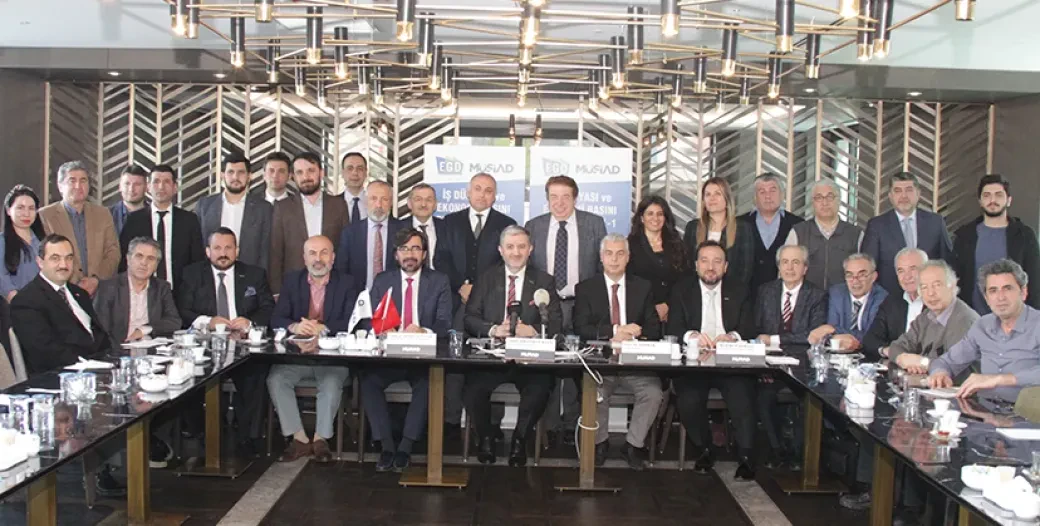
The first meeting of the “Business World and Economy Press Meetings” program, organized in partnership between MÜSİAD and the Economy Journalists Association (EGD), was held with the participation of MÜSİAD President Abdurrahman Kaan and members of the Board of Directors
Speaking at the "MÜSİAD-EGD/Business World and Economy Press Meetings" program held at the MÜSİAD Head Office, MÜSİAD President Abdurrahman Kaan said that Türkiye is not a country where a single economic model prevails, but rather consists of a mixed structure made up of a great many sub-economic models.
Noting that local differences and regional and sectoral disparities can produce entirely unexpected breaks and deviations, Kaan said: "That is why, while correcting one side with general, macro-level regulations, you may harm the other. The economy must of course remain faithful to the main axis of macro and political-economy principles. However, in countries like ours, fine tuning determines the colour of the work. This fine tuning is micro knowledge. Real and clean information coming from the field."
Kaan shared the following assessments:
"We host many executives from both the political and the state level. Politicians, bureaucrats, technocrats, ambassadors, consuls… Our guests come from a very wide spectrum. Without field knowledge, macro policies spring a leak somewhere along the way. Today MÜSİAD is advancing towards becoming the state's knowledge vault, both locally and globally. The new-era MÜSİAD is reshaping its entire transformation around this perspective. Those who remain idle in the face of change are doomed to lose. In parallel with this, we have named our own internal transformation 'Renewal'."
"We Say It in Advance So That Measures Can Be Taken"
MÜSİAD President Kaan stated that capital accumulation is the key card of a country's economy in periods of contraction and stress rather than in periods of expansion, and said: "If the state can use the support it provides to the capital bloc as a political-economy card both nationally and internationally, then it has received its return. Its fragility, on the other hand, emerges not in periods of growth and expansionary policies, but in periods of stagflation or financial squeeze."
Noting that within the economic architecture that has changed over the past 10 years the phenomenon of "economic crisis" is a matter of freedom of movement of the new paradigmatic concept of money rather than of real economic parameters, Kaan said that the financial system is used to create a manipulative communication trap and to steer economic agents in this way.
Kaan said: "One capital group defines itself by the amount of tax it pays. They say, 'We pay 80 percent of the corporate tax.' Today the share of corporate tax in GDP is 0.8 percent. It is not even 1 percent. Its share in the tax collected in Türkiye is around 8 percent. Giving a message to the business world from here amounts to manipulation. Will we define our strength by pre-tax profit or by manufacturing sales?"
Stating that MÜSİAD is an institution that obtains very serious data, Kaan said: "We say these things very early. We say them in advance so that measures can be taken." Noting that they would establish small and efficient working committees free of bureaucracy and move to a new management model, Kaan used the following expressions: "MÜSİAD knows well that the human being is not a resource but a value. We used to be a school that raised people; now we are turning this school into an academy. Because raising businesspeople is a step above."
"We Must Encourage Rural Life"
Answering journalists' questions after his speech, Kaan stated that life in the village and in the countryside must be re-established rather than life in the city, and said: "We must rebuild our villages. The Netherlands, with approximately USD 110 billion, is the country that exports the most food in the world. Our exports are USD 17 billion. We must encourage rural life. Today no one gives their daughter in marriage to a young man in the village. Because television and everything around us portray life in the city. There is no profitability either. Because there is no productivity."
Emphasizing that MÜSİAD is seeking to introduce a new model in agriculture with its "81 Biogas, Organic and Organomineral Fertilizer Facilities in 81 Provinces" project, Kaan explained that they aim to turn individual production in rural areas into SMEs.
Speaking about a project carried out by one of their members in Yozgat, Kaan continued his remarks as follows:
"A company acquired the production area of a field owner who farms on approximately 200 parcels; all of it was leased. There were about 140 tractors in the village, and now the number has dropped to 14. An area of 5,000 decares is currently used for fruit production. It is extremely modern. Migration to that village from İstanbul has now begun. In other words, the situation must be reversed with rational and correct policies.
A foreign company can come and buy the holding. Instead, we must operate economies of scale and bring cooperatives to the fore. It must be entirely grassroots-based. Our population increases by 1 million every year. We have very serious tourism expectations. In such a situation you must put your lands and your union to work very well. It must work towards this goal. It is the matter of lie down, stretch out, make money... They run the business at such an idle pace that... Our agricultural engineers are wandering idle. Take them, put them to work."
The program, which was held with strong participation, ended with a family photo.