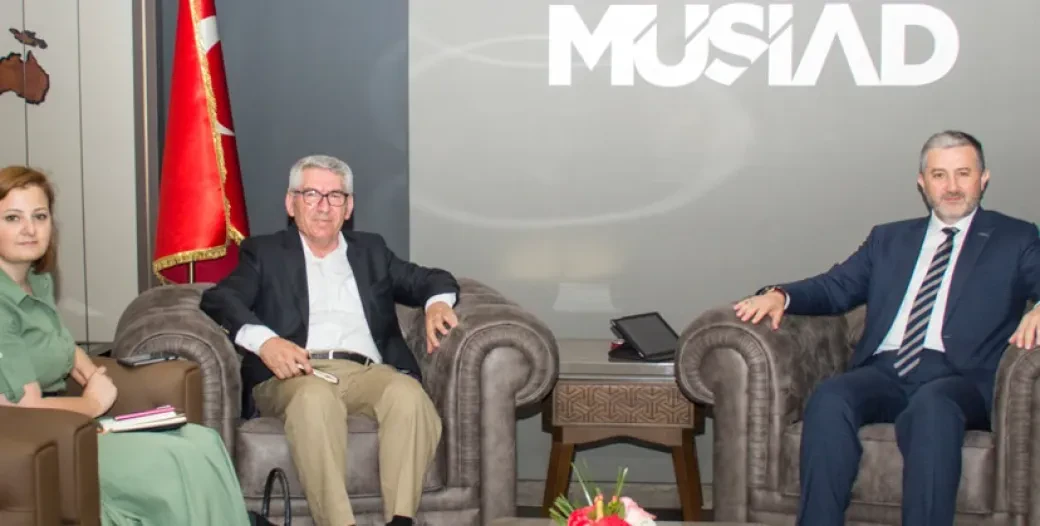
Abdurrahman Kaan, President of the Independent Industrialists and Businessmen Association (MÜSİAD), made statements to Ali Ekber Yıldırım, agriculture columnist of Dünya Newspaper, on Türkiye's agricultural problems, proposed solutions and the steps that need to be taken in order to achieve development in agriculture
MÜSİAD President Abdurrahman Kaan made statements to Ali Ekber Yıldırım, agriculture columnist of Dünya Newspaper, on Türkiye's agricultural problems, proposed solutions and the steps that need to be taken in order to achieve development in agriculture.
While bringing land consolidation, productivity, hemp production and many other projects for the agricultural sector onto the agenda, Kaan proposed planning covering at least 10 years in order to make use of the country's potential and to increase productivity.
In his interview, Kaan made the following statements:
The Independent Industrialists and Businessmen Association (MÜSİAD) has focused on projects aiming to make use of the country's agricultural potential, such as rural development, gastronomy, agriculture and livestock farming, and agro-tourism.
Abdurrahman Kaan, Chairman of the Board of Directors of MÜSİAD, said that planning covering at least 10 years is needed for Türkiye to be able to make use of its agricultural potential.
Speaking exclusively to DÜNYA, Kaan stated that the production mindset in rural areas must be revived and that measures which will increase the appeal of the countryside are needed for this, and said the following: ” We live on lands that have hosted many civilizations and where agriculture and settlement first began. The finds at Göbeklitepe show what kind of culture and what kind of past we come from. Agriculture and livestock farming are in our genes. This is our field of superiority. Yet we have drifted away from the production mindset in rural areas. We need to revive the production mindset once again. Our greatest need, however, is that we do not have 10-year planning. Today, the countries we consider to be in very good positions in agriculture are doing this planning. They have achieved productivity. We too need to do planning covering at least 10 years and to work on projects that increase productivity.”
The renewal process
Explaining that there is serious competition in the world in the production of technology-intensive, value-added products and that the traditional field must not be abandoned while taking part in these areas, Kaan said that as MÜSİAD they have entered a renewal process. Kaan said: ” In the past we used to say agriculture and food sector board. Now we say transformation in rural areas. We say agriculture and livestock development committee. Another of our headings is Turkish Cuisine; the Gastro Economy Committee. Again, we have project-oriented work such as the Competition in Food and Retail Committee.”
Project-Oriented Work with Universities
Recalling that industry-university cooperation has been discussed in Türkiye for years but that very little concrete progress has been made, Abdurrahman Kaan, Chairman of the Board of Directors of MÜSİAD, gave the following information about their work on this subject: “We established an office to develop cooperation between universities, the state and the private sector on a project basis. We named it AKS. As you know, 'aks' means a connector, an axle. The Academy, Public Sector and Industry (AKS) Office. Of course, since we are project-oriented, we will also need an office to evaluate the projects that come in. In addition to this, we have an office called EVO. The Industrial Productivity Office. Is the project that comes in really productive? Is it necessary for the country? Or is it imaginary? We evaluate this.”
Hemp Seed and Academy
Emphasizing that they carried out their first work on hemp, Kaan gave the following information: ”When the Presidential Government System was adopted, high boards were established. We work closely with these high boards. We carried out a modelling study. The main purpose of the work here is to develop domestic and national production. Many things have been said about hemp. Just like boron. It was said that it would replace oil and that Türkiye would become rich. It was said that boron would save the country. But nothing of the sort is apparent. A great deal has also been said about hemp. What do we have to do with hemp? Different things immediately come to mind. We said no, this has nothing to do with narcotics. There is a variety of our own that we call Turkish hemp. We went to Samsun Ondokuz Mayıs University and said, let us take this matter in hand. That is how we took our first step, and they have now started production of two seeds under the names Narlı and Vezir. We signed our cooperation protocol. Then we said we needed to establish an institute for this. Because you have produced the seed and you have produced the crop; what next — the fields in which it will be industrialized also need to develop. Our esteemed President took that step. The institute was established.”
Micro Algae Production
Explaining that they subsequently concluded a cooperation protocol with Ege University and carried out work on micro algae production with the Faculty of Fisheries, Kaan said that important steps have been taken regarding algae, which are a very important source of protein and are used in many fields.
Recalling that they have launched a cooperation with Yeditepe University on bacteria, Kaan made the following assessment: “We have seen that universities have serious studies in hand. But difficulties are experienced in transferring these to industry. As MÜSİAD, we represent production. In food, in textiles, in machinery, in the defence industry, our members have a say. When production is mentioned, we are there. Our effectiveness is lower in import-based industries. The segment that does the producing is MÜSİAD; seeing this, we are carrying out such work with universities.”
17 Project Proposals for Agriculture
Explaining that last year they held an important meeting in Adana under the name “Development in Agriculture” and carried out project-based work by also inviting ministry officials, Kaan said: ” We carried out studies on agricultural development. We presented them as a roadmap. Out of this meeting we identified and announced 17 projects. From clustering to other fields, all of these are productivity projects. The fruit investment we previously made in Yozgat is the finest example of this. Lands were consolidated and fruit production was begun. Migration to the area started. Including these, many models need to be embedded in agriculture.”
Rural Town Project
Recalling that they have carried out studies on rural transformation and on how development in agriculture and livestock farming is to be achieved, Kaan continued his remarks as follows: ””We have a project called Rural Town. In terms of rural development, the production mentality in Türkiye has fallen behind. In our understanding, a country's agricultural power is determined by its production power. But there is no comfort in rural life in Türkiye. We must also bring this comfort into the equation so that there is a movement from the city towards the countryside. When you examine countries such as Germany, the Netherlands and America, you see this. The man puts on his overalls, does the milking at the livestock enterprise and does his daily work, but he also has a social life. He has a car, a jeep. He has a certain standard of living. There are also some supporting subsidies. He has insurance. He is exempt from certain taxes. He consumes electricity and water more cheaply. We need to provide this in Türkiye too. In Türkiye, nobody gives their daughter in marriage to someone engaged in livestock farming. City life is attractive, while village life has ceased to be attractive. We need to keep women in the countryside. Women are more sensitive about insurance. We must provide their insurance. We must make the countryside attractive. But for those who produce. The state should cover their insurance. We also need to build the infrastructure of the villages. Supports must also be oriented towards production. There is an incentive per decare. People take it and sit idle. If we shift the supports to an output basis, if we provide support according to productivity, there will be very serious production.”
Production Must Be Oriented Towards Sales
Explaining that production in rural areas must be oriented towards sales, Kaan stated that the country's population and the number of tourists must certainly be taken into account when planning. Kaan commented as follows: ” According to our calculations, our population will be around 110 million in 2040. There will be approximately 70-80 million tourists. Taking this population as a basis, agricultural production and the regions in which livestock farming will be carried out must be addressed one by one. Groundwater is very important. When we look, groundwater is in the east and the south-east. Water is life. We need to practise irrigated agriculture in places where water is abundant. In other areas we should not produce forage crops. But there is no such planning. In the villages the mindset has moved away from production.”
Erzurum beans instead of Canada
Recalling that Erzurum is famous for its İspir Beans, MÜSİAD President Abdurrahman Kaan spoke as follows: ” When the mindset of production is lost, we buy beans from Canada. We buy from Kazakhstan. You talk to the producer in Erzurum and he says it is very cold, there is snow, the cost is high, so I cannot produce. Is Canada any less cold? Kazakhstan is far colder. We have always taken the comfortable option and drifted away from the production mindset. A shopping mall opened and the place is full. Consumption is rising. We need to revive the production mindset once again. This is why we attach importance to the gastro economy. Both to sustain the production of local products and to support production. Together with tourism, a serious income can be generated.”
Cities Will Compete Instead of States
Emphasizing that in the future the race will be between cities rather than states, Abdurrahman Kaan explained the following: ” There will be brand cities. They already exist at present. Brand cities are a new trend in the world. Funds also flow to these places in investments. For this reason we are matching our cities with brand cities and carrying out work accordingly. For example, in our view Erzurum and Erzincan correspond to Salzburg and Insburg in Austria. The Salzburg-Insburg region generates a value of approximately EUR 60 billion. What is there? There is winter tourism. Is it possible for us to do this in the Erzurum and Erzincan region? It is possible in every respect. We also have aspects in which we are superior. We can move even further ahead with gastro tourism. It has a cuisine that can be brought to the fore with cağ kebab and many other products. If we can bring EUR 10 billion to this region, per capita income will rise from USD 10,000 to USD 20,000. We are matching Samsun with Hamburg and İzmir with Melbourne. İzmir has a greater advantage than Melbourne. It is more advantageous with its agricultural potential, its port, its foreign trade and in many other respects. We matched Antalya with Los Angales and Konya with Kyoto. We have created such a model.”