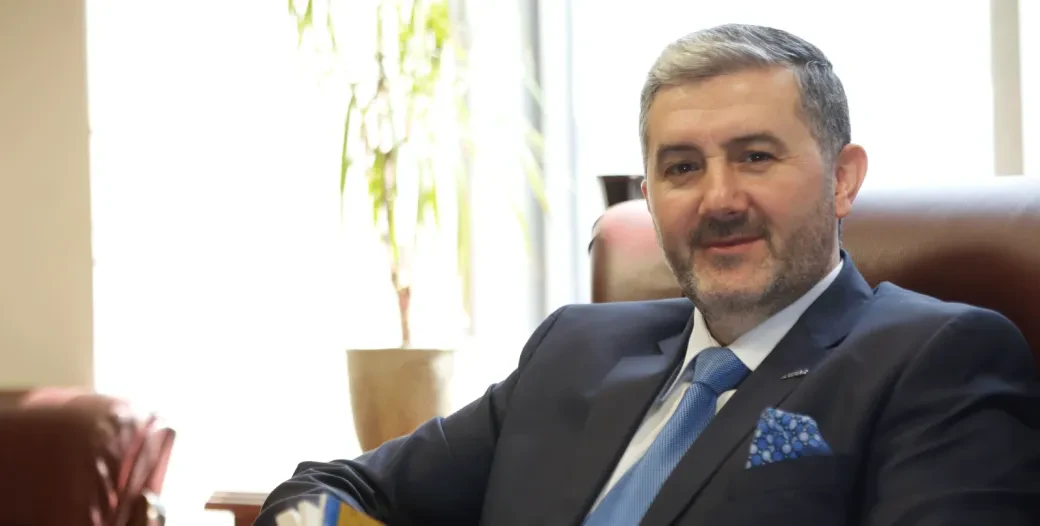
MÜSİAD President Abdurrahman Kaan was the guest of Hakan Güldağ, Şeref Oğuz and Vahap Munyar on Dünya Gazetesi’s Opinion Leaders programme. Kaan, who said "Let us establish production bases for pandemics and disasters", also made the assessment "the uncertainty has partly dissipated, a reform package is needed" regarding the new economic policy implemented after 6 November.
Abdurrahman Kaan, President of the Independent Industrialists and Businessmen Association (MÜSİAD), proposed drawing up "a national economic road map" while answering Dünya Gazetesi’s “Agenda Special” questions. Kaan said, "We have to establish production bases for pandemics and disasters that are likely to recur. By establishing production bases, it becomes possible to protect companies, employees and production in the event of a pandemic or a severe disaster and to keep them going without a full lockdown".
A national economic road map
How should Türkiye prepare for the post-COVID-19 period? On which dynamics should this preparation be based? In your view, what kind of national design does coping with the problems caused by the virus and being prepared for the aftermath require?
The post-COVID-19 period will of course not be a rose garden in which everything goes smoothly. First of all, the economic residue of this period will have to be cleared away. We therefore need to draw up a national economic road map starting today. First, in order to enter the category of self-sufficient countries, new production and investment planning must be carried out in our critical sectors, above all agriculture and livestock farming. Türkiye has still not been able to make effective use of its position on supply and logistics lines. Türkiye is still not a country that has been able to create brands or market high value-added products in the sectors in which it is an expert and in which it has been a producer in the world for many years. As MÜSİAD, we use our field-wide presence to explain to all our members the conditions of the new era in production and trade. We have to establish production bases for pandemics and disasters that are likely to recur. On this subject we designed our Production and Investment Bases Project, and we have brought two of them to life. If the model is examined properly, it will be seen that the basic logic of these bases, alongside production, essentially puts people first. By establishing production bases it is possible to protect companies, employees and production in such pandemic or severe disaster situations and to keep them going without a full lockdown. However, it is not only such projects; fundamentally, our economic outlook needs to change. Minimizing dependency on raw materials or semi-finished goods is essential.
Restructuring creates capital loss
How are we going to carry out the technological transformation process, which appears to have accelerated with COVID-19, with companies that are already in debt and can only stay afloat through restructurings?
In fact, crisis periods are periods in which the resilience of both economies and companies is tested. All the problems that had been lost within the system until then come to the surface. Unfortunately, the immune systems of our companies and of some of our sectors within the economic structure are weak or not resilient enough. They struggle to show resistance against viruses and they fall. The capital and financing structure of our companies, their maturity and sales system, their workforce qualification, their stock structure and management and their technical infrastructure contain the tests required for technological transformation in the post-COVID period. Our companies that cannot make sound planning on these five criteria unfortunately also limit, in a sense, our total economic reflex capability through their levels of indebtedness. As long as our companies borrow in foreign currency and earn income in Turkish lira, this immunity will not grow stronger. If we regard as an economic burden those companies which, because of their constant need for restructuring, in a way take the entitlement of companies with growth potential, and merely watch the process, we will then face a serious loss of capital. If we keep on with restructurings in order to keep our companies permanently afloat, our loss of capital will again be inevitable. Here one should not ignore the effect of the country’s credibility in international markets either. As our country’s credibility rises, corporate indebtedness ratios can be prevented from turning into a crisis. Another problem is credit costs. As costs rise, companies that borrow again in order to roll over their debts can find relief in a low interest rate environment. Likewise, a low exchange rate level will ease the burden of indebtedness. However, the important point here is that both individuals and companies give up their habit of seeing foreign currency as a safe haven.
Relations with the USA will continue soundly
When we compare the Biden era with the Trump era in the USA, what kind of economic and geopolitical differences do you see that will also affect Türkiye? How will Türkiye’s relations with the USA develop in the Biden era?
Biden was elected to the Senate in 1972 when he was only 29, making him the youngest politician to do so, and he has been an active player in American politics for half a century. At the same time he carries the mindset of a classic statesman. That is, he believes that every matter should be assessed and resolved with its own counterpart. Not only Biden’s but also his team’s view of Türkiye will contain the codes of the new era between us. Biden’s relationship with Türkiye is not new. He was one of the four senators whose signature was on the military embargo the USA imposed on Türkiye in 1975. In the 1980s he was one of the figures who conducted diplomacy during the USA’s military demands process. In the Obama era he was a highly active actor on Türkiye policies. But always at a distance. Biden is a figure who acts in accordance with diplomatic conventions. It can be said that he does not have the model of doing politics through first-degree social relations that Trump had. Indeed, even his visit to Türkiye during Mr. Erdoğan’s illness in 2011 was an entirely diplomatic manoeuvre. Although Kamala Harris does not have a direct history with Türkiye, she makes up for this through her advisers. Harris’s National Security Adviser is a thorough Eurasia and Middle East expert. He is someone who has held ambassadorial posts along this line. The Secretary of State of the Biden Administration is the person who effectively planned and managed the USA’s Syria policy. The Secretary of Defense is the figure who commanded US CENTCOM between 2013-2016. The official responsible for the Middle East and North Africa is an effective figure who knows the Kurdish geography of the Middle East very well. In short, the Biden administration confronts us with a rather critical team and a different management model. Moreover, it should not be forgotten that the Trump administration came almost entirely from the evangelical branch of the Protestant denomination, whereas Biden is a Catholic. He is the USA’s second Catholic President after Kennedy. This situation will of course also be pregnant with interesting developments in terms of the USA’s internal dynamics. In the new era we need to have weightier diplomacy and a sounder reflex capability. I am hopeful that both our diplomatic and our commercial relations will continue soundly in the new era.
There will be some axis shifts in the world
With the start of the administration of the vaccine, expectations in the world have partly improved. However, according to research, there are also concerns about the future all over the world. Climate change, growing income injustice, debts that have multiplied compared with 10 years ago. Trade wars, rising protectionist tendencies. How do you read the future?
In the early days of the pandemic it was said that a new process had been entered and that from now on a new and radical road map had to be drawn for a completely different world. Paradigm shifts, the great reset, capitalism being put on the table again, the end of globalization and so on... The economic crisis experienced after the pandemic should not have been a surprise for the world. Because there was already a global economic system that had been unable to find its point of equilibrium after the 2008 economic rupture, and many articles were speaking of the concept of a new economic architecture. This concept covered many issues, from the solution of income distribution inequality to the relocation of production centres, the systemic errors created by capital movements and the damage that the bubble in derivative markets would cause to real economic activities. The process that began with the pandemic brought all these problems to the surface many times over. No state was prepared for such a crisis. Therefore the collapse was great too, and new processes were dreamed of. But now I see that our initial enthusiasm is gone. We cannot say that anyone has made a move towards such great paradigm shifts. Instead, limited work is being done to repair some of the faulty parts of the system. In other words, we will again continue on our way patched up. Only, axis shifts will take place on some issues in the world. The change of production and supply centres, the emergence of new powers and hence new struggles for hegemony, national economies coming much more to the fore and nations first guaranteeing their capacity to be self-sufficient, the danger of drought that will begin with climate change opening up new strategic areas for us such as access to food, health and clean water, and our obligation to produce new policies against pandemics that are likely to recur, above all in food security and biosecurity... In the new era a world awaits us in which we must be more cautious.
Resources are not weak, they are simply not used efficiently
There is tremendous volatility in raw material prices. There is also a need for financing for new machinery and technology investment. Rolling over loans requires additional resources because of rising interest rates. It seems that one of the most important problems for the business world this year will be experienced in finding resources. How do you assess this situation? How can the problem be overcome?
Long before the COVID process I had said that the years 2019-2020 would pass with commodity crises and that afterwards we would experience serious fluctuations in raw material prices. Because at that time the analyses we made with the data we received from the field were giving the footsteps of the coming shock. I say it again now: we will see these fluctuations for another two years, that is, until the world economy gets through this process and normalizes again. The only issue here is not the raw material problem, but resources and financing at the same time. Türkiye is not a country that is weak in terms of resources; it is simply a country that cannot use its resources efficiently. For this reason we worked on and presented a model based on three kinds of efficiency: resource efficiency, capital efficiency and incentive efficiency, that is, their correct distribution and use. Operating these three under suitable conditions already provides us with additional resources. At the very least it prevents waste. Unfortunately we cannot overcome two fundamental problems. The first is creating project funds in which people can evaluate their savings and perhaps even become partners, and the second is, in the witty expression of the late Erbakan Hoca, establishing factories that make factories. That is, producing within our own structure the machinery lines that are the real cause of resource waste. If we can achieve the first, we will have converted wealth into capital both at the individual level and at company level, and this will generate additional resources; and when we achieve the second, we will prevent our external dependency and focus on production. There is no time left. The world will not wait for us. If we cannot position ourselves properly at this bend too, we will pay a bitter price for it.
The problem is not the fall of exchange rates but the establishment of lasting confidence
Last week foreign currency deposits fell by USD 2.1 billion. Has reverse dollarization begun?
While the perception of foreign investors shifted towards the Turkish lira in a positively priced environment, domestic investors unfortunately were not convinced. In other words, foreigners believed in and rewarded the new period’s political discourse more than domestic investors did. In fact we had been following the effects of this for quite a long time in the confidence indices announced as well. Even though some questions in the indices were removed, there were no dramatic deviations in the final results. Without a noteworthy dissolution in domestic investment, the rebuilding of net reserves will also be delayed. There is of course a very slow dissolution, but what matters is that it continues and increases. It should also be borne in mind that the USD 2.1 billion decrease that took place last week partly stems from calculations arising from the fall in the exchange rate. The problem is not that exchange rates are coming down; the problem is that confidence should be established permanently.
Let us move to the "Smart Agricultural Cities" model
Food inflation has risen in the world. Difficulties are being experienced in the supply of agricultural products. Practices such as Russia imposing restrictions on oil exports are increasing. What awaits the world and Türkiye in food? What kind of agriculture and food policy does Türkiye need?
We experience such a fluctuation once every 20 years. Because of both the changes in consumption habits after COVID and the need for more food owing to the growing population in the world, production planning in Türkiye must be handled with a holistic perspective up to the year 2030. In production planning for 2030, serious steps must now be taken in order to develop the organic structure of our soils in parallel with Türkiye’s food needs in agriculture and livestock farming. Sustainable planning must be put into practice in areas such as the active use of pastures, vertical farming, active irrigation and efficient livestock farming. In Russia, Ukraine and the Turkic republics — particularly in Kazakhstan and Uzbekistan — shifting production to those places in the coming period together with the leasing of land, in the animal product groups that are Türkiye’s main food consumption products, at the head of which come feed and protein sources, and concluding bilateral agreements in this direction, will be an important step in the struggle against inflation. Even if the COVID process ends, the constant increase in the world population makes new digital smart agriculture applications compulsory. As MÜSİAD we held the launch of our Smart Agricultural Cities Model that we developed, and we received serious support from the Ministry of Agriculture on this matter.
A single parameter in tight money may backfire
Exchange rates have fallen quickly but interest rates are high. Loan interest rates in the market are above 20 percent. The Central Bank of the Republic of Türkiye (CBRT) says it will not cut interest rates for a long time. How is this process affecting the business world?
This situation has an effect on exchange rates and on hot money inflows, but a clear calculation needs to be made here. Is the hot money coming in sufficient? Who really gains from a low exchange rate and high interest rates? How is the banking sector affected by this situation? How much longer can the real sector resist this? All over the world, those who make money from hot money come to a country when the exchange rate is high and leave when it falls, and thus obtain earnings of a serious amount. The financiers who borrow at zero or near-zero interest in their own countries and earn from the exchange rate in Türkiye are in fact doing ‘carry trade’. In other words, how permanent the incoming fund is needs to be thought through carefully. In a high interest rate environment, if it still provides a high return against inflation, deposit or bond holders come out ahead. In the banking sector the situation differs in terms of deposit and loan maturities. In fact banks come out ahead if interest rates are low. The real sector, for its part, can resist up to a point in a high credit cost environment. Because as a result of both the height of indebtedness ratios and the deterioration of the investment environment, a decline in investment appetite and production losses begin. This in turn means an increase in inflation, a rise in the unemployment rate and a contraction in GDP.
For the goal of price stability, a single-parameter course in tight monetary policy may backfire. The road map therefore needs to be modelled well, and in this regard we trust both our Central Bank and our economic administration. The Central Bank is the guarantor of the country’s financial stability. For this reason, as the four important representatives of the business world, we of course gave an assurance that we will stand beside the Central Bank and the Ministry of Treasury and Finance in their struggle. This is a national duty. The decisions taken as required by the conjuncture are at the discretion of our state. As MÜSİAD, while standing by our state, we underline that the ultimate solution lies in increasing production and making the investment environment suitable.
There is a very strong appetite for investment
There is a serious test on supply. The President of İSO emphasized that the difficulties experienced in supply are at an intolerable point. There is an accusation that in iron and steel and in petrochemicals they turn to exports for the main industry, do not give enough intermediate goods to SMEs at home and inflate prices. How can these problems be solved in the short and long term?
Our industrialists in Türkiye have a very strong appetite for investment in this period. Not only large enterprises but also SME structures are very insistent and eager to grow and to invest. We must urgently turn this situation into an advantage. Not only in the metropolises but everywhere in Anatolia, producers are truly ready to write a new success story if they are brought together with a financial structure suitable for investment. However, there are of course some problems here. It is true that, particularly in the sectors you listed, companies have turned to exports because of the foreign currency advantage and have supplied goods to the domestic market on a more limited basis. What really needs to be done here is to increase production, particularly in iron and steel, petrochemicals and plastic raw materials. In the long term, it is for companies to revise their import strategies, that is, in fact, to invest in raw material production.
The uncertainty has partly dissipated, a reform package is needed
How do you assess the economic policy implemented after 6 November?
In fact the period after 6 November shows, in a sense, a phase in which the expectation effect in the economy has been well managed. The return to orthodox policy in the economy and the dominant emphasis on the discourse of transparency revived the Turkish lira positions that foreigners had reduced almost to zero. With the difference between the interest rate arrangements implemented as required by the conjuncture and real inflation, we in fact reached a strong position among the countries providing high returns in the world. The removal of the asset ratio, the increase in capacity utilization rates and the positive perception left on foreign investors by the messages given that tight monetary policy would be implemented with determination both had a suppressing effect on the country’s risk premiums and partly dispelled the atmosphere of uncertainty. This situation accelerated the inflow of hot money and the exchange rate gained serious downward momentum. This of course created an environment that will be reflected in production costs in the next period. The insistent and determined stance of the economic administration and of the Central Bank in the struggle against inflation, and their preference at this stage for cooperating with all economic stakeholders in order to develop policy, of course gave hope to business people, to end consumers and to foreign capital alike. In other words, up to this point there is of course a movement in a good direction. However, all these steps are merely paths leading towards the main artery road that must be taken.
It is useful, it buys time, but it does not offer an ultimate solution. It does not last forever. After a while the market will demand of you more permanent and fundamental moves, that is, economic planning. For this reason, in particular, the steps to be taken to support production planning and foreign direct investment and the reform packages prepared to improve the investment environment need to be put into practice. I am also sure and hopeful that these steps will come.
President Kaan: Let Us Establish Production Bases for Pandemics and Disasters
News from MÜSİAD