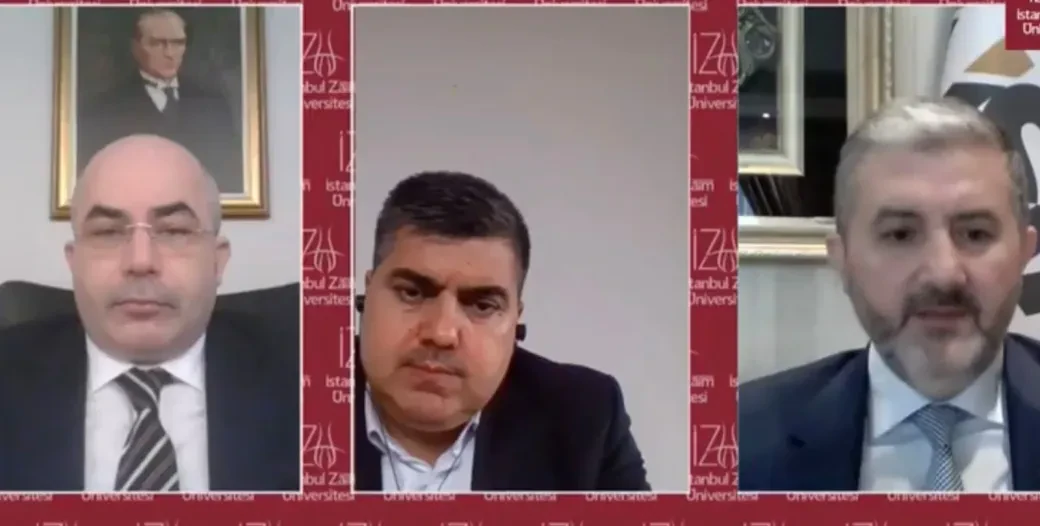
Abdurrahman Kaan, President of the Independent Industrialists and Businessmen Association (MÜSİAD), took part as a speaker in the International Conference on Islamic Economics and Finance, organized for the 12th time this year by the International Research and Application Centre for Islamic Economics and Finance of İstanbul Sabahattin Zaim University in cooperation with national and international institutions.
At the programme, which President Recep Tayyip Erdoğan joined by teleconference, he shared his assessments on the developments taking place in Türkiye and the world, the measures taken within the scope of the Coronavirus pandemic and the Islamic understanding of economics.
President Erdoğan, who stated that the distorted order produced by the interest-based order and economic understanding still prevailing in the world can be corrected through Islamic economics, which places the human being at the centre and exalts labour, made the assessment, I believe that in the world of the future the current economic system based on interest and exploitation will give way to participation, in which risk sharing is essential. Indeed, we see that developing technology and fintech applications are spreading Islamic finance instruments throughout the world."
Erdoğan stated that Islamic finance institutions, which operate on the basis of profit and loss sharing, also meet an important need of the hundreds of millions of people who do not wish to become involved with interest, and said that these institutions have drawn the attention of broad segments of society by successfully weathering the economic shocks experienced in recent years in particular.
There Is a Major Financing Gap
Noting that, according to the United Nations Conference on Trade and Development, the total investment need in developing countries is approximately USD 3.9 trillion a year, Erdoğan continued as follows:
"Considering that current investment levels stand at around USD 2.5 trillion, there is a major financing gap. Participation finance institutions can take the initiative and assume a leading role in closing this gap. The use of products such as sukuk needs to be made more widespread in order to finance large, long-term infrastructure investments. Of course, in putting all of this into practice, important duties fall to you, our esteemed academics, and to our universities as much as to politicians. I believe that when we fulfil this responsibility all together, new windows of opportunity will open before us."
In the second session of the programme, MÜSİAD President Abdurrahman Kaan, İstanbul Sabahattin Zaim University Rector Mehmet Bulut, Central Bank of the Republic of Türkiye Governor Murat Uysal, Banking Regulation and Supervision Agency (BDDK) Chairman Mehmet Ali Ekben, Capital Markets Board (SPK) Chairman Talat Ulussever and Participation Banks Association of Türkiye (TKBB) Chairman Metin Özdemir shared their assessments as panellists.
Everything That Is Islamic Serves the Human Being
President Abdurrahman Kaan said, "Islamic economics is the grassroots-nourished economic model of an understanding based not on a colonialist mentality driven by the greed for gain and rent, but on production and just distribution, placing the human being at the centre."
In his address at the special session held within the scope of the 12th International Conference on Islamic Economics and Finance, Kaan said that the fact that the economic conditions and possibilities of an interest-free system were being discussed at a summit with broad participation and many stakeholders was a particular source of happiness and pride for them.
Emphasizing that everything that is humane is Islamic, Kaan said, "Everything that is Islamic serves the human being. Islamic economics is the grassroots-nourished economic model of an understanding based not on a colonialist mentality driven by the greed for gain and rent, but on production and just distribution, placing the human being at the centre."
Noting that money has drifted away from its defined value, Kaan stated the following:
"In the year I took over the office of President of MÜSİAD, at the Global Participation Finance Summit we organized, we underlined that an interest-free system, that is, humane finance, would emerge as a vital element in the chaotic world order awaiting us in the near future. On the principle of the efficient management of scarce resources, the fundamental tenet of the science of economics, we questioned the systematics of the position and value of money. Some three years ago we insistently underlined and said that the monetary system, if it went on this way, would reach the point of collapse. We said that in the process that prepared the 2008 crisis and deepened in its aftermath, the understanding based on production had been replaced by a vicious circle in which all sectoral balances were made to work in favour of the financial markets on the basis of balancing those markets, and that one day this would reach the point of blockage and explosion.
After this point, unfortunately, the basic elements of the real economy such as production, employment and social welfare lost their importance and a surrender to money and the financial system around it began. In other words, the process of managing economic policies through financial instruments actually began. The derivative began to take the place of the real."
The Pandemic Will Trigger Global Impoverishment
Stating that in a system driven by the concern for financial rent, production, raw material and labour markets are squandered merely to feed the financial system, Kaan expressed that the gulf in income distribution, the army of the unemployed and the monopolization of supply chains stem from imbalance and a wrongly constructed algorithm.
Pointing out that the economic contraction to be experienced in the post-pandemic period will trigger a global impoverishment, Kaan stated that global prosperity therefore needs to be redefined and its conditions re-established