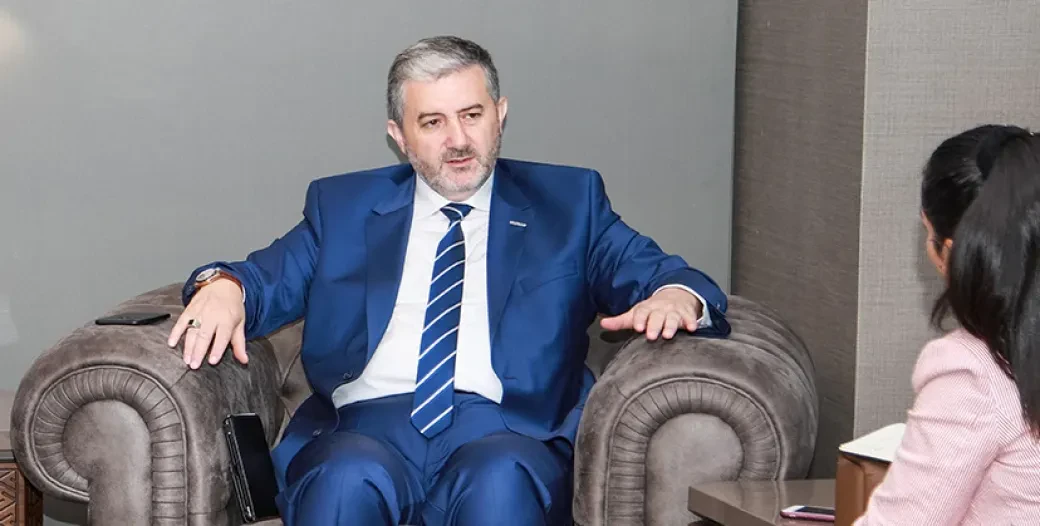
MÜSİAD President Abdurrahman Kaan pointed out that, following the transition to the Presidential system of government, the structures of business world organizations in the field of economy must change, and said, “The system has been very well established, but in practice some stopgap measures are needed, particularly in the field of economy. For the system to operate as it should, business world organizations such as chambers and commodity exchanges must also renew themselves. We need a business world structure that is in line with the fundamental policy change at the top, that sees the problems in the field and produces solutions.”
The President of the Independent Industrialists and Businessmen Association (MÜSİAD), Abdurrahman Kaan, said that in order for Türkiye to achieve its targeted development drive, business world organizations must attain a form that will work in greater harmony with the state institutions renewed after the Presidential system of government. Pointing out that a more dynamic structure has been created within state institutions under the new system but that the business world is currently struggling to adapt to it, Kaan said, “When you look at why trade and investment are not progressing at the targeted pace today, I can easily say that business world organizations which have failed to renew themselves have a large share in this. While the world is changing and the model of government in Türkiye is changing, our civil society organizations must change themselves as well.” Emphasizing that under the Presidential system of government there is now a different state structure consisting of more dynamic ministries, high boards, offices and institutions affiliated with them that act more swiftly, Kaan said, “The system has been very well established, but in practice some stopgap measures are needed, particularly in the field of economy. Professional associations must change structurally and institutionally. For the system to operate as it should, business world organizations such as chambers and commodity exchanges must also renew themselves. We need a business world structure that is in line with the fundamental policy change at the top, that sees the problems in the field and produces solutions.”
We Must Not Expect Everything from the State
Pointing out that in Türkiye, which aims to increase its global competitiveness in the new period, the business world organizations that will give momentum to growth are in need of a serious transformation and that not everything should be expected from the state, Kaan explained to Hürriyet the renewal process launched in this context by MÜSİAD, which is approaching its 30th year. Stating that MÜSİAD has also launched a renewal process in order to attain a structure that will work in harmony with the change in the state, Kaan said: “In our renewal motto we defined our philosophy as ‘business development, business environment development’. We adopted a committee approach instead of sector boards. We also changed our management structure. We created a structure we call the sun-layered management model, in which each unit is closer to the centre and in more frequent communication with one another.” Noting that MÜSİAD has moved to a project-based system in the new period, Kaan said: “We say that for Türkiye it is now time to work, not to talk. We say that the power of money is determined by the production power of the country, and we believe that the necessary steps for this must also come from the business world. In this context we established our national production committee, which we gathered under the headings of trade, partnership and investment. We address many topics such as the domestic automobile, unmanned aerial vehicles and agricultural production under this committee. We have also established committees in different fields, such as the new tourism resources development committee and the new cities and industrial estates committee.”
Matching Brand Cities with Their Counterparts
Noting that they have launched a city economies project in order to turn cities into brands, Abdurrahman Kaan said, “We matched the brand cities of the world with our own cities by considering many aspects such as geography, population density, production and income sources. We developed development projects compatible with our economy and our cities. In this context İstanbul-New York (USA), İzmir-Melbourne (Australia), Antalya-Los Angeles (USA), Mardin Granada (Spain), Adana-Sdyney (Australia), Samsun-Hamburg (Germany), Erzurum-Salzburg (Austria), Balıkesir-Seoul (South Korea), Tekirdağ-Rotterdam (Netherlands), Mersin-Singapore (Singapore), Sakarya-Busan (South Korea).”
Polarization in the Field of Capital Must Be Eliminated
Stating that they define MÜSİAD as a capital base, Abdurrahman Kaan said: “As a capital base, we said let us put forward an original capital. In order for capital to grow stronger, we are developing projects for national economic goals under the heading of the nationalization of capital. We are developing new projects under headings such as the strengthening, nationalization, reform and maturing of capital. There is no synchronization of capital in Türkiye. The polarization of capital must be eliminated. We are in talks with YASED and we are looking at what we can do together with TÜSİAD. Capital must act together in this process. You cannot get anywhere by polarizing; companies may compete with one another, but in terms of mindset it is necessary to act together in capital.”
The President of the Independent Industrialists and Businessmen Association (MÜSİAD), Abdurrahman Kaan, said that in order for Türkiye to achieve its targeted development drive, business world organizations must attain a form that will work in greater harmony with the state institutions renewed after the Presidential system of government. Pointing out that a more dynamic structure has been created within state institutions under the new system but that the business world is currently struggling to adapt to it, Kaan said, “When you look at why trade and investment are not progressing at the targeted pace today, I can easily say that business world organizations which have failed to renew themselves have a large share in this. While the world is changing and the model of government in Türkiye is changing, our civil society organizations must change themselves as well.” Emphasizing that under the Presidential system of government there is now a different state structure consisting of more dynamic ministries, high boards, offices and institutions affiliated with them that act more swiftly, Kaan said, “The system has been very well established, but in practice some stopgap measures are needed, particularly in the field of economy. Professional associations must change structurally and institutionally. For the system to operate as it should, business world organizations such as chambers and commodity exchanges must also renew themselves. We need a business world structure that is in line with the fundamental policy change at the top, that sees the problems in the field and produces solutions.”
We Must Not Expect Everything from the State
Pointing out that in Türkiye, which aims to increase its global competitiveness in the new period, the business world organizations that will give momentum to growth are in need of a serious transformation and that not everything should be expected from the state, Kaan explained to Hürriyet the renewal process launched in this context by MÜSİAD, which is approaching its 30th year. Stating that MÜSİAD has also launched a renewal process in order to attain a structure that will work in harmony with the change in the state, Kaan said: “In our renewal motto we defined our philosophy as ‘business development, business environment development’. We adopted a committee approach instead of sector boards. We also changed our management structure. We created a structure we call the sun-layered management model, in which each unit is closer to the centre and in more frequent communication with one another.” Noting that MÜSİAD has moved to a project-based system in the new period, Kaan said: “We say that for Türkiye it is now time to work, not to talk. We say that the power of money is determined by the production power of the country, and we believe that the necessary steps for this must also come from the business world. In this context we established our national production committee, which we gathered under the headings of trade, partnership and investment. We address many topics such as the domestic automobile, unmanned aerial vehicles and agricultural production under this committee. We have also established committees in different fields, such as the new tourism resources development committee and the new cities and industrial estates committee.”
Matching Brand Cities with Their Counterparts
Noting that they have launched a city economies project in order to turn cities into brands, Abdurrahman Kaan said, “We matched the brand cities of the world with our own cities by considering many aspects such as geography, population density, production and income sources. We developed development projects compatible with our economy and our cities. In this context İstanbul-New York (USA), İzmir-Melbourne (Australia), Antalya-Los Angeles (USA), Mardin Granada (Spain), Adana-Sdyney (Australia), Samsun-Hamburg (Germany), Erzurum-Salzburg (Austria), Balıkesir-Seoul (South Korea), Tekirdağ-Rotterdam (Netherlands), Mersin-Singapore (Singapore), Sakarya-Busan (South Korea).”
Polarization in the Field of Capital Must Be Eliminated
Stating that they define MÜSİAD as a capital base, Abdurrahman Kaan said: “As a capital base, we said let us put forward an original capital. In order for capital to grow stronger, we are developing projects for national economic goals under the heading of the nationalization of capital. We are developing new projects under headings such as the strengthening, nationalization, reform and maturing of capital. There is no synchronization of capital in Türkiye. The polarization of capital must be eliminated. We are in talks with YASED and we are looking at what we can do together with TÜSİAD. Capital must act together in this process. You cannot get anywhere by polarizing; companies may compete with one another, but in terms of mindset it is necessary to act together in capital.”