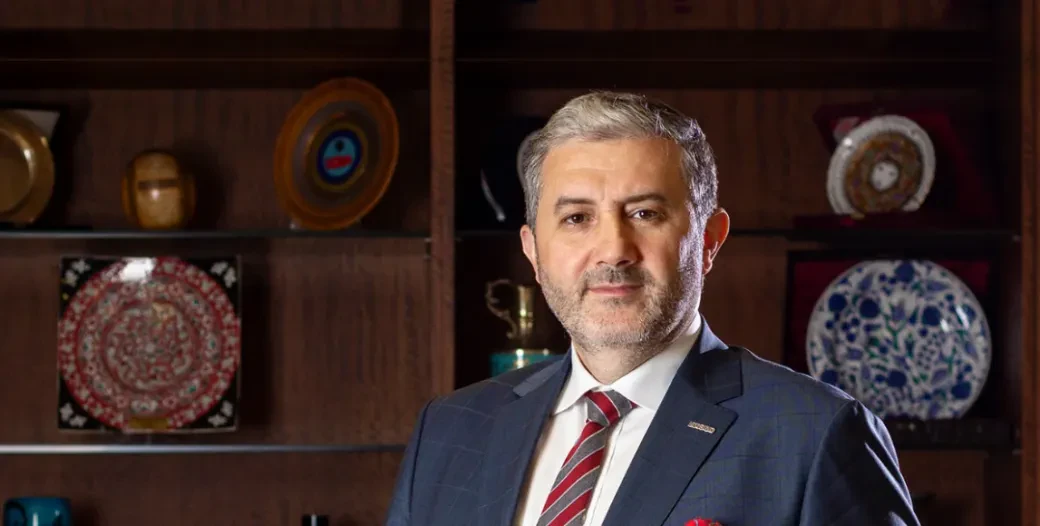
Abdurrahman Kaan, President of the Independent Industrialists and Businessmen Association (MÜSİAD), shared comprehensive assessments with Dünya Newspaper on the developments in the Eastern Mediterranean, Türkiye’s energy needs, the targets planned for the energy sector in line with the 2023 Vision, and Türkiye’s oil exploration activities
Noting that energy-focused steps that have gradually escalated tensions have recently been taken in the Eastern Mediterranean along the axis of Israel, Egypt, the Greek Cypriot Administration of Southern Cyprus (GCASC), Greece, Lebanon, Syria and most recently Libya, President Abdurrahman Kaan pointed out that recent history must be examined closely in order for the process to be handled soundly.
Stating that, on the matter of the energy resources in the Mediterranean, the GCASC has acted since the early 2000s by disregarding the TRNC, which has a say on the island, and Türkiye, which has the longest coastline in the Eastern Mediterranean, Kaan emphasized that the Greek Cypriot administration unilaterally divided the region into 13 parcels through the so-called Exclusive Economic Zone (EEZ) delimitation agreements it signed with Egypt in 2003, with Lebanon in 2007 and with Israel in 2010.
Emphasizing that, of the EEZ parcels declared by the GCASC, parcels numbered 1, 4, 5, 6 and 7 off the south-west of Cyprus overlap with the Turkish continental shelf, while parcels numbered 2, 3, 8, 9, 12 and 13 overlap with the areas claimed by the TRNC, Kaan stated that this situation is not an acceptable one for Türkiye and the TRNC.
Touching on the fact that the United States, Russia, the United Kingdom, France and Italy also carry out activities in the region with international energy companies despite having no border with it, Kaan spoke as follows:
Attempts Are Being Made to Exclude Türkiye
“With the navies of the relevant states being deployed in the Eastern Mediterranean in order to provide assurance to the Italian ENI, the French Total, the Russian Novatek and the US companies Noble Energy and Exxon Mobil, which were granted drilling permits in the so-called EEZ areas in the region, and with the EU’s statements of support for its member the GCASC, the Eastern Mediterranean has become an important centre in which many countries want to have a say.
Among the countries bordering the Eastern Mediterranean, Israel’s energy companies Delek and Avner are located in the so-called parcel 12 together with their US partner Noble Energy. The Israeli-US partnership, which discovered many natural gas fields in the said area, made the discovery of the Tamar field with a reserve of 280 billion cubic metres off the coast of Israel in 2009 and of the Leviathan gas field of 620 billion cubic metres in 2010.
Israel, which has taken steps in a regional direction in natural gas exports, wants to implement a pipeline project called East-Med together with Greece and the GCASC that will send gas beneath the Mediterranean to Greece and from there to Europe. Israel, which established close contacts with Türkiye when the project first came onto the agenda because of the fact that the most economical and logical route passes through Türkiye, subsequently formed alliances aimed at excluding Türkiye by also seeking the support of the United States in the region.”
Türkiye’s Peaceful Solution Proposals Have Been Ignored
Noting that Türkiye has taken measures in order to protect its sovereign rights arising from international law and, owing to its guarantor responsibility in Cyprus, the rights of the Turkish Cypriots as well, Kaan emphasized that the TRNC and Turkish governments have sought peaceful solutions and made numerous solution proposals despite the unilateral initiatives of the GCASC.
Pointing out that all well-intentioned solution proposals were left inconclusive by the Greek Cypriot administration, Abdurrahman Kaan stated that Türkiye, by increasing its presence and economic activities in the region, has responded with firm moves to the manoeuvres aimed at encircling it in the Mediterranean, severing its ties with the island of Cyprus and seizing its energy resources.
Kaan emphasized that Türkiye, on entirely justified grounds, has assigned the drilling vessels Fatih and Yavuz, and the seismic survey vessels Barbaros Hayreddin Paşa and Oruç Reis to carry out hydrocarbon operations, and that it is highly important that the AK Party, the MHP, the CHP and the İyi Party, which have groups in the Grand National Assembly of Türkiye, support this stance displayed by the government.
Türkiye Must Turn Its Geopolitical Position into an Advantage for Our National Interests
Noting that energy demand is gradually increasing all over the world in parallel with the growing population and industrialization, President Kaan stated that this situation will be even more pronounced particularly in developing countries.
Noting that the increase in transport carried out via Eurasia has become highly important for our country, Kaan emphasized that Türkiye, with its strategic position, serves transit through both land and strait traffic.
Emphasizing that Türkiye is located in a dangerous geopolitical position in terms of its close border relations and alliances, Kaan noted that, in the face of developments such as the ethnicity problems that have become increasingly evident in recent times, the separatist ethnic movements that have become politicized in Europe, the EU process and the growing Chinese influence in international trade and within the WTO, the risks and opportunities that “Türkiye’s bridge identity” imposes on Türkiye must be analysed very well so that the risks are minimized or neutralized, while the opportunities are developed and updated so that they can be used in line with our national interests.