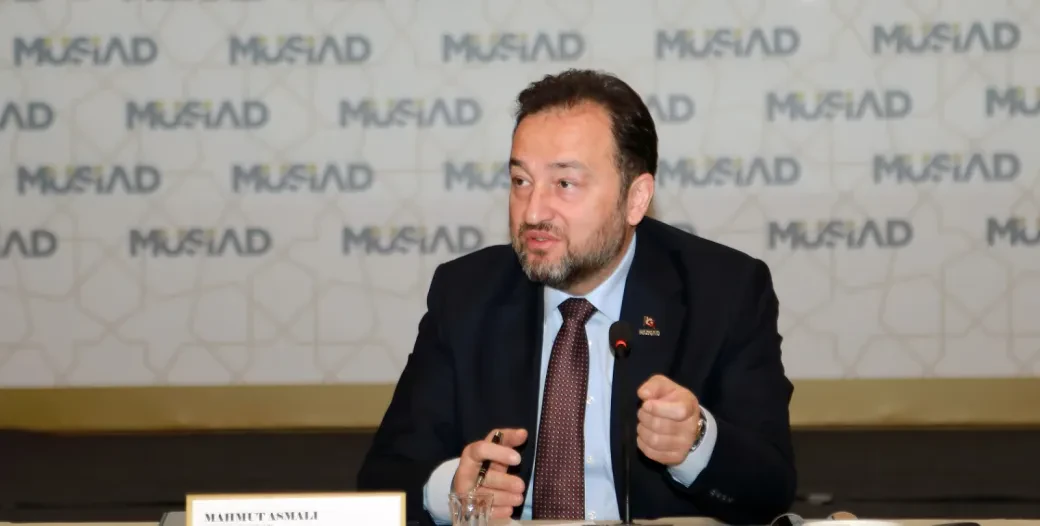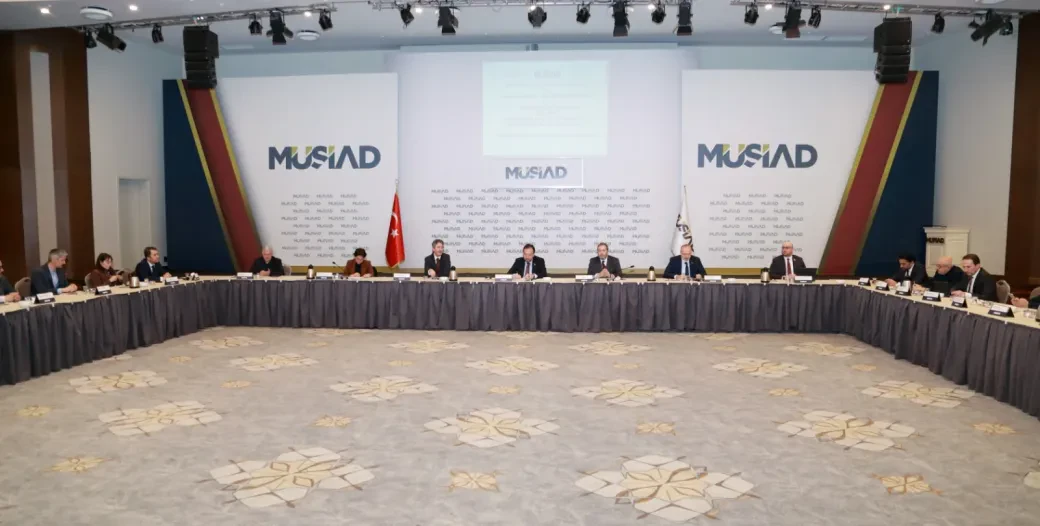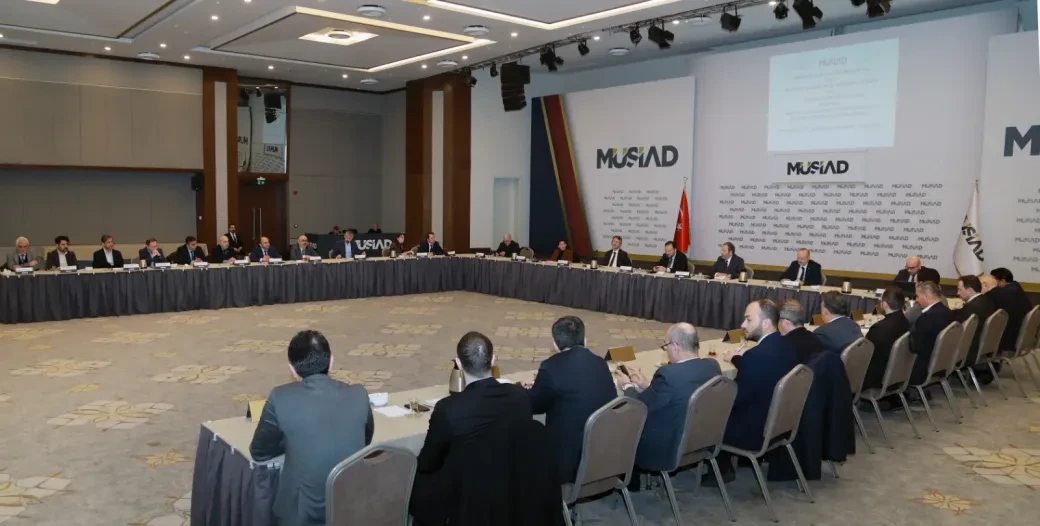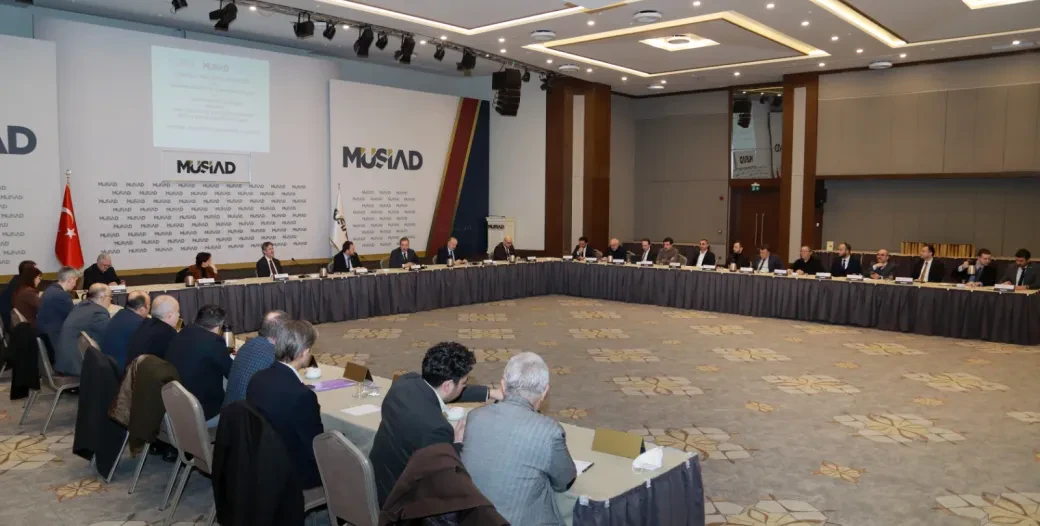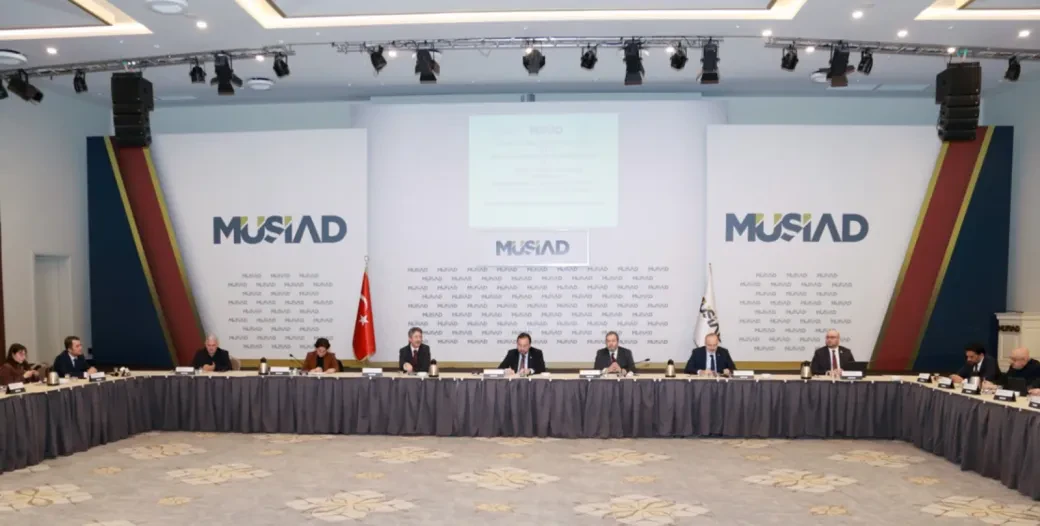
The Akhi Culture and National Production Movement Workshop was organized hosted by MÜSİAD, with the participation of MÜSİAD President Mahmut Asmalı, İstanbul Director of National Education Levent Yazıcı and Education Support Platform İstanbul Branch President Seçkin Turan. President Asmalı, who shared his assessments at the program, drew attention to the importance of Akhi culture and shared MÜSİAD's work in this field.
The Akhi Culture and National Production Movement Workshop was organized hosted by the Independent Industrialists and Businessmen Association (MÜSİAD). At the event, held with the participation of MÜSİAD President Mahmut Asmalı, İstanbul Director of National Education Levent Yazıcı and Education Support Platform İstanbul Branch President Seçkin Turan, assessments regarding the reflections of Akhi culture in the business world were discussed. Speaking at the program, President Asmalı referred to the protocol signed between the İstanbul Directorate of National Education, the Education Support Platform and MÜSİAD, and said: "We wish to contribute to our young people being raised within Akhi culture and with a national understanding, and to support the raising of morally upright young people skilled in the professions the business world is looking for."
"Akhi tradition provides an important reconciliation both among tradesmen and between tradesmen and citizens"
Stating that Akhi culture establishes an important mechanism of reconciliation both among tradesmen and between tradesmen and citizens, President Asmalı made the following assessment: "The Akhi institution builds an ecosystem that encompasses all segments of the business world in both horizontal and vertical dimensions, and that addresses gains and losses at the personal, corporate, social and universal levels on the same axis."
President Asmalı continued as follows:
"The Akhi vision, which assumes an important mission in the evolution of economic and commercial life towards a structure with far greater added value, paves the way for honest and principled trade while also developing the social system and morality. Akhi tradition provides an important reconciliation both among tradesmen and between tradesmen and citizens. It guides the just and sustainable advancement of trade and craftsmanship. When we look at the historical development of the Akhi tradition, it is striking that it had a mission such as easily finding work for the many craftsmen among the Turkmens who migrated from Central Asia to Anatolia; enabling these people to compete with the local Byzantine craftsmen in Anatolia; preserving the quality of the goods produced in order to hold on in the market; and adjusting production according to need. Instilling the ethics of craft in craftsmen, making the people economically independent, and helping those in need in every field are among the most important components of Akhi culture. The Akhi institution builds an ecosystem that encompasses all segments of the business world in both horizontal and vertical dimensions, and that addresses gains and losses at the personal, corporate, social and universal levels on the same axis. Nourished by the cultural and spiritual values our society has carried from the past to the present, it opens the way to the formation of a common business ethic and business model."
"We wish to support the raising of young people skilled in the professions the business world is looking for"
In his speech, President Asmalı stated that as MÜSİAD they attach importance to the cooperation protocol signed with the İstanbul Directorate of National Education and the Education Support Platform, and said: "We wish to contribute to our young people being raised within Akhi culture and with a national understanding, and to support the raising of morally upright young people skilled in the professions the business world is looking for."
President Asmalı continued his remarks as follows:
"As a result of the changes made in vocational education, regulations were adopted in favour of employers and employees. With the changes made, the state took over the employer's burden. Thus our state removed a burden of TRY 1-2 billion from the employer. There are 256 organized industrial zones in Türkiye. Vocational training centres existed in 87 of these OIZs. At the end of 2021, vocational training centres were established in all OIZs. If there is a master trainer at an enterprise, that enterprise will be able to take on 40 apprentices. In the coming years, a far greater added value will be built in the Turkish economy through investments that strengthen the master-apprentice relationship. The number of students studying at vocational training centres is projected to reach 500 thousand in May 2022. Following these regulations, we will see the number of apprentices employed in different sectors multiply rapidly. MÜSİAD's signing of the Akhi Culture and National Production Movement Cooperation Protocol with the İstanbul Provincial Directorate of National Education and the Education Support Platform is another reflection of this perspective. The protocol, prepared taking into account the needs of the labour market, will ensure that topics focused on technology, equipment, human resources, R&D, production and the like required for the creation of the needed qualified workforce, as well as work related to Akhi culture, are placed on the agenda and evaluated in a multidimensional manner. The scope of the protocol has been determined as the renewal of the education and training programs given in schools so as to cover Akhi culture, the preparation of a curriculum for presenting Akhi culture as course content, and the preparation of the materials required for this education and their submission to the ministry. Within the scope of the signed protocol, training sessions will be organized in schools to introduce Akhi culture to teachers and students. We wish to contribute to our young people being raised within Akhi culture and with a national understanding, and to support the raising of morally upright young people skilled in the professions the business world is looking for."
"An education process equipped with Akhi culture will in itself be a great gain"
İstanbul Director of National Education Levent Yazıcı, who took the floor at the program, pointed out that education processes equipped with Akhi culture would in themselves be a great gain, and made the following assessment: "In line with the objectives of our ministry, with an integrated structure that puts forward a new vision in vocational education through a new perspective that we will integrate with the sector, we aim for a wholesale change together with the schools we work with. We assumed that within the scope of the current protocol we could realize the new initiatives we target in vocational education and that our youth, by adopting the values of Akhi culture, could contribute to a new model with a multifaceted business ethic and family life. Work aimed at developing vocational and technical education is very important for our strong tomorrows. The outputs of the process of updating framework curricula that incorporate Akhi culture and preparing educational materials will truly be a great gain in themselves."
Education Support Platform İstanbul Branch President Seçkin Turan, who drew attention to the importance of interinstitutional work within the scope of the event, said: "It is important to carry out curriculum preparation work shaped by Akhi culture, to prepare educational content and to create internship opportunities. The protocol will make a great contribution to raising the qualified workforce the sector needs and to the vocational activities and projects to be undertaken for technical education."