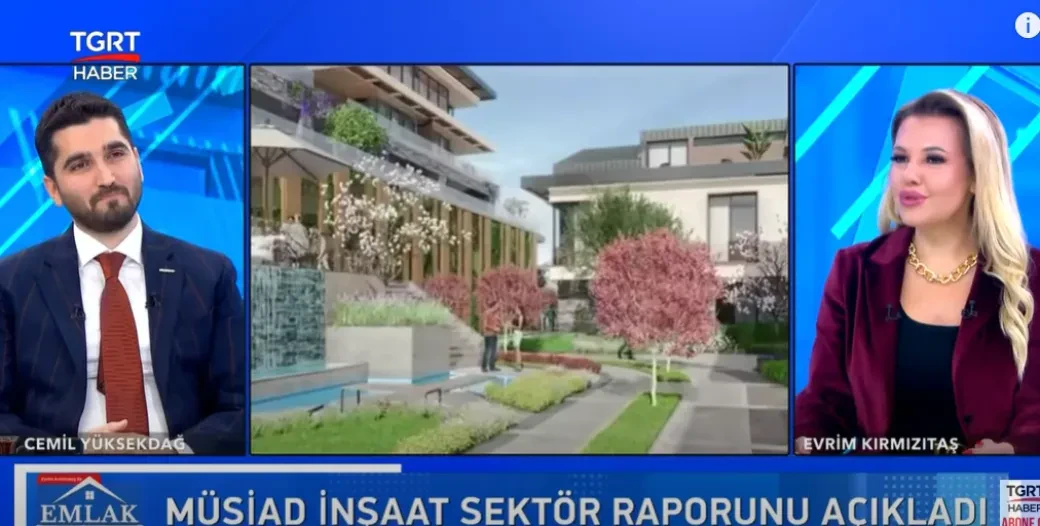
The MÜSİAD (Independent Industrialists and Businessmen Association) Construction and Building Materials Sector Board, which in 2024 researched many issues by meeting with experienced sector representatives, from the construction and real estate sector, housing production and financing problems to the increasingly growing housing problem and the earthquake reality of İstanbul, which has become a metropolitan city, announced its report.
Construction and Building Materials Sector Board Chairman Cemil Yüksekdağ, who was a guest on the Emlak Dünyası programme with Evrim Kırmızıtaş, gave information about the report entitled “Accessibility to Housing: Problems and Solution Proposals”.
Yüksekdağ: “There is a decline in the number of construction permits obtained for new housing production”
MÜSİAD Construction and Building Materials Sector Board Chairman Cemil Yüksekdağ, who prepared the report, said, “In 2025 the sales figure is expected to approach 1.5 million. The annual new housing need in our country is between 800,000 and 1 million. Owing to rising construction costs, decreasing land stocks and the contraction of the sector in recent years, a decrease is also observed in production. Over the last five years the number of construction permits obtained for new housing production has fallen to 400,000-500,000 units.”
“Mass migration and sudden housing demand have magnified the problems”
The reasons increasing the housing need in Türkiye were listed in the report as population growth, migration movements, urbanization, the rapid movements experienced in the migrant population such as refugees and asylum seekers in recent years, and the economic problems experienced. In addition, the report stated: “The mass migration affected by the recent Kahramanmaraş-centred natural disaster we experienced and the sudden housing demand have caused the problem to grow even further. On the other hand, the ageing of the existing housing stock and unplanned construction are effective in the growth of the housing problem and in the increase of the housing deficit.”
“Reverse migration from İstanbul must be a state policy”
A separate heading was also devoted to İstanbul in the prepared report. It was emphasized that the inadequacy of the existing housing stock makes access to housing and a suitable rental environment more difficult: “The housing sector is going through a serious bottleneck and the shelter problem is becoming a more serious problem with each passing day. The failure of incomes to keep up with rising prices has also made access to rental housing more difficult, especially in large metropolises. İstanbul, which faces earthquake risk and hosts millions of migrants within it, must urgently be removed from being a centre of attraction, and turning Anatolia into a centre of attraction through a reverse migration initiative must be addressed as a state policy.”
“Existing housing finance models cannot solve the problems under today's conditions”
In the report, which included the view that “it is also a fact that the banking-indexed housing finance models currently being implemented are far from being a remedy for problems, especially in periods when economic indicators worsen”, it was noted that the “closed pool” housing finance system, which envisages the use of interest-free credit, has attracted the interest of citizens in recent years. In addition, it was conveyed that the staged home ownership system led by companies developing branded housing, the “first the land, then home ownership” model, is also being implemented as a solution to the housing accessibility problem.
In the report of the MÜSİAD Construction and Building Materials Sector Board, the short and medium-term solution proposals for accessibility to housing were listed as follows:
- Appropriate financing conditions and models should be developed on both the consumer and the producer side for accessibility to housing.
- The way should be opened for savings in individual pension schemes to be transferred through the system (without the money being withdrawn) to project real estate investment funds for the purpose of buying a home.
- A structure in which, in urban transformation processes, the title deeds of rights holders are first transferred to the fund, the subsidy provided by the state under the “half from us” campaign is transferred to P-REIFs, and the fund shares are converted into title deeds after construction is completed, could accelerate urban transformation processes.
- Affordable housing production for middle-income groups through housing cooperatives can be redesigned.
- With a mechanism through which the state can supply land at more affordable prices to developers that will produce affordable housing, housing production costs can be brought down.
- In order for sustainable housing finance models to be put into practice, it is essential to reduce dependence on bank loans and to design capital-market-oriented investment and financing ecosystems in which savings are brought into the economy.