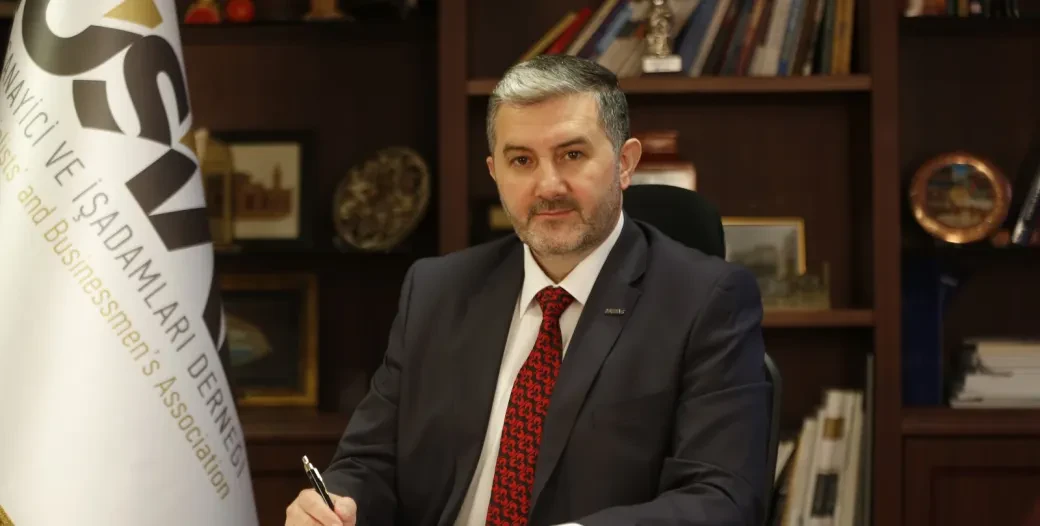
Türkiye, which is taking successive new steps in the field of the economy, plans to implement the 11th Development Plan and the New İstanbul Approach as well, alongside the declines experienced in interest rates and housing loans. MÜSİAD President Abdurrahman Kaan made important assessments regarding the reforms carried out in the field of the economy.
Türkiye continues to implement the reform packages prepared in the field of the economy. So how will the reform packages be reflected in Turkish industry? What is Türkiye's position in the trade wars? Abdurrahman Kaan, President of the Independent Industrialists and Businessmen Association (MÜSİAD), assessed the reforms carried out in the field of the economy.
Answering the questions of Ezgi Aşık from Aksam.com.tr, MÜSİAD President Kaan emphasized that the Turkish economy needs a brand-new motivation and a new leap forward. Kaan said: “In an environment where global trade wars have intensified to this degree, it is essential that we increase the performance of our export products in existing and new markets so that Türkiye, which delivered a very significant performance by carrying out USD 168.1 billion of exports throughout 2018, sustains this success.”
The 11th Development Plan was added this year as the newest of the reform packages carried out in the field of the economy. What effect will the plan have on the country's trade and industry?
We attach great importance to the 11th Development Plan, both in terms of its content and in terms of the period it covers. For besides containing the macro policies that will determine the new road map of the Turkish economy in its rebalancing process, the fact that the plan ends in 2023 further increases the importance of the 11th Development Plan. On this road leading to 2023, a strategic year in both political and economic terms, the vision drawn by the 11th Development Plan will be very important.
As MÜSİAD, during the preparation stage of this important plan, we conveyed our views on the new period's economic policies to the Presidency of Strategy and Budget and took an active role. On behalf of the business world, we view very positively the fact that the macro and micro scale targets and policies included in the plan are, on the one hand, realistic and down-to-earth in a manner suited to the realities of the Turkish economy, and on the other hand contain bold and innovative headings.
“It Will Be a Lifeline for the Real Sector”
How do you assess the New İstanbul Approach? What contribution will it make to the economy? Can indebted companies restructure themselves?
Companies' preference for taking on more debt in order to obtain financing, owing to the decline in profitability or equity capital, gives rise to serious problems in the medium and long term. For companies' greater preference for bank loans, and the increase in financing costs as loan use rises, unfortunately draw our companies into a vicious circle.
The fact that the New İstanbul Approach offers debt restructuring opportunities to companies that wish to repay their debts, and that, where deemed necessary, it also offers the opportunity to restructure companies' management structure and financial structure, is of the nature of a lifeline for the real sector. We believe that, in order for our companies' high indebtedness ratio to be brought down to far more reasonable levels in a sustainable manner, a market structure based not on debt but on partnership must be established. We believe that the steps taken along this path will pay off in the medium and long term, and that, thanks to the business people who will take part in the management and partnership process, new doors of opportunity will be opened to entrepreneurs and savers.
“It Has Led to a Revival in Domestic Demand”
How do you assess the reduction of interest rates on housing loans? Do you think the reduction of interest rates will continue? How will all these developments be reflected in the real estate sector?
The decision taken by the Central Bank of the Republic of Türkiye to cut the policy rate, and its reflections on market interest rates, have been a very positive development in terms of their effects on reviving domestic demand. The arrival of a record level of applications immediately after the decline in housing loans shows that there will be a serious revival in the real estate sector.
We estimate that the positive reflections on the real sector of interest rates, which we expect to be brought down gradually to lower levels in the period ahead, will continue. At the same time, we believe that we must by no means disregard the Interest-Free Housing Finance Systems, on which we as MÜSİAD have expended intense effort.
This system, in which the consumer obtains the right to receive a housing loan or other real estate loans in return for holding a deposit for a predetermined period, constitutes a very important alternative in housing finance. We attach great importance to the Interest-Free Housing Finance System in that, besides being a reliable and stable savings instrument, it also brings benefits such as increasing the national savings level, providing resources for housing finance, contributing to financial stability in the medium and long term, and enabling low-income earners to acquire affordable housing.
“We Must Increase Our Production-Oriented Policies”
What kind of position does Turkish trade hold within world trade? What path are we following with the reform packages that have been carried out? What kind of profile do we as Türkiye present in a world economy marked by trade wars?
We have witnessed that the negative effects of the 2008 global crisis on trade policies have not been completely overcome and that, as a consequence, the reorganization of international trade and the emergence of new rules have dragged the global system into a tension described as “trade wars”. In this context, in the post-global-crisis period in which protectionist policies have increased, the manner in which countries intervene in trade is a matter that must be followed very sensitively.
We must determine very well which types of practices in global trade cause the greatest restrictive effect on our country's export products. In an environment where global trade wars have intensified to this degree, it is essential that we increase the performance of our export products in existing and new markets so that Türkiye, which delivered a very significant performance by carrying out USD 168.1 billion of exports throughout 2018, sustains this success. In order to surpass this performance and attain a sustainable structure, we must continue on our way by increasing our production-oriented policies.
“The Economy Needs New Motivation and a New Leap”
How do you assess the country's economy? What are the market's expectations? Can the Turkish economy return to a growth process with the reform packages that have been carried out?
The Turkish economy needs a brand-new story, motivation and leap forward. The most important pillars of the reform process that will make this achievable will be discourse, policies and the implementation of those policies. In this context, we believe that the Turkish economy, in its rebalancing process, will enter a rapid development process thanks to the dynamic structure of the new system of government.
We regard the two-year period covering 2019 and 2020 as highly critical on the path of development. We think that, along with the series of announced reform packages and with the interest rate cuts, which we believe will continue gradually, increasing their effect, all the measures taken by the economic administration to revive domestic demand will be reflected positively in the economy, particularly from the final quarter of the year onwards.
“We Have Work Under Way for Those Who Invest in Türkiye”
As MÜSİAD President, what are the projects you are trying to implement in the near future
As MÜSİAD, we have entered a new structuring that we call renewal. We have completed our 29th year; we have established a new understanding and a new philosophy in Türkiye. We created a new management model, and we named it the solar system. It is a first in the world, and I think it will be a model for Türkiye. There is again a central structure, but it is a more project-oriented undertaking with a philosophy of its own.
Here it comes under the main philosophy of business development and business environment development. At the same time, under the heading of planning and implementation, we have brought a new understanding to Türkiye with a new structuring model that we divide into assembly and field, in which the high boards are again included but, subordinate to them, under thematic and semi-thematic names.
We have an undertaking that we call MÜSİAD INVEST. We have this work particularly as a unifying force in investment, that is, for those abroad who invest in Türkiye. Again, in connection with the renewal process, there are those who come to make very serious investments, and we meet with them. We even work in that field down to their residence in Türkiye. With MÜSİAD ACADEMY we are carrying out very serious work on training qualified business people. As a capital base, MÜSİAD, with our projects in every respect, will both bring gains to and develop its members and serve its country, and at the same time, together with this integration in the world, we are also localizing the investors who will come.