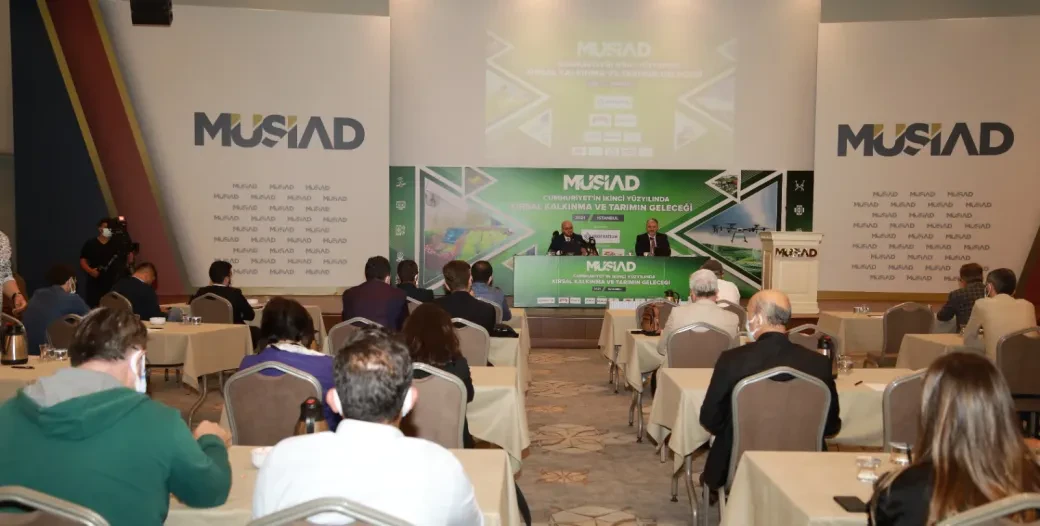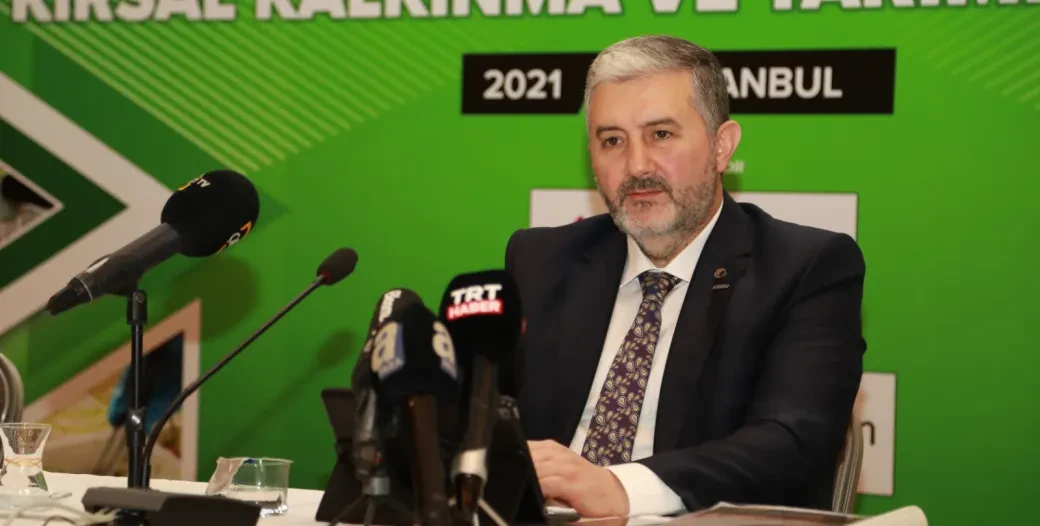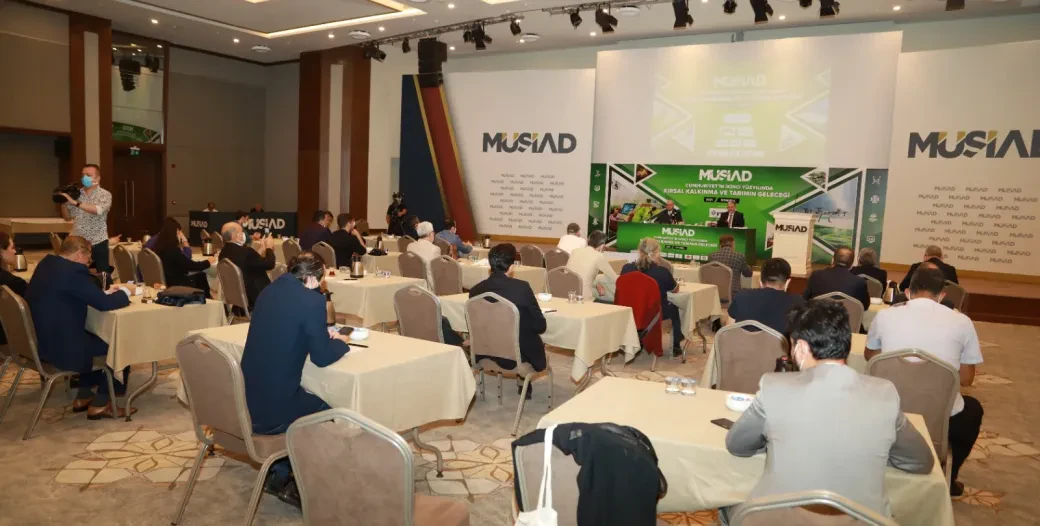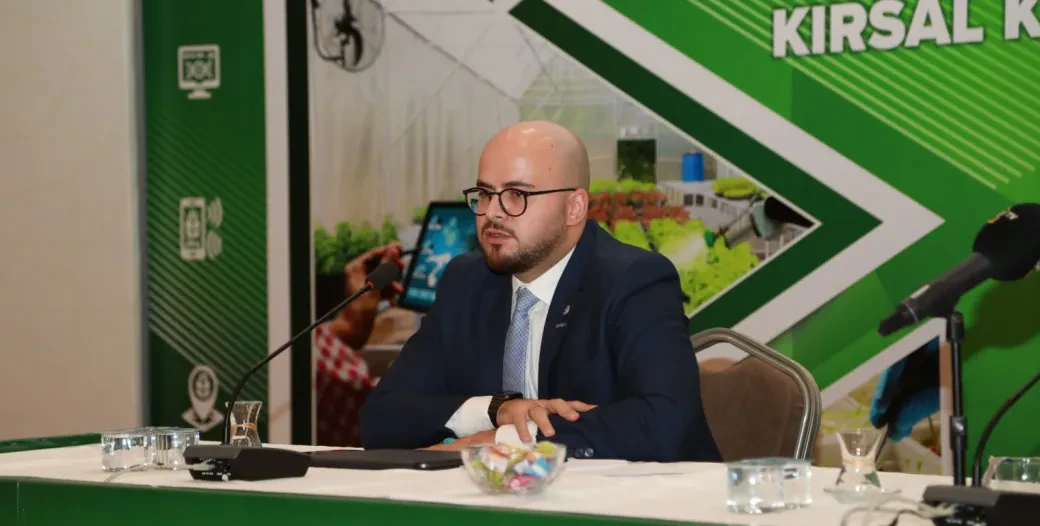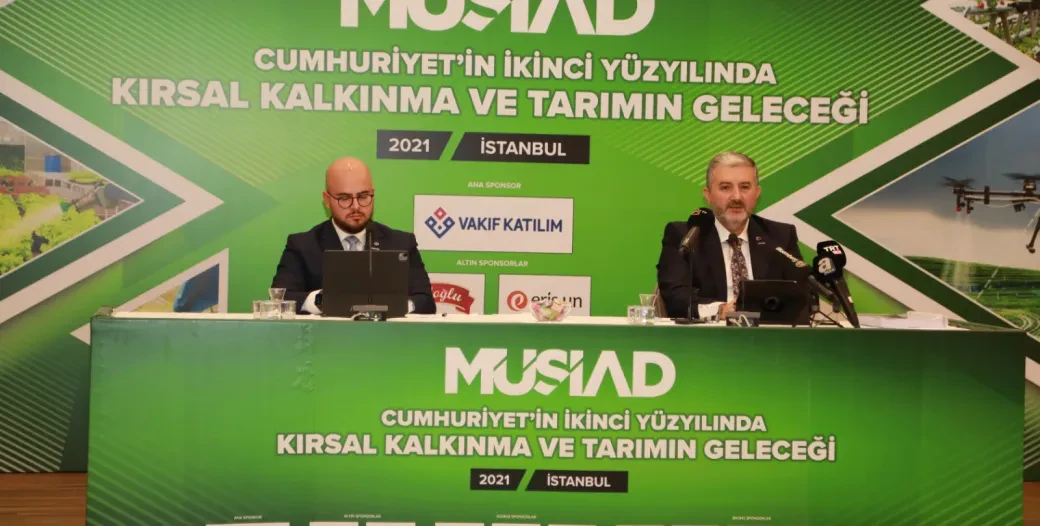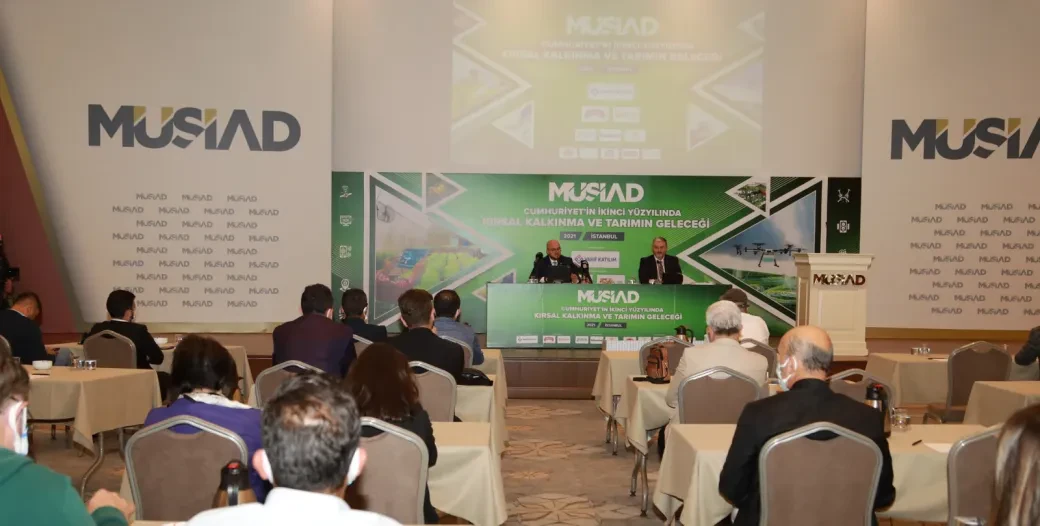
The Independent Industrialists and Businessmen Association (MÜSİAD) announced, at a press conference held at the MÜSİAD Head Office, the innovative data relating to the ‘Report on Rural Development and the Future of Agriculture in the Second Century of the Republic’, which was prepared under the leadership of the MÜSİAD Rural Development Committee with the support of academics who are experts in their field and which takes the pulse of the agricultural sector.
The ‘MÜSİAD Agriculture 2021 Report’ presented, alongside forecasts that will shape the future of the agricultural sector, important clues about the opportunities Türkiye has in agricultural production. The report, which contains many topics falling within the agricultural ecosystem such as seed production, crop production, livestock farming and fisheries, also shed light on technical fields such as breeding work and mechanization in agriculture. The ‘Report on Rural Development and the Future of Agriculture in the Second Century of the Republic’, which analyses the opportunities in the agricultural sector and guides investors and entrepreneurs wishing to accelerate their investments in this field, also addressed the topics of qualified migration, rural development, the European Union and the Green Deal. Proposals and strategies for the future were handled in a way that encompasses the stakeholders of the sector.
AN INNOVATIVE ROADMAP WAS PRESENTED
The results of the ‘MÜSİAD Agriculture 2021 Report’, in which future trends that will shape the tomorrow of the agricultural sector — such as the future of seed technologies, new opportunities in livestock farming, organic and ecological livestock farming, smart farms, animal breeding and new breeds, fisheries, organic agriculture, vertical farming and urban farms, system components in environmentally controlled agriculture, digital agriculture and forestry — were analysed, presented an innovative roadmap to all stakeholders of the Turkish agricultural sector as to which strategies should be invested in during 2021 and beyond.
“WE MUST TURN OUR FACE TO THE COUNTRYSIDE”
Stating that agricultural production holds a very important position in terms of countries' external dependency and self-sufficiency, MÜSİAD President Abdurrahman Kaan said: “We must break free from the situation of recent times, in which we have drifted away from the production mentality in the countryside, and focus on projects that increase productivity. The population of Türkiye is expected to reach 110 million in 2040. Taking this population as a basis, we are examining one by one the regions where agricultural production and livestock farming will be carried out.” Underlining that, in order to achieve rural development, it is first of all necessary to make progress in food, agriculture, livestock farming and forest products, Kaan continued as follows: “There are 7 thousand varieties of seed in the fertile lands of Anatolia. Being able to pass this wealth on to future generations is of vital importance. There is serious competition in the world in the production of value-added products. In the agricultural sector too we must advance with the power of technology and act with an understanding of rural transformation as we undertake new projects. For this reason, we must turn our face to the countryside.”
“THE SECTORS THAT EARN TÜRKİYE NET FOREIGN CURRENCY ARE FOUND ONLY IN THE CATEGORY OF AGRICULTURE AND AGRICULTURE-BASED INDUSTRY”
Also sharing current data on Türkiye's agricultural potential, Kaan said: “Agricultural exports, which stood at USD 22.7 billion in 2018, reached USD 23.4 billion in 2019, USD 24.4 billion in 2020 and USD 15.6 billion in the January-July period of 2021. Türkiye has crop product exports at the level of USD 16.4 billion. Wood and forest product exports follow the crop product group with USD 5.6 billion. Animal product exports, on the other hand, stood at the level of USD 2.5 billion. Agriculture-focused industrialists carry out 30 percent of Türkiye's exports. The sectors that earn Türkiye net foreign currency, that is, those that do not run a trade deficit, are found only in the category of agriculture and agriculture-based industry.”
“TECHNOLOGY TRANSFER OFFICES AND TECHNOPARKS MUST BE SUPPORTED”
Emphasizing that the agricultural technology sector must be institutionalized in order to develop agricultural capacity, Kaan continued his remarks as follows: “For this purpose, technology transfer offices and technoparks must be supported.One of the most critical issues in agriculture is to carry out production planning correctly. Assessing regional conditions well and planning, several years in advance, production suited to the climate and soil structure of each region and, where possible, with high added value will both give us an export advantage and prevent the loss of land and time. Türkiye is one of the countries where family farms are most widespread. Providing the support policies necessary to ensure the sustainability of these farms will facilitate continuity and generational transfer in agriculture. Not only family farms; moving to a system of large farms through the consolidation of small plots of land where necessary, and securing the advantage of scale in agricultural production as well, is still one of Türkiye's most important problems. I would like to repeat a point that I have always raised: it is now essential that the grants and incentives provided by the state also be monitored in agricultural production, and that the concept of incentive efficiency be perceived and accepted as a component of production-investment-trade synchronization. In the green economy model, also referred to as low-carbon production, it is essential to prevent the waste or pollution of agricultural resources, to ensure that industrial production is built with respect for land structures in a way that does not disrupt agricultural production, and to build the infrastructure required for this, namely nature-respecting organized industrial zones (OIZs).As MÜSİAD, we have completed the first prototype of our project of medium-scale industrial estates that respect nature from their energy to their waste management, which we call SME Incubation Centres. This model has been accepted by the Ministry of Industry and Technology as a standard for all other OÖSS. Developments in the world over the last twenty years must be followed not only in mass agriculture but also in precision agriculture and even soilless agriculture applications, and areas for agricultural production must be built, whether enclosed or open, even in urban environments. Indeed, as part of city life, kits should be produced with which agricultural work can be carried out in narrow spaces at home or in the areas in front of the house. In this way, the urban population can be convinced both of the awareness of production before consumption and of how productive and enjoyable a job agricultural production is.”
“A COUNTRY THAT CANNOT PRODUCE FOR ITSELF IS DOOMED TO LOSE”
Saying that caution must be exercised regarding the global centres of power on the subject of agriculture and livestock farming, Kaan used the following expressions: “Even though Agriculture and Livestock Farming touch our lives at such a vital point, they unfortunately continue to lie at the centrifuge of the global centres of power and multinational companies. Their involvement in production to such an extent unfortunately both lowers food quality in the face of profitability and thereby triggers the diseases of the new century, and, most importantly, plays with the health of our children. For this reason, a country that cannot itself produce what comes to its own table is doomed to lose.”
“THE INVESTMENT PROCESS FOR CONCEPTS SUCH AS DIGITAL TRANSFORMATION, SMART AGRICULTURE AND VERTICAL FARMING MUST BE ACCELERATED”
MÜSİAD Rural Development Committee Chairman Abdullah Eriş, who said, “The United Nations (UN) predicts that the world population will increase by 40 percent in 2050 to reach 9 billion. The increase of the population by 3 billion people shows that 70 percent more food production will be needed in order to meet food demands”, made the following comment:
“The ‘Report on Rural Development and the Future of Agriculture in the Second Century of the Republic’, in which innovative and technological developments for the future are conveyed, revealed that the investment process for concepts that come to the fore in the agricultural sector, such as digital transformation, smart agriculture and vertical farming, must also be accelerated.”
“WITHIN THE FRAMEWORK OF THE HIGH WELFARE AND LIVING ECOSYSTEM, WE AIM FOR AN ECOSYSTEM THAT BRINGS TOGETHER THE OPPORTUNITIES FOUND IN THE CITY WITH THE NATURAL LIFE FOUND IN THE COUNTRYSIDE”
Eriş, who used the expression, “In the coming years, with natural and smart living projects, Türkiye will become one of the world's few countries with high production values, self-sufficient, producing and obtaining the highest yield from its lands”, said: “We plan for innovative developments in agriculture, together with agricultural modernization applications such as agricultural meteorology, early warning systems, irrigation and fertilization automation, smart fertilizer management, precision spraying and traceability software, and for environmental, technological and innovative principles, to be implemented in the ‘Smart Agricultural Cities’. Within the framework of the ‘High Welfare and Living Ecosystem’, we aim for an ecosystem that brings together the opportunities found in the city with the natural life found in the countryside.”
“THE 2023 AGRICULTURAL TARGET IS FOR TÜRKİYE TO BECOME ONE OF THE TOP 5 COUNTRIES IN TERMS OF PRODUCTION VALUES”
Underlining that the 2023 agricultural targets are for Türkiye to become one of the top 5 countries in terms of production values, Eriş emphasized that they are working for the revival of the economy, the protection of natural resources and the environment, and for the pressure on the city to decrease so that development in rural areas becomes effective.
You can review the report at https://tarimingelecegi.com/ .
Click here to watch the promotional video.