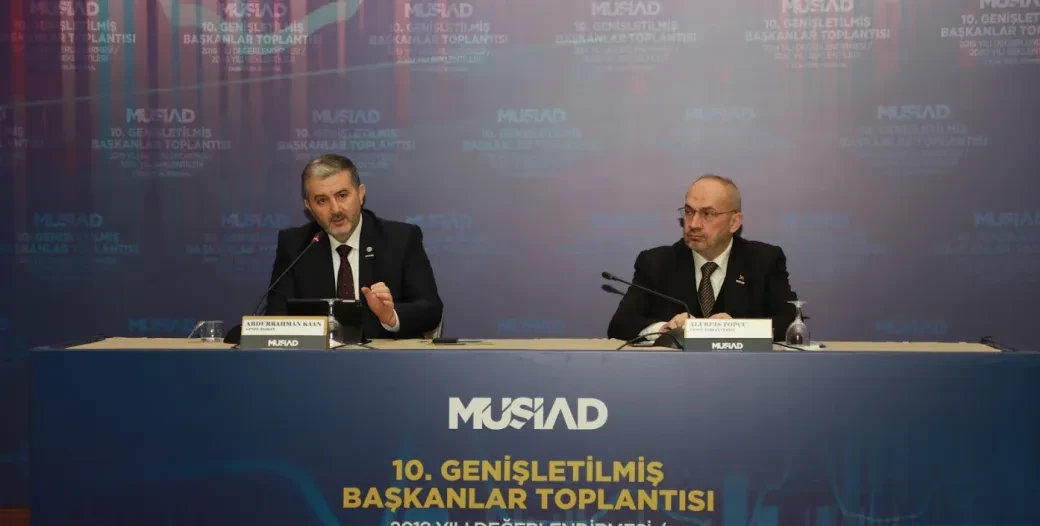
The 10th Extended Presidents Meeting of the Independent Industrialists and Businessmen Association (MÜSİAD) was held at the MÜSİAD Head Office under the chairmanship of President Abdurrahman Kaan
Within the scope of the 10th Extended Presidents Meeting, MÜSİAD's Türkiye Branch Presidents came together at the Head Office for the review of 2019 and the targets for 2020. Delivering the opening speech of the program, President Kaan said, "With both its geopolitical structure and its economy in a rebalancing process, Türkiye can be turned into a centre of attraction for the hot money in the region."
In his speech, Kaan shared his assessments on the global economy and the Turkish economy.
Stating that 2019, which passed with difficult and harsh socio-political, economic and political manoeuvres not only for Türkiye but all over the world, has forced the business world to be more prudent and more cautious in 2020, the President of MÜSİAD said, "At the same time, 2020 stands before us as a year in which our ability to react correctly and quickly in the face of change will also be tested."
Drawing attention to expectation management in the economy, Kaan said that keeping negative expectations and possibilities constantly on the agenda would bring no benefit to anyone.
Kaan noted the following:
"Among the foremost criticisms we have received recently are comments that we constantly maintain our optimistic attitude and do not point to problems. Let me state that, as MÜSİAD, we absolutely do not accept this. We argue that the atmosphere of inertia and tension that pessimistic pictures would create will undermine the positive trends alive in the economy.
Look, let us not forget that the pessimistic scenarios you place inside a well-functioning system will draw the well-functioning structures into a cycle of gloom as well. Of course, the Turkish economy is going through a difficult period. However, in these days when we have begun to clearly hear the footsteps of the global recession, every analysis made by singling Türkiye out is incomplete and manipulative, both in its good and in its bad aspects."
Stating that 2019 was a year of mass demonstrations and socio-economic strain, Kaan noted that since April the streets in Hong Kong had turned into a battlefield because of the controversial bill providing for the extradition of criminals to China, and that this region accounts for a significant portion of Türkiye's technology imports.
Stating that, according to unofficial figures, more than 500 demonstrators lost their lives in the protests that began in Iran because of the hike in fuel prices, Kaan said:
"Iran retains its status as a partner for many of our businesspeople for 2020, but the damage the embargoes have caused to our cooperation is also evident. The foreign policy adjustment that the American Senate is pursuing as an alternative to the presidential system may, under these conditions, bring us face to face with the United States once again. Looking at the matter solely through the axis of the S-400 defence systems would be a narrow analysis. The idea of a joint European Army that Macron proposed to Merkel, and Merkel's favourable view of the issue, are also among the signs showing that NATO will stand before us in 2020 with a new structure."
Conveying that, before the events in Iran began, President Recep Tayyip Erdoğan had put forward subtexts to the effect that events similar to those in Iraq could also be seen in Iran, Kaan said, "Under these conditions, the safe haven for Middle East capital will once again be the lands of Türkiye."
Explaining that the victory Türkiye has won both on the field and at the table has also opened the doors to a brand-new era for the reconstruction of Syria, Kaan said, "The demonstrations in both Iran and Iraq are read differently from the point of view of the business world. Everywhere in the world, social events shed their local identity within a short time and become the field of action of global dynamics. In such cases, risk and threat are read within the same sentence. With both its geopolitical structure and its economy in a rebalancing process, Türkiye can be turned into a centre of attraction for the hot money in this region."
Noting that Türkiye is a country with a very broad geopolitical hinterland, Kaan said, "While this situation is an opportunity for economic partnership options and commercial partnerships, it also brings with it a rather difficult struggle to ensure economic security."
"We congratulate our President for his political genius on the Libya issue"
Recalling the developments in the Eastern Mediterranean, Kaan said, "We congratulate and thank our esteemed President for his political genius on the Libya issue."
Recalling the saying "Geography is destiny", Kaan assessed, "In 2020 as well, Türkiye will continue, with increasing strength, to be the protector of oppressed geographies and the economic centrifugal field of the line stretching from Yemen to Libya, from Iran to Iraq and from Syria to North Africa in the Middle East."
Stating that North and Central Africa will be an area for drawing up a new trade plan, Kaan said, "The course of China's investments, particularly in Central Africa, within the scope of the Belt and Road Project is striking. The reconstruction of Central Africa is virtually being carried out through Chinese capital, and the logistics line passes through our country. Of course, being at the junction point of the Silk Road is important, but within the scope of the Belt and Road, Türkiye needs to review its brand of being a logistics country, and the extent to which the line will contribute to our industrial and production system must also be addressed in detail."
Stating that, as MÜSİAD, they will put two important foreign policy issues on the table with two comprehensive workshops in the first months of 2020 and examine their impact on production and trade, Kaan said, "One of these will be the analysis of our economic partnership with the EU, which will be restructured after the Brexit process; the second will be a workshop at which the advantages and threats of the Belt and Road line for our country's production, investment and industry will be put on the table. Because both phenomena contain outcomes that will affect our country's SME potential in particular and our motto of domestic and national capital."
"In 2020, the direction of the economy and trade will shift eastward"
Pointing out that it is now an undeniable fact that the direction of the economy and trade will shift eastward in 2020, Kaan continued as follows:
"I recommend being present as a much more active economic partner in the region with which we have historical and cultural ties, above all Uzbekistan. In mid-2019 we launched our work to activate an equivalent trade and investment network in 2020, not only in Central Asia but in the Balkan countries as well. As MÜSİAD, I declare before you that we will open a suitable trade and investment line for our members in this regard, and that we have completed a very comprehensive project in terms of content for this purpose."
Abdurrahman Kaan stated that they had shared with the relevant authorities the need to develop a sales-oriented and project-based incentive system, and that they would follow a much more active action plan in 2020 for the reorganization of the legislation on this matter.
"We will announce our Rural Towns project very soon"
Kaan said that with the Rural Towns project they will announce very soon, they will present the replanning of urban fabrics and the reverse migration that has begun as a solution that will establish new settlement areas, provide a much healthier and more homogeneous demographic distribution and at the same time increase employment.
Stating that the most vital issue here will be the regulation of the conditions of firms' access to financing, Kaan said, "Important responsibilities fall to state and government officials here. Encouraging domestic procurement will feed the appetite for production and investment in our SMEs and larger firms."
Stating that foreign manufacturers are still at the top of the list of preference for transport vehicles, Kaan said, "Yet using preference in favour of domestic firms both in the automotive supplier industry and in the transport vehicle infrastructure sectors is a matter also mentioned within the 11th Development Plan. We are of the opinion that it must be implemented without delay."
Conveying that the fact that bulk purchases or production tenders are still carried out with very large-scale firms continues to be a serious element of pressure for SMEs, which are the locomotive of both production and employment in the economy, Kaan said, "For this reason, we have established a system of medium-scale industrial zones in which SMEs will grow with a much healthier infrastructure and will be able to receive orders by acting together. Here, we aim to put the advantage of setting standards and being an accreditation body, which being a pioneer has given us, to work in favour of SMEs in 2020."
“The Safe Haven for Middle East CAPITAL Will Once Again Be the Lands of Türkiye”
News from MÜSİAD