Our President Abdurrahman Kaan said, "The digitalization process, if evaluated well, will also bring many advantages with it. Especially if the interest and appetite of our SMEs for digitalization increases, a significant productivity gain will be achieved in production."
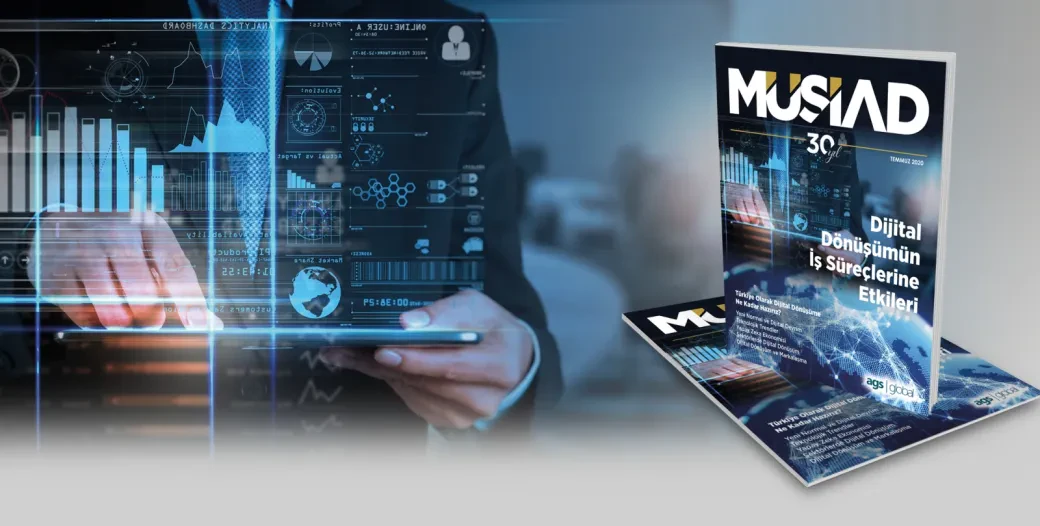
In his statement to the Anadolu Agency correspondent regarding the report "The Effects of Digital Transformation on Business Processes" prepared by MÜSİAD, Kaan stated that they are carrying out intensive work in order to turn the crisis experienced all over the world with the pandemic process into an opportunity in the medium and long term.
Stating that with the pandemic process the concepts of nationalization in industry and digital transformation have gained considerable importance, President Kaan said, "First of all, we believe that the pandemic process has once again shown the importance of nationalization in industry. Because we see that economies based solely on the services sector have naturally suffered far heavier damage in this process, whereas our country has decoupled positively from other countries with its existing industrial capacity. In this scope, thanks to our flexible production capacity and our proximity to large markets, we can state that, compared with neighbouring countries, Türkiye is a candidate to become a major production base."
"There will be sectors that decouple both positively and, unfortunately, negatively"
Stating that the pandemic process will have sectors that decouple both positively and, unfortunately, negatively, Kaan said:
"At first glance, we can say that it carries the potential to provide great advantages for medical supplies and services, food production and retail, information and communication technologies and the e-commerce sector. As for the sectors that will be most adversely affected by the pandemic process, we can predict that they will be tourism and accommodation, all kinds of air, sea and land transport, the exhibition business, entertainment, automotive and construction. However, in the period ahead, the importance and investments that all enterprises, without sectoral distinction, attach to tools supporting virtual work and communication will also increase rapidly. Because it is estimated that the pandemic process will deeply affect labour markets at the global level and that the unemployment rate will make a serious jump in almost every country. The projections put forward for the near future of the global economy indicate that unemployment rates reaching 20 percent will be in question for many countries."
"The digitalization process will bring many advantages with it"
Emphasizing that interest in digitalization will increase in order to ensure continuity in the workforce, Kaan continued his words as follows:
"The digitalization process, if evaluated well, will also bring many advantages with it. Especially if the interest and appetite of our SMEs for digitalization increases, a significant productivity gain will be achieved in production. Again in this scope, e-exports, a highly profitable and high-volume line of business, also hold significant potential. For this reason, thanks to our dynamic population and our business skills, it is essential that we act by correctly reading the requirements of this transformation."
Noting that in line with this understanding they have established the Digital Transformation and the SME Development and Branding Committees in order to support the digitalization drive, Kaan stated: "As a result of the additional supports offered and to be offered for the real sector and our consumers in the domestic market, and of making good use of the possible opportunity environments that will emerge in foreign markets, we believe that as a country we will close the pandemic process with the least damage. On this occasion, I hope that our research titled “The Effect of Digital Transformation on Business Processes”, prepared in cooperation between MÜSİAD and AGS Global Research, will shed light on the future and be benefited from by all sectors."
91.9 percent will complete their digital infrastructure processes
MÜSİAD SME Development & Branding Committee Chairman and AGS Global Founding Partner Abdülkadir Sıcakyüz, for his part, drew attention to the following points in his assessment of the report:
"Within the scope of this report we prepared in cooperation with MÜSİAD and AGS GLOBAL, we carried out a broadly attended survey with the participation of 340 business world representatives from 25 different sectors. According to the report, 70.8 percent of firms expect a wave of digital transformation that will affect their business processes in the near future. We see that with the Covid-19 process an expectation of rapid digital transformation has emerged in almost all sectors and that preparations have begun on this matter. A very large portion, 91.9 percent, of the business world representatives who participated in the survey stated that they will complete their digital infrastructure processes in the short and medium term. While 57.4 percent of the firms participating in the survey see the entry of artificial intelligence into our lives as a positive and facilitating element, 41.8 percent state that it will be facilitating but that they have concerns. 42.4 percent of the firms participating in the survey state that budget insufficiency is the leading element slowing down digital transformation processes. Insufficiency of human resources (40 percent), not knowing which technologies are needed (23.8 percent) and the absence of a certain strategic road map (23.8 percent) emerge as other important headings."
Within 10 years the reserve currency will be cryptocurrencies
Also conveying the prominent headings regarding cryptocurrencies in the survey, Sıcakyüz said, "46.9 percent of the company representatives participating in the survey say that within the next 10 years the reserve currency in the world will be 'cryptocurrencies'. The proportion of those who see gold as the reserve currency is 33.9 percent. From what is distilled from the report we will once again see that, for a stronger economic model, digitalization must be encouraged, the necessary support and incentive systems must be reconsidered, action must be taken with a perspective based on increasing digital competencies at all stages of education, and more support must be given to digital infrastructures that will strengthen domestic and national production and services."
"The size of the artificial intelligence economy in 2030 will be USD 15.7 trillion"
MÜSİAD Digital Transformation Committee Chairman and Teknopalas A.Ş. Founding Board Member Fahrettin Oylum conveyed that the transformative impact multiplier created by technologies such as artificial intelligence, 5G and the internet of things basically in all sectors brings out risks and opportunities for the business world. Oylum continued as follows:
One of the greatest concerns today of the actors operating in the traditional economy is losing the gains they have obtained as a result of years of struggle in the face of an entrepreneur who emerges with an innovative product. The business world, which clearly sees this effect in sectors such as retail, media and education, is thinking about the ways of boarding this train without being left outside digital transformation.
The size of the economy that the artificial intelligence economy alone will create by 2030 is projected to be USD 15.7 trillion. When we consider a blockchain economic size of USD 3 trillion, an internet of things technologies size of USD 500 billion and the other transformative technologies, this figure rises above a figure of USD 20 trillion. When we look at the size of today's world economy of USD 133 trillion, we can assume that the countries that will have a say in these technologies will be the new world leaders of the next 100 years. While the data communication speed to be obtained with 5G technology and the volume of data to be obtained from internet of things devices that will find a place in every area of life feed artificial intelligence companies, the new companies that will deeply shake sector dynamics on the basis of all these technologies will not give much chance to companies that make no concessions in struggling within the traditional economy. Or the users themselves will bring about this change."
Emphasizing that the leadership of many sectors existing today will in the coming periods be handed over to the companies that use artificial intelligence technology best in that sector, Oylum said, "The point that really needs attention here is the fact that the companies creating this disruptive effect will emerge not from among the companies that prefer the traditional economy model, but on the contrary from start-ups that have transformative ideas about that sector."
Services, health and logistics will be the sectors most affected by artificial intelligence
Touching upon the sectors that artificial intelligence will affect, Oylum said, "We can say that sectors such as services, health and logistics are the sectors that will be affected most rapidly by this transformation process." Oylum said the following:
"When we examine the data obtained in the report, we also see the finding that the representatives of these sectors will be able to manage their businesses with less human power, that is, with a digital workforce. However, this does not mean that other sectors will not be affected by this transformation process. The most important actors of digital transformation are the speeds of microprocessors and the exponential increase achieved in their speeds. This situation also affects the impact process of the transformation in direct proportion. In a transformation process taking place this rapidly, we think it will be beneficial for all sectors to review their current situations and urgently determine their digital transformation processes. Likewise, the establishment by the NGOs, professional chambers and chambers of commerce and industry in which the relevant sector representatives operate of new mechanisms to support their members on this matter will contribute to getting through this transformation process with less damage."
Assessing the work carried out in Türkiye in the context of digitalization, Oylum said, "Digital Transformation is being addressed as a process all over the world. It is a process that, since the day the transformation process began, has continued to accelerate further and renew itself as if it will never end. Türkiye too is aware of the continuity of this transformation. By establishing the Digital Transformation Office under the new Presidential system, our state has shown the importance it attaches to this issue and how critical the matter is." Oylum continued his words as follows.
"According to the data in our report, we see that close to 70 percent of the participants have taken at least the first step in their digital transformation processes. However, we see that they need support in creating the road map they require in order to carry this forward and place it on a structure that will turn it into a sustainable transformation. In particular, the shaping by institutions such as KOSGEB of their support mechanisms in this process according to this new era will make a significant contribution to the transformation process of enterprises. Likewise, TOBB can contribute to its members' management of these digital transformation processes with a budget to be created within its structure."
The era of "Metal Collars" is coming
Pointing out that the definitions in the business world will also change in the age of artificial intelligence, Oylum said, "First of all, I would like to state that we should also see artificial intelligence as a robot. Just as employees today are classified as blue and white collar, we can describe robots, which we can regard as new labour force resources, as 'Metal Collars', and artificial intelligence as 'Virtual Collars'. It is obvious that these two new classes will also trigger a sociological transformation in society. With this awareness, we think that the concept of Society 5.0, launched in Japan, should also be seriously put on the agenda in our country. That the country with the largest investment in the field of artificial intelligence in the world is again the People's Republic of China, which has grown with an “economy model based on cheap human labour”, may be seen as a contradiction; however, China, which is aware of the social effects it will experience if it does not take an active role in this process, aims to take the lion's share of this great artificial intelligence economy and keep the wealth in its own country."
Also offering recommendations to the business world in Türkiye, Oylum continued his words as follows:
The first of the two most effective ways before us as the business world in Türkiye to become part of this transformation process should be to develop new business models for our sector on the "as a service" economy together with information technology companies that develop products related to our sector.
As a second alternative model, it is to partner, with our capital, our know-how and our connections, with entrepreneurs who develop products aimed at our sector. With the startup investment model we will implement in this way, we will both have included the accelerating effect of startups in the digital transformation processes of our existing enterprises, and, in the event that the venture we have invested in grows, we will have increased our chance of obtaining a good position in the sector again. We see that as Türkiye, in the new period we will be acting with a growth model based on manufacturing and innovation instead of an import-based economic growth model. For our enterprises that wish to grow within this model drawn by the state's most competent figures, transforming their businesses by making an innovation- and production-oriented digital transformation plan will be the most important step they can take today for the future of their businesses.
YOU CAN CLICK TO EXAMINE THE REPORT