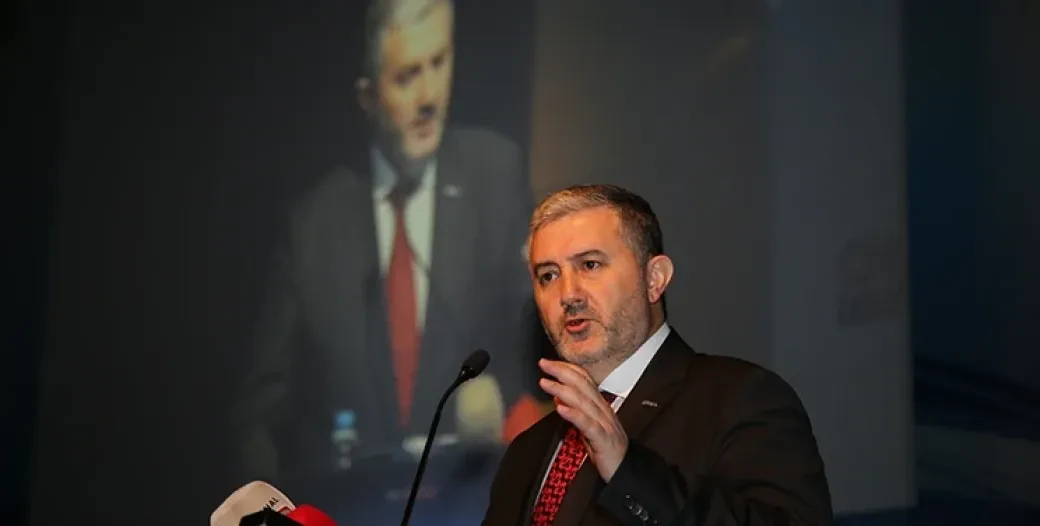
Speaking at the programme, which was organized with the contributions of the Sivas Governorship, the Sivas Municipality and the Chamber of Commerce and Industry, President Kaan shared his assessments regarding the Turkish economy.
Touching in his speech on the period of the national struggle, Kaan said: "One hundred years ago, on these lands, the flag of an all-out struggle was raised in the name of freedom. Today the world is being reshaped. One hundred years later, as if history were repeating itself, the will of nations is once again being tested. As the new centres of power and the new trade routes of the global system are being determined, national economies and local differences are once again trying to open up a space of existence on the economic stage with their own identities. The figures show us a world market that has been reshaped over the past 30 years. In 1990, the economy of the USA accounted for a quarter of the global economy. The European Union countries, with 32 percent, were a serious threat to the USA. In that same year, in this bipolar world order, China's share of the global economy was only 2 percent, while the share of the East Asian countries was 17 percent. What was happening in Türkiye during this period? The 1990s were the years in which Türkiye financed growth with high inflation. With economic volatility reaching 4.5 percent, our country remained very far from a stable growth strategy and spent all its strength on the fight against terrorism. By 2008, which is accepted as the milestone at which the economic architecture of the new era was determined, the area occupied by the USA in the global economy had fallen to 23 percent and that of the EU to 30, while China's share had risen to 7 percent," he said.
“So-Called New National Pact Borders Are Being Dictated To National Economies”
Stating that this is exactly the right time to review not only economic parameters but also security perceptions, Kaan said: "There is a concept we frequently voice. That field knowledge will govern economic superiority in the new world order. Whether or not the Belt and Road Project is completed, the issue is less the commercial advantages this project will create than the closeness of contact it establishes with the commercial knowledge of all the countries along this line or in its hinterland. The reason such belt lines are created is, in a sense, to discover and bring under control the depth of the economic field in countries. A century ago, here, at the Sivas Congress, the principles of the National Pact were adopted. Full independence and national sovereignty were accepted as fundamental principles. Today the new world order is redefining the elements of national power that will ensure the security of national borders. So-called new National Pact borders are being dictated to national economies. We must be particularly prepared for these."
'We Have Prepared a Wide-Ranging Master Plan'
Stating that as MÜSİAD they have prepared a wide-ranging master plan on this matter, Kaan continued as follows:
"In the 30th year of the road we set out on with the motto 'Our cause is Türkiye', we underlined that the economic actors of our country must walk together and in a synchronized manner, saying 'Together for all eternity, in good times and in bad'. We have also completed our own institutional structuring in line with the new requirements of the new world order awaiting us. Measuring national power is possible only by seeing the economy as the fundamental element of national power. In the name of our national economy initiative, we acted on the following equation. The competitive advantage we will create in three fundamental components will bring our country to the level of economic self-sufficiency. Economic self-sufficiency is the key factor in today's new world order. Planning the future of strategic resources and the capacity to react instantly to change, that is, 'economic reflex', is an indicator of our capability in economic war and struggle. Economic security and economic intelligence are the new fields of manoeuvre and management brought to us by the new economic architecture. These are the new political elements. The work to be carried out in these areas will make us both strong and the key country of all trade lines and belts. It is precisely at this point that the importance of field knowledge emerges once again. Economic war is not merely the continuation of a series of trade wars."
“The Dissemination Of Our Institutional Process That Began With Renewal Is Our Fundamental Economic Aim”
Sharing MÜSİAD's new economy motto with the participants for the first time at the Economy Forum, Kaan said the following:
"The dissemination of our institutional process that began with Renewal is our fundamental economic aim. For this reason, the plan we have prepared is a national breakthrough, an economic paradigm shift. The plan is the passing of capital into national hands. It is the natural result not of necessity but of consensus. It is the economic equivalent of the new understanding of governance. The plan is the search not for imitation but for the original. It is the preparation for the period after 2023. The plan is a change not of appearance but of architecture. It is the requirement not of cliques but of the people. It is once again an infrastructure investment towards the economic tradition. The name of our plan is therefore the National Economic Architecture. The aim here is the revival of local advantages and regional economies in line with the new equation I mentioned above for the measurement of national power, and the transition to a project-oriented production-trade-partnership and investment line. Because we know that the power of money in a country is determined by that country's power of production. The aim in this model is not to scale and classify capital, but to create a network economy that is spread across the base and fed from the base. We know one thing very well: movements that find no response at the base, or that do not gain broad acceptance at the level of the base, are not long-lived."