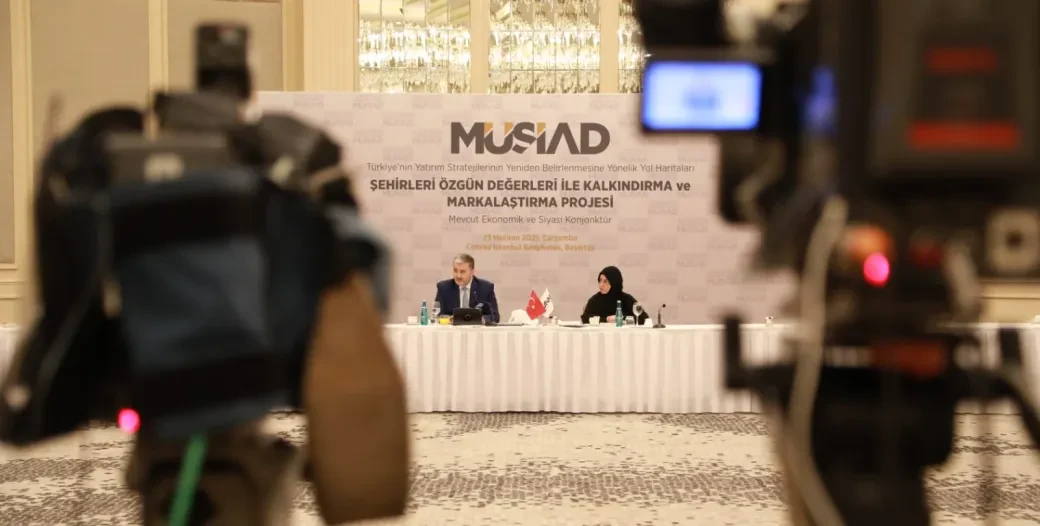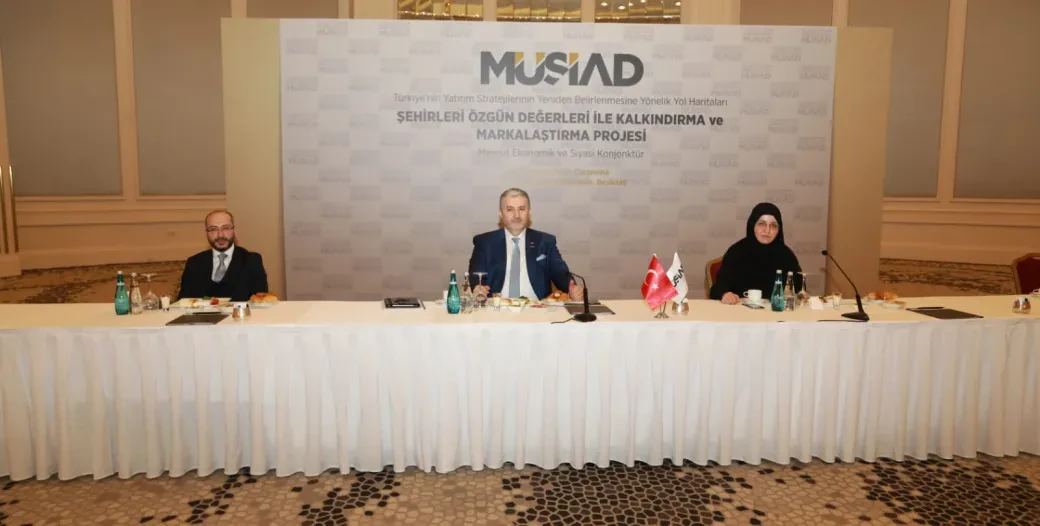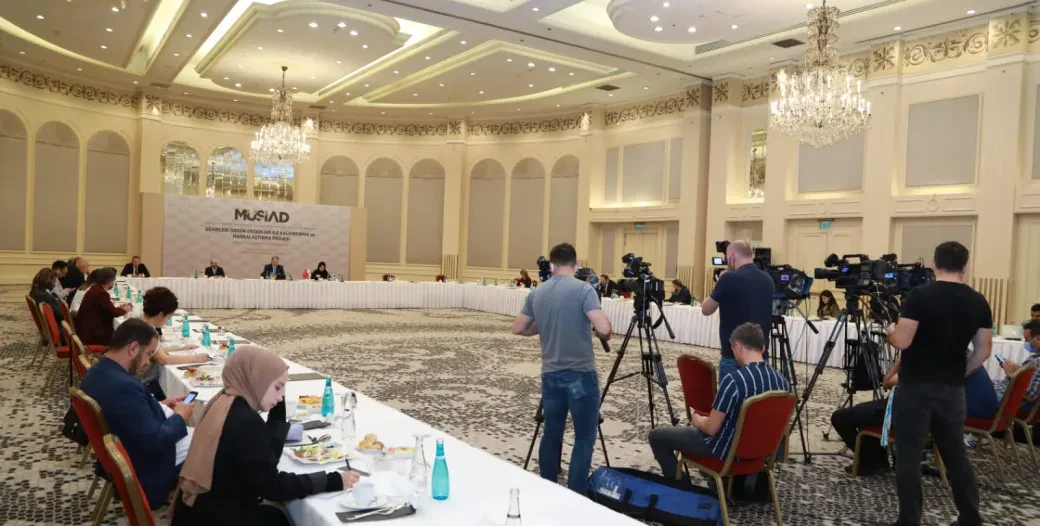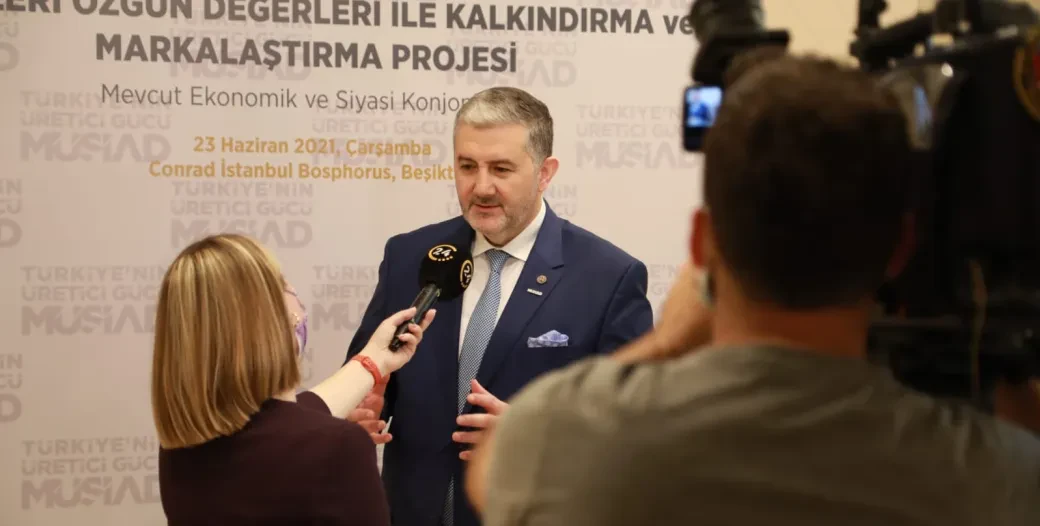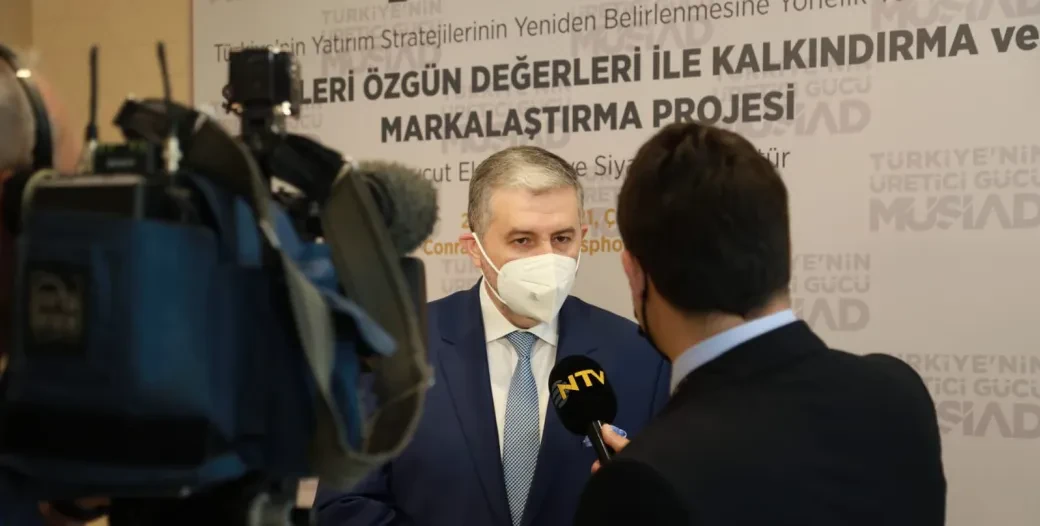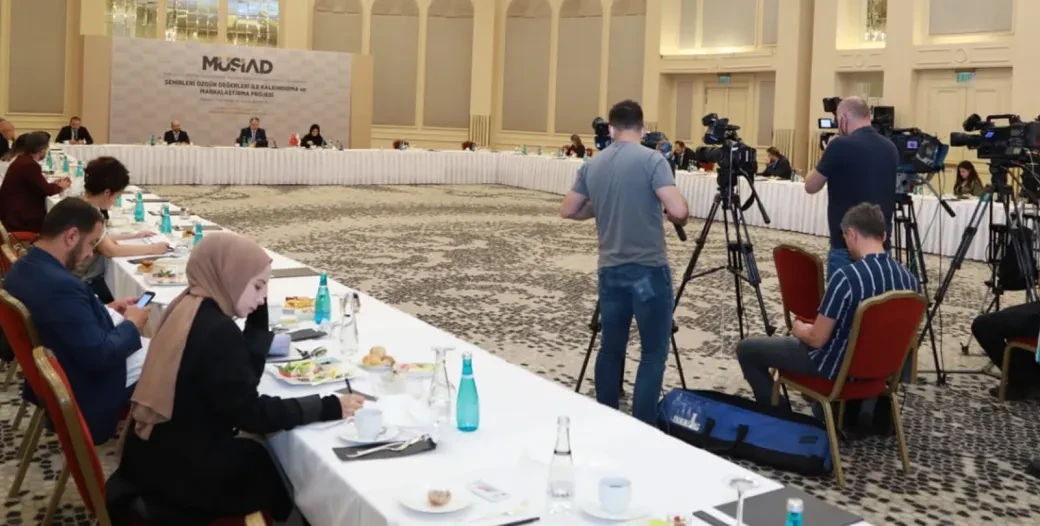
MÜSİAD, which set out with the aim of structuring Türkiye's brand cities, shared the important headings of the ‘Developing Cities Through Their Own Distinctive Values’ project and the kind of road map that should be followed at a press conference held at the Conrad İstanbul Bosphorus.
MÜSİAD President Abdurrahman Kaan conveyed as follows the strategies and methodologies they focus on in this project, which aims to shape Türkiye-focused investment strategies: “We will structure Türkiye's cities, each of which is suited to development and growth with its own distinctive assets, with the philosophy of creating city brands. By determining the asset inventories of these cities, we will compare the suitable ones with their counterparts around the world. We will analyze how their counterparts around the world have converted their own assets into high values and through which action plans they have reached this point.”
A new era is beginning in the world, and the concept of investment, like many other concepts, is changing its shell. Saying, “Unless we follow this change well and establish a proper investment network worldwide, our deficit in direct investments will unfortunately also trigger the erosion of our national capital stock”, MÜSİAD President Abdurrahman Kaan drew attention at this point to the importance of adopting the logic of turning Türkiye into the world's investment market and of establishing a widespread investment network worldwide.
“TÜRKİYE MUST ATTRACT MORE INVESTMENT”
Emphasizing that Türkiye has been losing ground in recent years particularly in direct foreign investment, Abdurrahman Kaan commented: “Although the year 2020 locked down investments all over the world, as economic activities and trade reopened they unfortunately shifted towards developing countries; Türkiye is not receiving its due share of this. 70 percent of global direct investments went to developing countries. While direct investments in Asia amounted to approximately USD 476 billion, China became the country attracting the most direct investment in the world with USD 163 billion. The United Nations Conference on Trade and Development published the investment inventory for the year 2020 at the beginning of this year. A decline on such a scale was last seen in 1990. Investments worldwide fell by %42, from USD 1.5 trillion to USD 859 billion. However, from the end of 2020 and during 2021, investment increased its volume towards developing countries. According to the data of UNCTAD, which regards Türkiye as being in the ‘Western Asia’ region, investments made in this region fell by 24 percent to USD 21 billion. Investments made in Türkiye, on the other hand, recorded a 19 percent decline compared to 2019 and unfortunately the latest point reached was USD 6.8 billion in 2020. In the final months of this year we unfortunately see negative values. In other words, we are watching investors withdraw from our country to a considerable extent. The first of the two largest investments was the investment made by another investment firm, Yamma Investments, managed by the London-based investment companies Metric Capital Partners and its local partner Afendis Capital Partners. The other large investment was Qatar's purchase of a 10 percent stake in Borsa İstanbul, which was also widely discussed in the public.”
THE MOST IMPORTANT COMPONENTS OF THE CITY ECONOMY
Türkiye draws attention with its geopolitical position, the cultural heritage it has carried from the past to the present, its historical beauties and its production and export performance standing out in many different sectors from agriculture to finance, from construction to automotive, from tourism to telecommunications, as well as with its cities that provide added value to the Turkish economy. According to research conducted worldwide, a city's acquisition of brand value accelerates the establishment of the city economy. The most important criteria playing the leading role in this process are domestic and foreign investments… Stating that the city economy examines the optimum harmony and output between the city, the individuals who make up that city and the fundamental characteristics of the city in the location choices and other economic, socio-economic and economic-political decision processes of households, firms and local administrations that bring economics and geography together, Kaan continued his remarks as follows: “Researching the local administrations in a city, urban planning, the factors that will lay the ground for that city's branding, the production and marketing processes of these criteria, why individuals prefer to live in that city and the ways of increasing these reasons is among the most important components of the city economy.”
“WITH THE ‘DEVELOPING CITIES THROUGH THEIR OWN DISTINCTIVE VALUES’ PROJECT, WE ARE COMPARING OUR CITIES IN TÜRKİYE WITH THEIR WORLD COUNTERPARTS AND ESTABLISHING EVALUATION CRITERIA”
Stating that MÜSİAD has designed a special project precisely at this point within the framework of its mission of ‘developing cities through their own distinctive values’, Abdurrahman Kaan said: “When this whole system is combined with the ‘Developing Cities Through Their Own Distinctive Values’ project, which will encourage the production of high value-added assets and capital by processing regional economies and cities with their own values, the ‘investment systematics’ is completed. Channelling investment correctly is the second fundamental pillar of the strategy of establishing an investment network… This is only possible by putting city economies back on their feet with the right investments and by ensuring that the contributions of cities to GNP follow a similar line when compared with their world counterparts. We are comparing our cities in Türkiye with their world counterparts and establishing evaluation criteria,” he said.
QUESTIONS SEEKING ANSWERS
According to Kaan, in this period in which migration is rising as a serious socio-economic problem, answers must be found to 7 important questions in order to create a city economy:
1-Why should individuals prefer to live in that city or to stay in that city?
2-What is the definition and the value of the city of birth for the young population?
3-What does the city promise to individuals?
4-What is the weight and the importance of the city in the country's economy?
5-What are the contributions of the city to the country's competitive advantage in world markets?
6-How are the pluses and minuses of the city defined when compared with its counterparts in the world?
7-What needs to be done for the city to reach the economic and social conditions of its counterparts in the world?
TWO FUNDAMENTAL MODELS COME TO THE FORE IN BRANDING A CITY: ‘6-CRITERIA CITY PERFORMANCE MEASUREMENT’ AND ‘THE MODEL OF CITIES COMPLEMENTING ONE ANOTHER ACCORDING TO THE GLOBAL CITY INDEX’
When branding a city, it is also necessary to decide with what kind of model to proceed. Underlining that at this point they proceed with two fundamental models, namely the ‘6-Criteria City Performance Measurement’ and the ‘Model of Cities Complementing One Another According to the Global City Index’, Abdurrahman Kaan commented: “According to the 6-Criteria City Performance Measurement, cities are classified into 6 separate categories, also called the 6P, and the distinctive qualities of cities are compared with one another through these criteria. A comparison is made between the assets held by cities in the same categories and the value they produce. A road map is determined for the city producing less value so that it can reach the level of the other city possessing the same assets. At this point, London is an extremely successful example… When the criteria of city codes and the recognition of the city are taken into account, London is virtually an open buffet for tourists wishing to discover the sophisticated tastes of the world… Not only entertainment, but also a focal point of cultural tourism. At the same time a huge stock exchange around which world capital revolves… With the public green areas in all its boroughs where creative ideas are exhibited, apart from the 14-acre public area at Hudson Yards, and the residential development around these areas, New York also holds a very successful position.”
“IN OUR OWN WORK AS MÜSİAD, WE MADE USE OF THE FUNDAMENTAL ELEMENTS OF THE TWO MODELS BOTH WHILE BUILDING THE INFRASTRUCTURE AND WHILE PREPARING OUR ACTION PLAN”
Emphasizing that in the ‘Model of Cities Complementing One Another According to the Global City Index’ cities are divided into two groups, namely ‘excellent cities’ and ‘rapidly developing cities’, Kaan made the following statement: “Rapidly developing cities carry themselves up to a higher league within the framework of four sub-criteria. Excellent cities, on the other hand, group among themselves the cities in which 5 fundamental criteria such as the vitality of business life, human resources, information exchange, cultural experience and engagement in political life are most widely observed. Under these fundamental headings, the city that is most likely and easiest to reach the main factor through various sub-criteria, that is, to be matched, is determined. In our own work as MÜSİAD, we made use of the fundamental elements of these two models both while building the infrastructure and while preparing our action plan.”
6-CRITERIA CITY PERFORMANCE MEASUREMENT
1- Promotion and recognition of the city (Promotin-Pm): It is determined how frequently the name of that city appears in search engines, in traditional media and in new-generation social media. Criteria such as the interest shown in the city by influencers, the frequency with which the cinema and music industries use this city as a set, appearing in the top ranks in search results and images having been published with care are taken into consideration.
2-Quality of public spaces (Place-Pc): The natural structure of the city and the harmony that its historical or modern-period architecture provides with the history of the city are analyzed. Cleanliness in the streets and neighbourhoods, security, park areas, greenery-landscaping and the crime rate in the city stand out as the fundamental components determining the quality of public spaces.
3-The output provided by the city (Product-Pd): The key institutions and organizations of the city (Strasbourg-EU Commission, Paris-MEDEF Headquarters, Newyork FED), the presence of world-renowned universities conducting important research, the infrastructure and connection points such as airports and transport networks that will provide the city's connection with other cities, and other attractive elements such as museums, congress centres and well-known hotels are among the most important items determining the performance of the city.
4-The level of prosperity provided by the city (Prosperty-Ps): The support the city provides to GDP for the sake of the good management of both its entrepreneurship and its capital components, and how many of the world's leading 500 companies have investments in that city or were founded in that city, are examined.
5-Human resources (People-Po): Human resources is one of the most important building blocks determining the performance criterion of a city… It covers a wide spectrum from the level of culture to literacy, from the number of university students to the number of local residents settled in that province who have not migrated. Different parameters such as the number of criminals in the city, the birth rate, population density and qualified manpower are evaluated.
6-The codes of the city (Programming-Pg): The whole of criteria such as cultural and artistic activities, the history of the city and the traces of this history preserved in the city, the culinary culture of the city and its prevalence in the world, its famous restaurants and entertainment venues and the form of the nightlife of the city is defined as the codes identified with the city.
“WE WILL ENCOURAGE THE STATE TO MAKE THE RIGHT INVESTMENT IN THE RIGHT CITY”
Abdurrahman Kaan summarized the fundamental starting points and aims of this project as follows: “We will structure Türkiye's cities, each of which is suited to development and growth with its own distinctive assets, with the philosophy of creating city brands. By determining the asset inventories of these cities, we will compare the suitable ones with their counterparts around the world. We will analyze how their counterparts around the world have converted their own assets into high values and through which action plans they have reached this point. We will observe why our cities cannot convert similar inputs into high GDP and determine what kind of action plan should be adopted at this point. And most importantly, we will encourage the state to make the right investment in the right city.”
“IN THE FUTURE, NOT STATES BUT CITIES WILL COMPETE”
Conveying that positioning cities in the new world will be easier and more effective than positioning the state, Abdurrahman Kaan said: “In the future, not states but cities will compete. If we develop similar inputs with effective investment and business models, the comprehension and internalization by the local population and by entrepreneurs of the fact that Aydın, for instance, will be positioned in the world economy as a city possessing the same added value as Bordeux will in fact be a positive move for embracing the city and accelerating the investments here. Although our cities possess the same assets as their examples in the world, because they cannot use their capacities by concentrating on the right fields, unfortunately the expected output cannot be achieved and the potential cannot be exploited.”
WHAT KIND OF ROAD MAP WILL BE FOLLOWED?
Saying, “We will match the ‘Model of Cities Complementing One Another According to the Global City Index’ with the cities we have determined in Türkiye that fit this framework”, Abdurrahman Kaan continued his remarks as follows: “We will align the leading cities that stand out in categories such as business life, human resources, information exchange, cultural experience, political engagement, the richest 500, non-native population, interest in TV news, museums, consulates and attachés — such as New York, Paris, London, Washington, Hong Kong, Tokyo, Melbourne and St. Petersburg — with our cities according to the fields in which they make a difference. In the same way, starting from how the cities that move fast in certain fields according to the Global City Index — such as individual welfare level, economy, innovation, governance, stability, infrastructure, patents per capital, quality of bureaucracy, environmental performance, transparency, ease of doing business, private sector investments, direct investment, national income per capita and development in health services — make a difference, we will apply this model as well to the cities we have matched.”
ON WHICH COMMON GROUND DO THE CITIES OF TÜRKİYE AND OF THE WORLD MEET?
Kaan also gave innovative examples about the matches between the cities of Türkiye and of the world: “For instance, we matched our province of Afyon with Japan's city of Beppu. Afyon's main source of income is agriculture and livestock breeding. Dry farming is carried out on %68 of the cultivated land and irrigated farming on %32. Afyon is among our few provinces in terms of thermal springs and hot springs. Thermal tourism activities continue throughout the year in the province. Beppu is likewise known for its hot springs. Beppu, a typical large-scale tourism region, has the largest hot spring and hot spring water production volume in Japan. Elazığ, on the other hand, is matched with Austria's city of Graz. The important products manufactured in Elazığ are renewable energy, minerals, aquaculture products, agricultural and livestock products… The most important industrial fields of Graz are mechanical engineering, environmental technology, steel-girder construction, transport-related manufacturing, electrical engineering and electronics. Erzincan is matched with Austria's city of Innsbruck. Both cities display parallels in many fields, from education to health, from transport to communications, from industry to logistics, from agriculture to tourism, from nature sports to culture. The common ground of Erzurum, which is matched with Austria's city of Salzburg, is tourism-focused activities… Isparta, which stands out as Türkiye's rose and rose oil production centre, is matched at this point with France's city of Angers, known as Europe's city of flowers with its famous botanical gardens. İzmir, which holds an important share in every field of the tourism sector from yacht tourism to congress tourism, from faith tourism to cruise tourism, possesses advantages similar to Australia's city of Melbourne.”
YEREL 2023 WILL SUPPORT BRANDS WITH BRANDING POTENTIAL
Stating that another initiative supporting this project is the establishment of the Yerel 2023 brand, Kaan said: “This brand of ours, whose expansion is YER 23 El, aims, in line with our 2023 targets, to support our companies with branding potential in order to bring out first national brands and then, with companies selected from among them, international brands, and to export these brands together with their brand added value to world markets as an element of investment. Within the scope of our project, the screening of our local elements and of our members and the competency tests have begun,” he said.